
Where Data Tells the Story
© Voronoi 2026. All rights reserved.

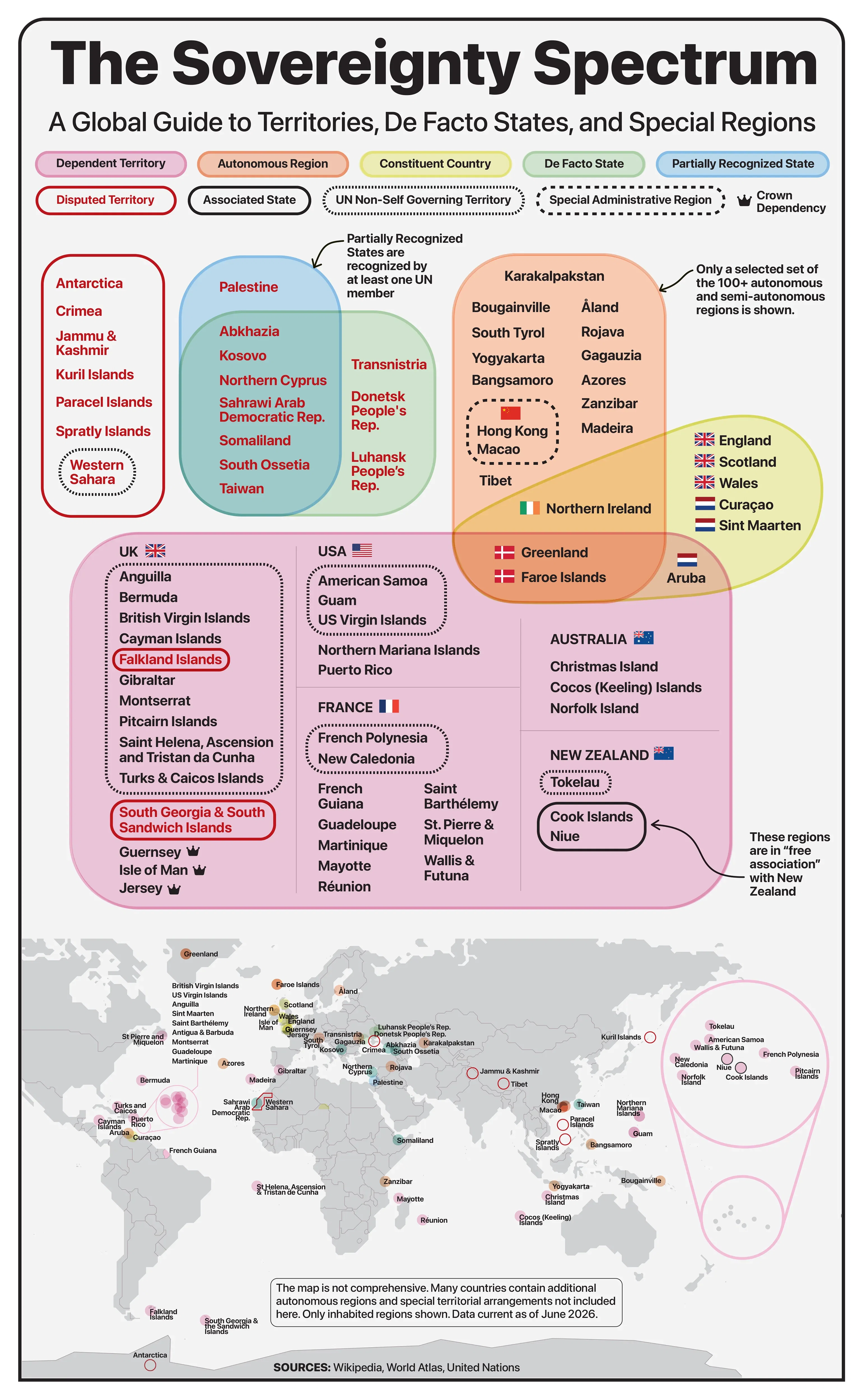
A Global Guide toTerritories, De Facto States, and Special Regions of the World
Have you ever looked at a map and wondered why you've never heard of a particular "country"? There's a good chance it isn't a sovereign state at all, but belongs to one of the many categories that exist between full independence and complete integration into another country.
This chart explores the gray and often-overlapping areas between sovereignty and dependency. It explains why Scotland is considered a country despite not being sovereign; why French Guiana remains part of France despite being 4,400 miles (7,100 km) from Paris; and why Greenland belongs to Denmark while Aruba lies in the Caribbean as part of the Kingdom of the Netherlands. It also highlights the many islands and territories around the world that remain linked to distant sovereign states. The goal of this chart is to clarify the world's often-overlooked spectrum of sovereignty.
The categories are arranged from least to most sovereign:
Disputed territories are shown separately. These areas may not fit neatly into any of the categories above but remain important because they are claimed by two or more sovereign states.
UN Non-Self-Governing Territory
Chapter XI of the United Nations Charter defines a Non-Self-Governing Territory as a territory whose people have "not yet attained a full measure of self-government." The UN currently maintains a list of such territories as part of its decolonization program.
Dependent Territory
A dependent territory is a territory that is not fully sovereign and remains under the jurisdiction of another state, which is responsible for some or all aspects of its governance, defense, or foreign affairs. Most are islands or overseas territories located far from their administering state. Only inhabited territories are included here.
Autonomous Region
This is a subdivision of a sovereign state that possesses a significant degree of self-government while remaining under the ultimate authority of the national government. Because more than 100 autonomous and special-status regions exist worldwide, only selected examples are shown.
Associated State
This is a self-governing country that has voluntarily entered into a formal relationship with another sovereign state, which typically assumes responsibility for certain external affairs such as defense or diplomacy.
Constituent Country
This is a country that forms part of a larger sovereign state while retaining a distinct national identity and varying degrees of self-government. Examples include Scotland and Northern Ireland within the United Kingdom.
De Facto State
This is a political entity that exercises effective control over a territory and operates as an independent state but lacks broad international recognition as a sovereign country. Many maintain their own governments, militaries, currencies, and institutions.
Partially Recognized State
This is an entity that functions as an independent sovereign state and is recognized by at least one United Nations member state, but lacks universal international recognition.
Special Designations
Some territories are known by constitutional designations unique to a specific country.
—Special Administrative Region – Used exclusively by China, this designation refers to a territory that operates under a distinct legal, economic, and political system within the People's Republic of China. The only current Special Administrative Regions are Hong Kong and Macao.
—Crown Dependency – A self-governing possession of the British Crown. The three Crown Dependencies—Jersey, Guernsey, and the Isle of Man—are not part of the United Kingdom, although the UK is responsible for their defense and international representation.
Among these entities, Palestine is recognized by the largest number of UN member states.
Palestine — 157
Kosovo — 110
Sahrawi Arab Democratic Republic — 36
Taiwan — 11
Abkhazia — 5
South Ossetia — 5
Northern Cyprus — 1
Somaliland — 1 (Israel became the first UN member to formally recognize Somaliland in December 2025).
The Cook Islands and Niue, which are in free association with New Zealand, are recognized by 65 and 28 UN member states, respectively.
Two archipelagos in the South China Sea make the list: the Paracel Islands are disputed by China, Taiwan, and Vietnam and the Spratly Islands are disputed by China, Taiwan, Vietnam, the Philippines, Malaysia, and Brunei.
Antarctica is claimed in whole or in part by seven countries—Argentina, Australia, Chile, France, New Zealand, Norway, and the UK—which maintain territorial claims, but these claims are effectively frozen under the Antarctic Treaty System, which prohibits new claims and suspends disputes over existing ones.
As geopolitical relationships evolve, some of the territories and entities shown here may eventually join the list of the world's fully sovereign states, while others may become more closely integrated with their administering countries.