What We’re Showing
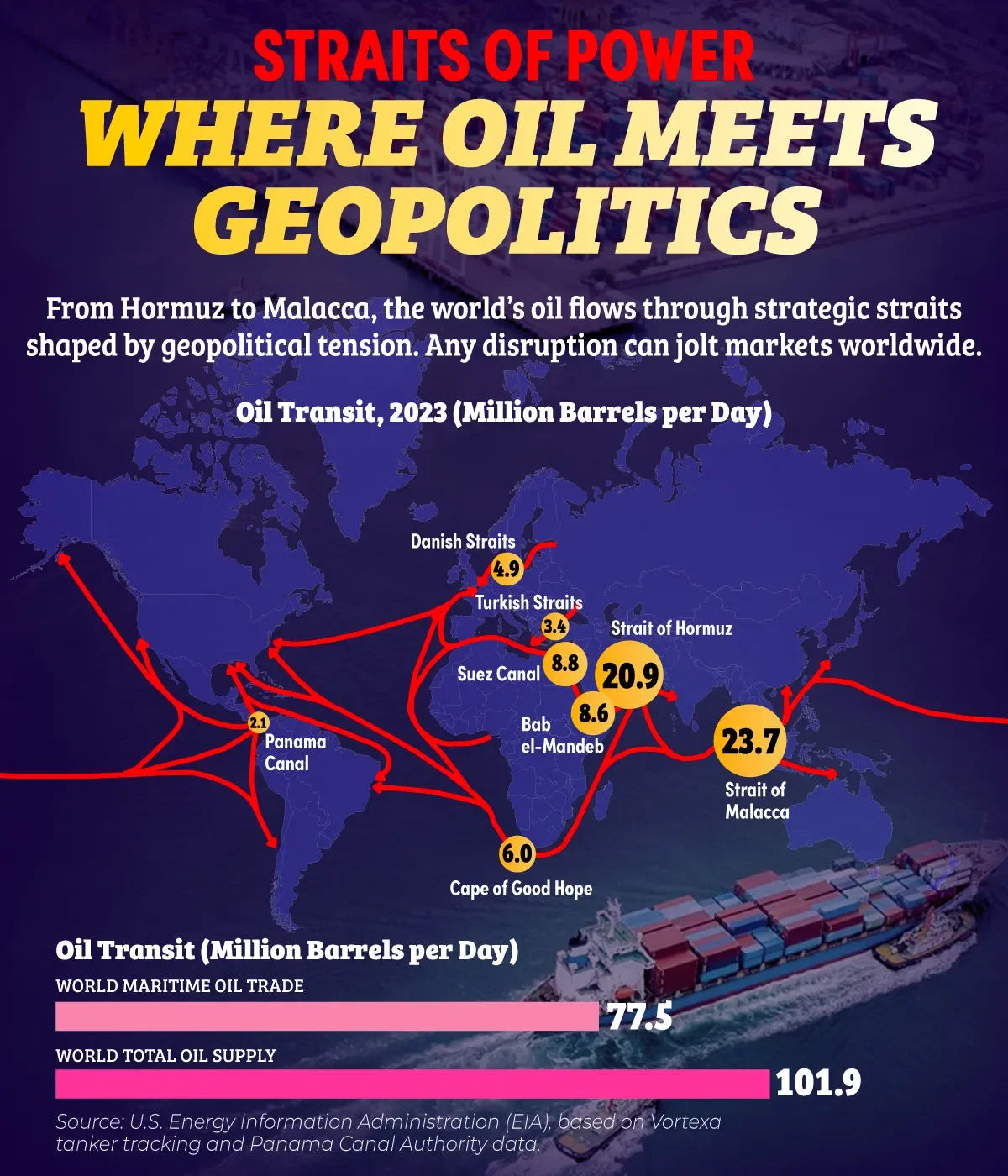
This graphic maps the world’s most critical oil chokepoints by daily transit volumes in 2023, measured in million barrels per day (mb/d). These narrow maritime corridors collectively handle 77.5 million barrels per day of oil trade, compared to total global oil supply of 101.9 million barrels per day.
Together, the visuals highlight how global energy flows are concentrated through a small number of strategic sea lanes — underscoring their geopolitical and economic importance. The data is sourced from the U.S. Energy Information Administration (EIA).
Key Takeaways
- The Strait of Malacca is the world’s busiest oil chokepoint, carrying 23.7 mb/d, making it the single largest artery of maritime oil trade.
- The Strait of Hormuz ranks second at 20.9 mb/d, reinforcing its position as one of the most strategically sensitive waterways in global energy markets.
- The Suez Canal (8.8 mb/d) and Bab el-Mandeb (8.6 mb/d) form a critical corridor linking Middle Eastern supply to European and global markets.
- Secondary but strategic routes — including the Cape of Good Hope (6.0 mb/d), Danish Straits (4.9 mb/d), Turkish Straits (3.4 mb/d), and Panama Canal (2.1 mb/d) — play vital roles, particularly when primary routes face disruption.
- In total, roughly three-quarters of globally traded oil moves through these chokepoints, making them central to global trade stability and price security.
Source: U.S. Energy Information Administration (EIA), based on Vortexa tanker tracking and Panama Canal Authority data.