
Where Data Tells the Story
© Voronoi 2026. All rights reserved.

ELI5 (Explain It Like I’m 5)
The US and Iran signed a 14-point peace agreement. The key trick is that Iran gets its oil money back, frozen cash released, and the sea blockade lifted BEFORE the two sides even start talking about the nuclear deal.
Iran closed the Strait of Hormuz just 72 hours after signing because Israel (which didn’t sign the deal) kept troops in Lebanon. The $300 billion reconstruction fund mentioned in the deal was then denied by Trump.
The full binding deal must be done in 60 days, or Trump says the bombs return.
The Story
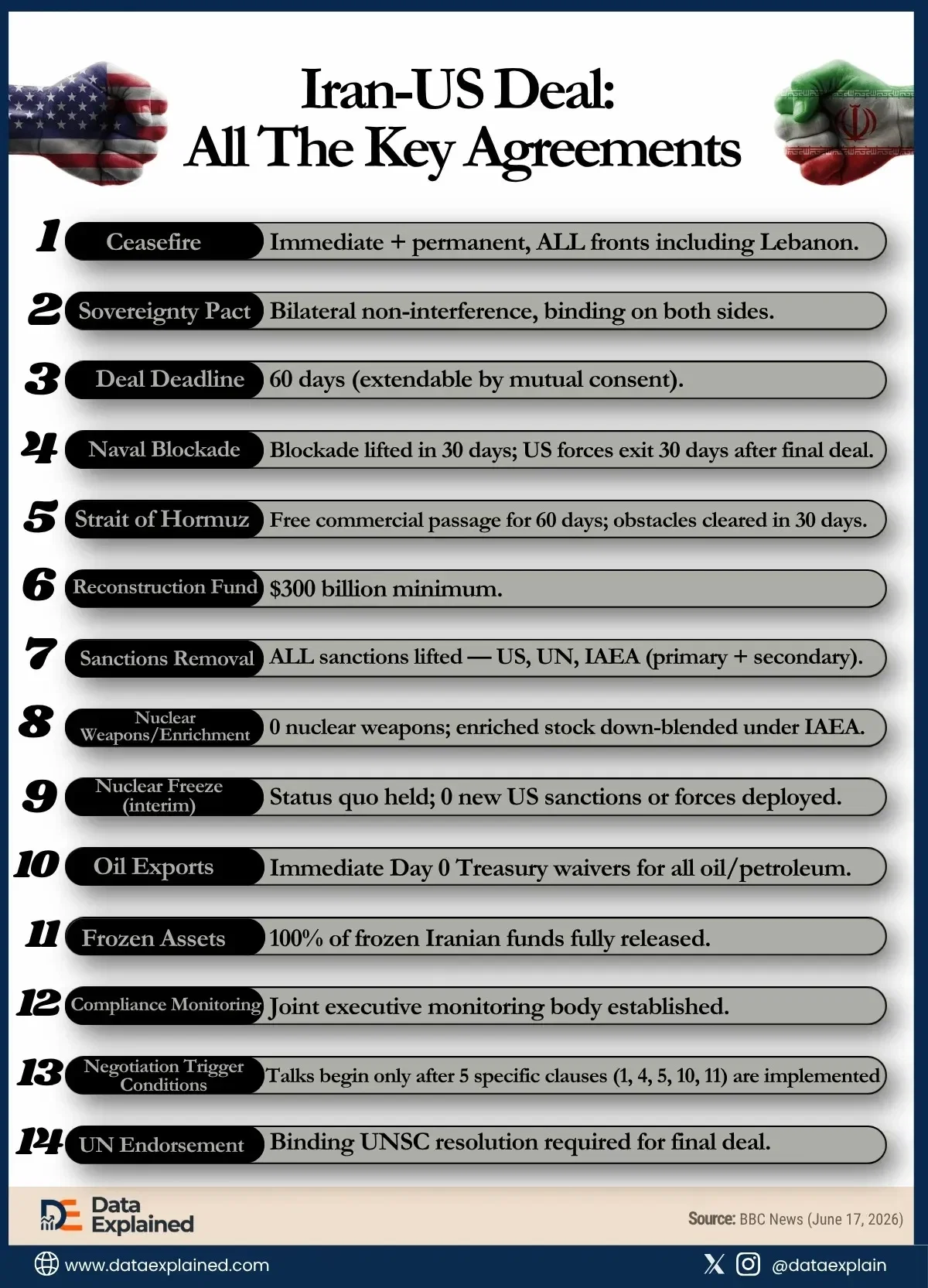
The memorandum of understanding between the United States and Iran was read aloud to reporters by anonymous senior US officials on June 17, 2026.
Iran’s government subsequently released the text of the agreement, which matched the US officials’ readout.
The visual above distills the 14 points, reducing each clause to its most measurable or decision-relevant metric.
Read that way (as data rather than diplomacy), the deal’s architecture becomes specific.
ALSO READ: How Iran Conflict Became America’s Most Expensive Per-Day War
TankerTrackers confirmed Iran’s first crude oil exports in two months, with at least two Iranian supertankers exiting the US Navy blockade perimeter carrying a combined 3.8 million barrels of crude oil.
Point 10, which is the “Immediate Day 0 Treasury waivers for all oil/petroleum,” was the fastest to implement operationally in the agreement.
Iranian oil moved before formal ceremonies concluded.
Point 1 was different.
Iran said it was closing the Strait of Hormuz over the violation of the first clause in the 14-point MOU, which called for the war to stop on all fronts, including Lebanon.
Hezbollah and Israel continued to trade attacks.
Iran also considers it a violation of the MOU for Israel not to pull forces out of Lebanese territory, something Israel says it will not do.
Neither Israel nor Hezbollah signed the MOU. Yet Point 1 explicitly covers Lebanon and references “allies in the current war.”
ALSO READ: Current Iran War Marks 6th Major Oil Supply Disruptions Since 1973