
Where Data Tells the Story
© Voronoi 2026. All rights reserved.

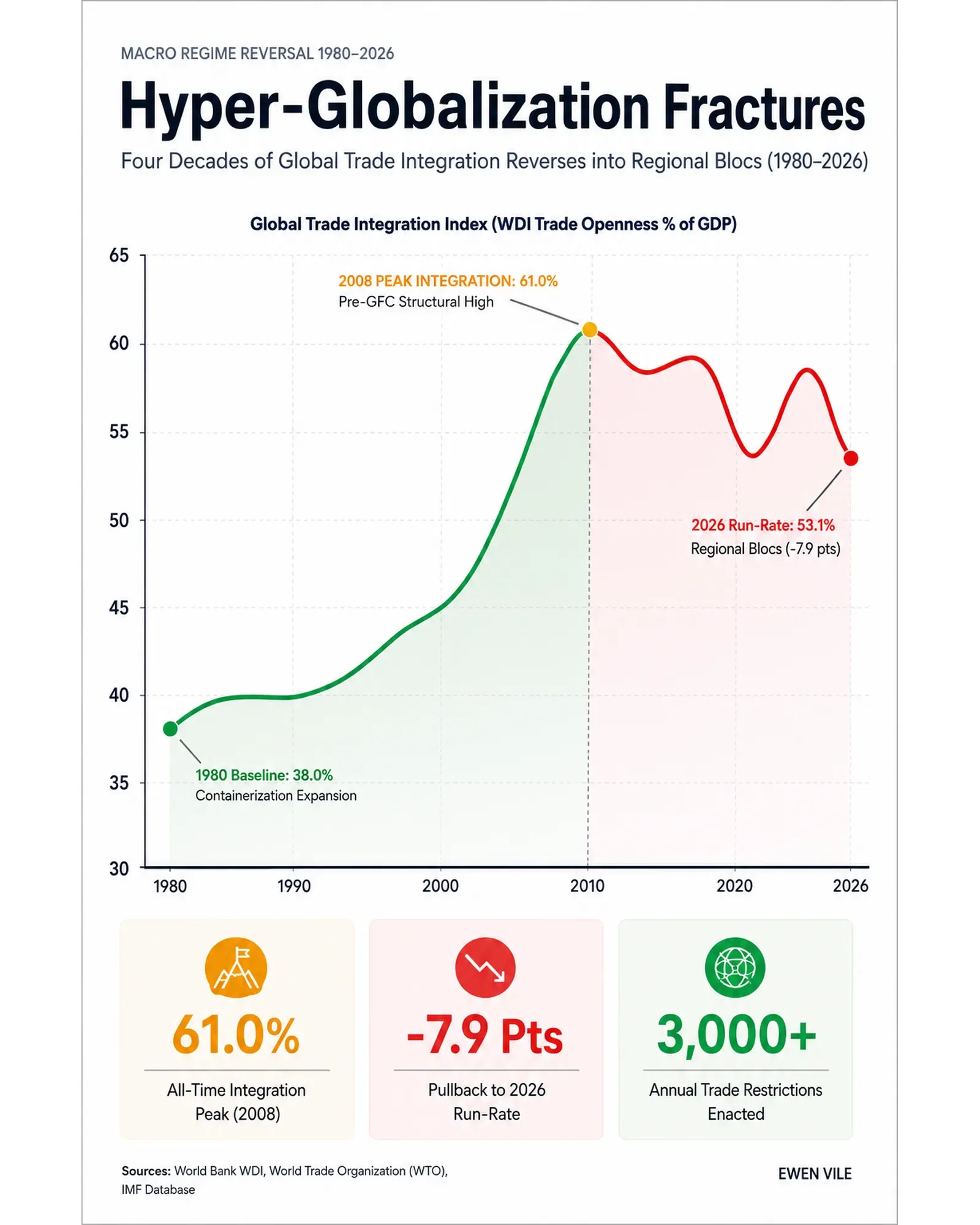
Four Decades of Global Trade Integration Reverses into Regional Blocs (1980–2026)
Four Decades of Global Trade Integration Reverses into Regional Blocs (1980–2026)
For four decades (1980–2008), the global economy operated under a single overriding imperative: hyper-globalization. Driven by containerization, tariff reductions, and China's 2001 WTO accession, world trade as a share of global GDP surged from 38.0% in 1980 to an all-time peak of 61.0% in 2008. That multi-decade integration era optimized global manufacturing for absolute cost efficiency, establishing sprawling cross-border Just-In-Time (JIT) supply chains.
Between 2008 and 2026, that trend officially reversed. Following the 2008 financial crisis, the 2018 US-China tariff escalations, COVID-19 supply disruptions, and the rise of national industrial policies (such as the U.S. CHIPS Act and EU Green Deal), hyper-globalization fractured. World trade has retracted to 53.1% of GDP as nations prioritize resilience, national security, and "friend-shoring" over minimum-cost efficiency.
Key Metrics & Highlights: