
Where Data Tells the Story
© Voronoi 2026. All rights reserved.

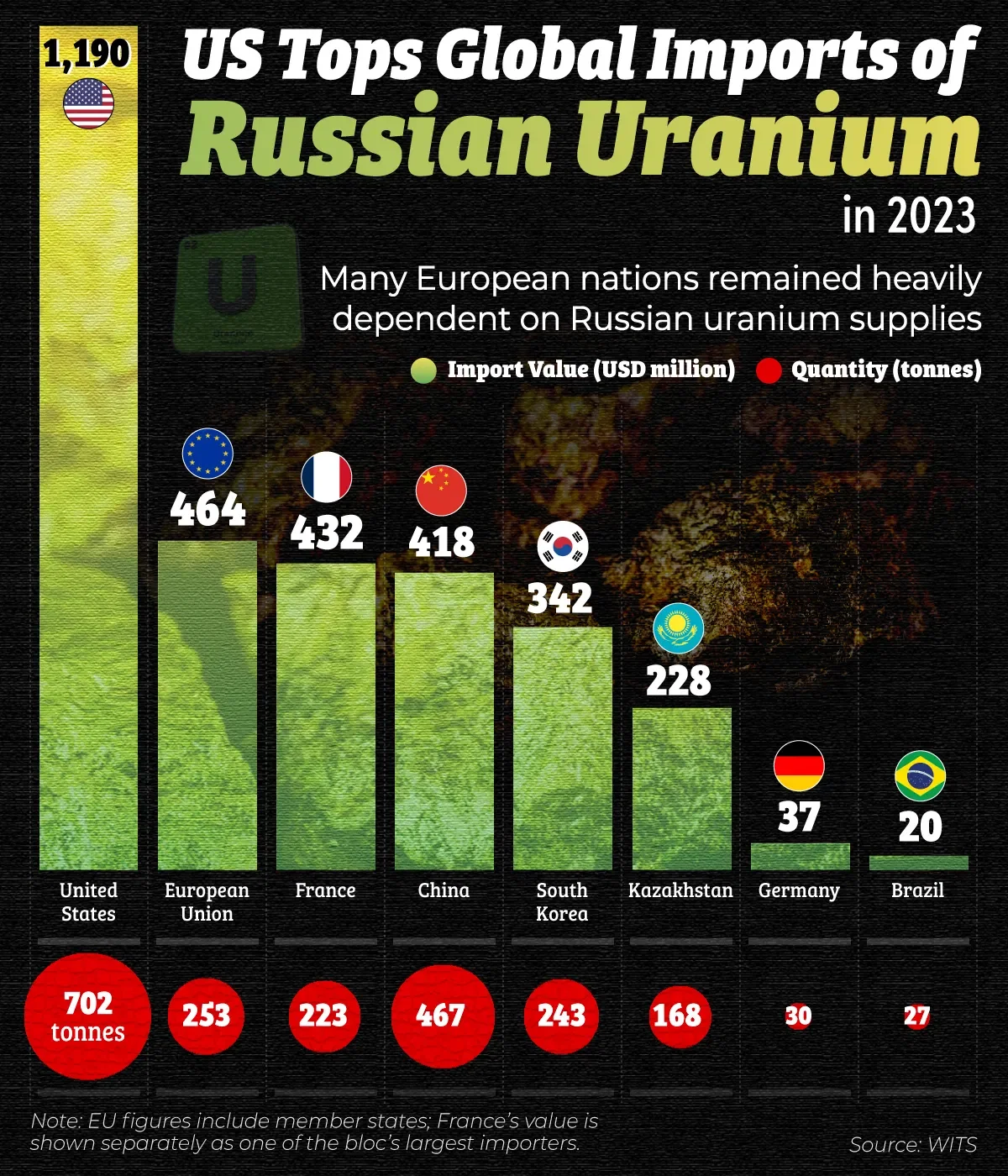
This infographic maps the countries most dependent on Russian uranium imports in 2023, measured by both trade value and physical volume. The data shows that despite geopolitical tensions and sanctions linked to the Ukraine war, Russia remains deeply embedded in the global nuclear energy supply chain. The United States led imports at $1,190 million, followed by the European Union ($464 million) and France ($432 million). China, South Korea, and Kazakhstan also recorded significant trade flows. Quantities further highlight dependence, with the U.S. importing 702 tonnes, far ahead of China (467 tonnes) and the EU (253 tonnes). The figures reveal how energy security and nuclear fuel needs continue to shape strategic choices across rival blocs.
Nuclear supply chains are difficult to replace, allowing Russia to retain influence in a critical energy sector despite broader economic isolation.