
Where Data Tells the Story
© Voronoi 2026. All rights reserved.

Many European cuisines aren’t complete without eggs.
But just how much egg does the average European consume annually? This varies by country.
Some countries consume hundreds of eggs per person each year, while others barely consume a few dozen. Let’s find out which country consumes the highest.
Compared with leading global egg-consuming countries, Europe presents a mix of moderation and enthusiasm.
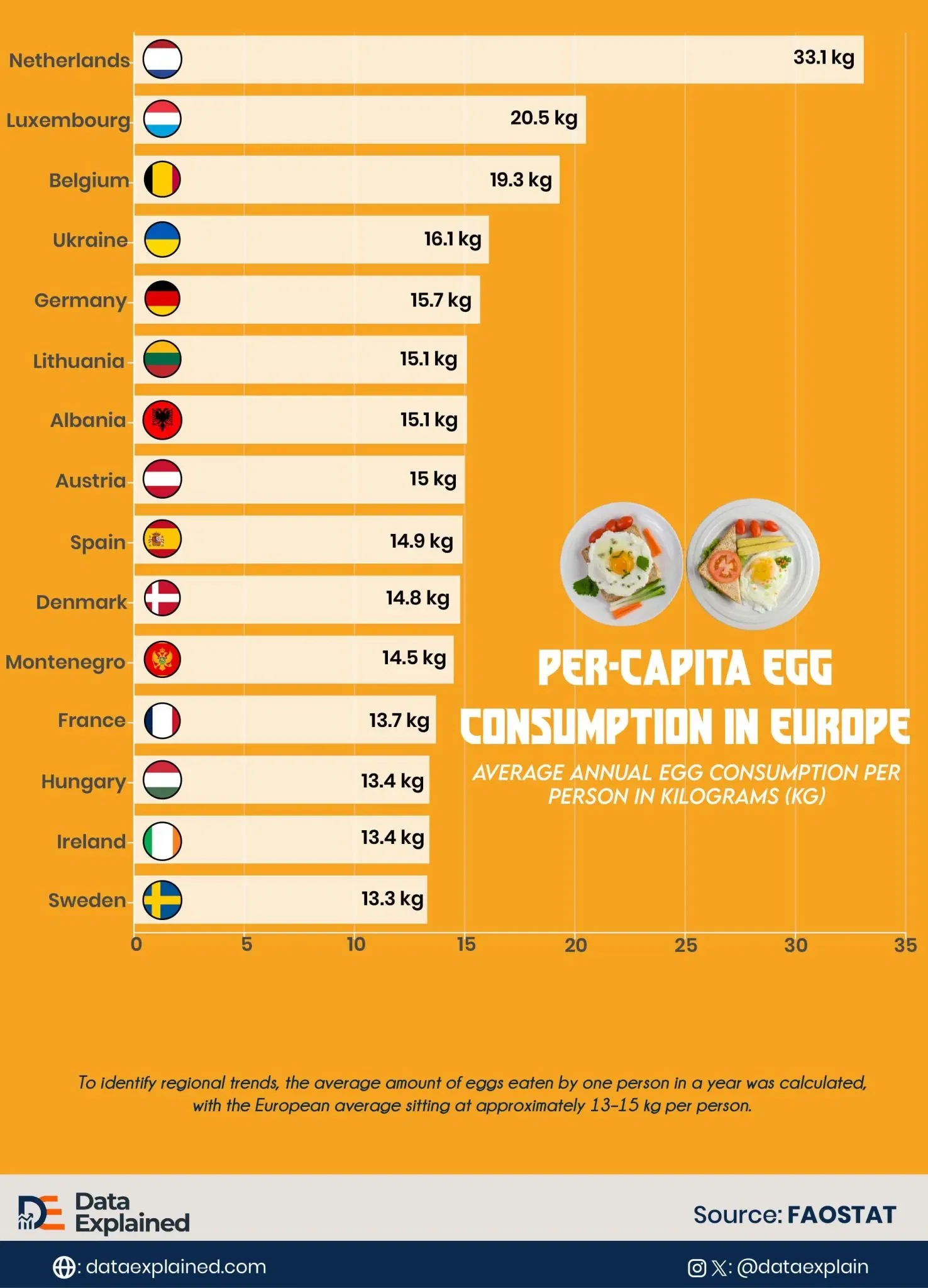
The Netherlands, for instance, ranks among the world’s top consumers with around 33 kg per person per year, challenging countries like Japan and Mexico, where eggs are used and eaten daily.
This puts the Dutch ahead of most European countries and close to the global elite in per-capita egg intake.
Meanwhile, countries like Belgium, Luxembourg, and Ukraine, with averages of 17–20 kg per person, remain above the European regional average of roughly 13–15 kg but below Asia’s egg-heavy diets.
On the other hand, France and Germany stay around 12–14 kg per person, which is roughly half the Dutch rate.
Compared globally, this puts them closer to countries like Canada and Australia, where eggs are common but not a key part of the diet.
Europe’s figures also stand in contrast to those of other regions. In Africa, the average per-capita egg consumption is just 3–5 kg per person annually, with even the continent’s top consumers, Seychelles and Libya, falling well below Europe’s regional average.
South America is closer to Europe, averaging around 12 kg per person per year, with Paraguay at 17.7 kg — a figure comparable to Belgium and Luxembourg.
The contrast across Europe highlights cultural food traditions, which shape how many eggs are consumed.