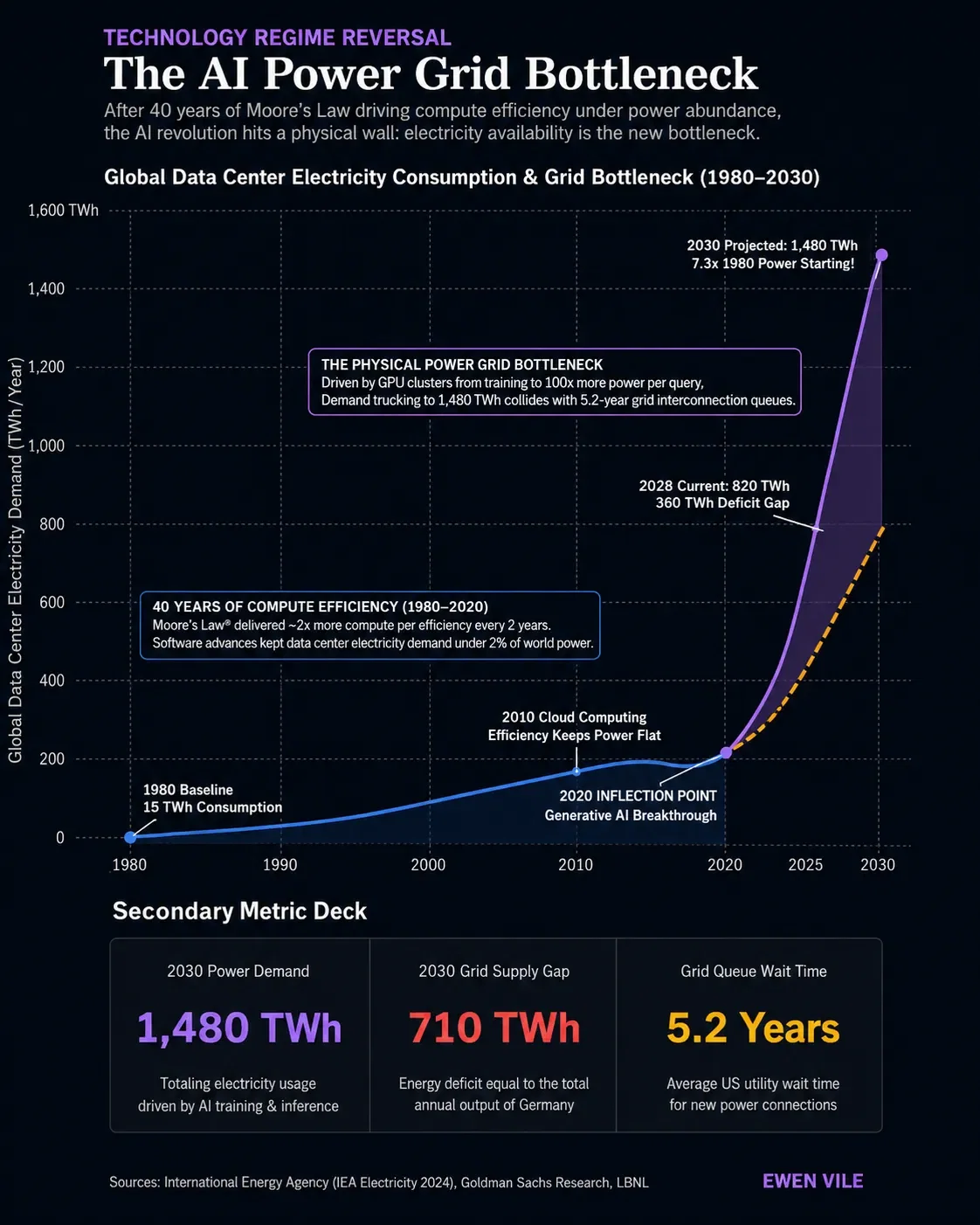
Four Decades of Compute Efficiency Collides with Physical Power Infrastructure (1980–2030)
The Era of Power Abundance (1980–2020)
For four decades, digital technology operated under an assumption of power abundance.
Governed by Moore's Law and Dennard Scaling, chipmakers doubled transistor density every two years while exponentially improving energy efficiency per calculation. Global data center electricity demand remained flat at under 2% of world power (~240 TWh).
The Generative AI Shift (2020–2026)
In 2020–2026, the generative AI revolution broke that 40-year linear efficiency assumption.
- High-Density Workloads: Training and running Large Language Models requires massive clusters of GPUs (such as NVIDIA H100/B200), consuming up to 10x the power per query of a traditional search engine.
- Rapid Demand Surge: Global data center electricity demand is projected to triple from 510 TWh in 2024 to 1,480 TWh by 2030.
Grid Bottlenecks & Strategic Pivots
This explosive demand is colliding directly with legacy electric power grids:
- Interconnection Delays: Average utility interconnection queues have expanded to 5.2 years.
- Hyperscaler Solutions: Big Tech companies (Microsoft, Amazon, Google, Meta) are securing off-grid nuclear power and Small Modular Reactor (SMR) agreements to bypass grid bottlenecks.
Key Metrics & Highlights
- 2020 Pre-AI Baseline: 240 TWh
- (Flat power consumption era under Moore's Law)
- 2030 Projected Demand: 1,480 TWh
- (3x demand surge driven by AI workloads)
- 2030 Power Deficit Gap: 710 TWh
- (Electricity shortfall equivalent to Germany's annual output)
- Utility Interconnection Wait: 5.2 Years
- (Average US grid connection queue)