
Where Data Tells the Story
© Voronoi 2026. All rights reserved.

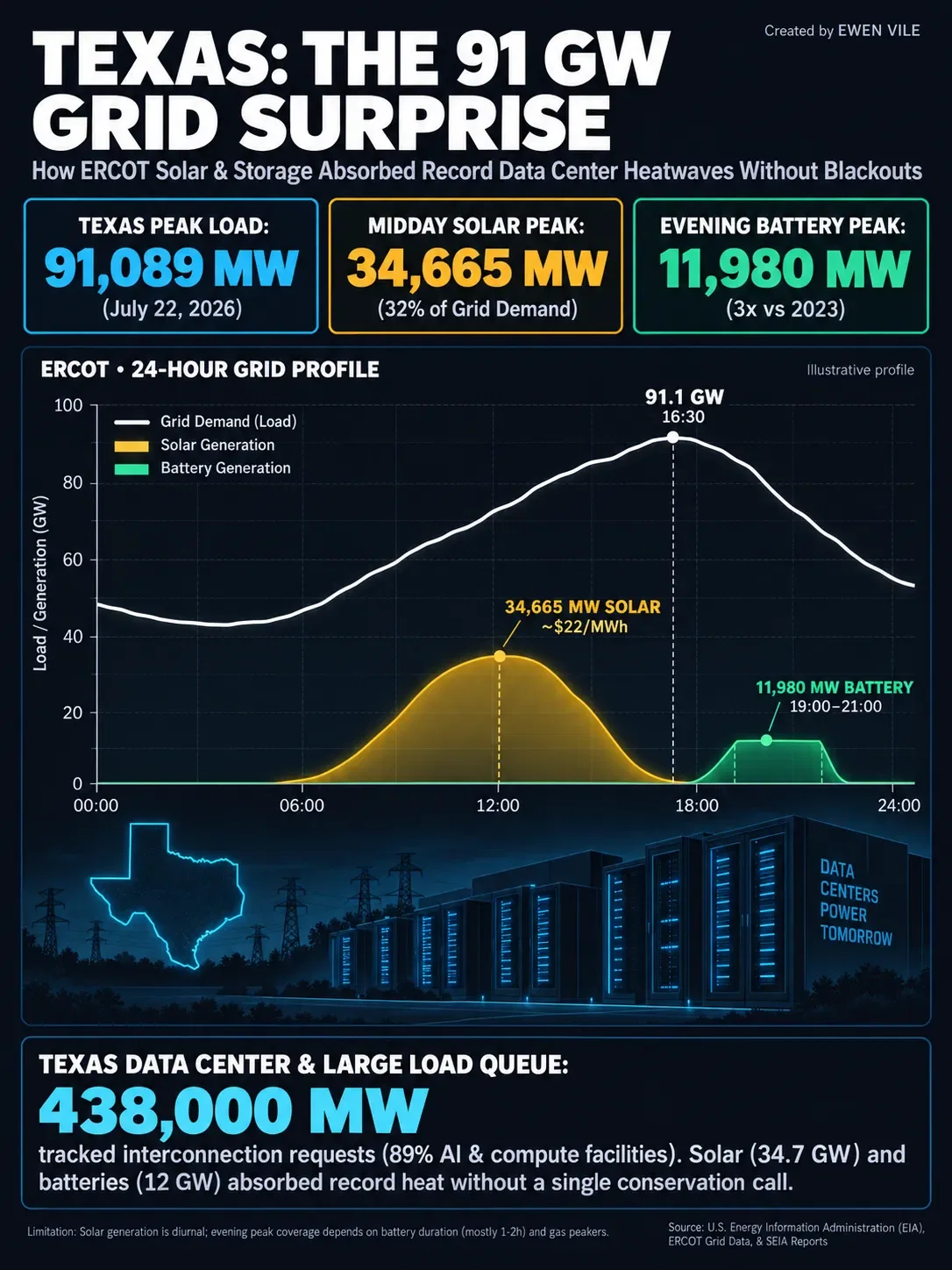
When real-time electricity demand on the Texas power grid (ERCOT) shattered all-time records twice in 24 hours—peaking at a staggering 91,089 MW on July 22, 2026—many analysts expected severe price spikes, emergency alerts, or even rolling blackouts.

Instead, something remarkable happened: the Texas grid operated calmly without a single public conservation call, and wholesale electricity spot prices cleared at an average of just ~$22/MWh—more than 95% below the system's $5,000/MWh scarcity price cap.

How did the Lone Star State absorb a 91 GW heatwave fueled by a 438,000 MW Texas data center and Permian electrification queue?

The secret lies in the diurnal synergy between two rapidly scaling technologies across Texas:
1. Midday Solar Absorption: With 53.5 GW of installed utility-scale solar across Texas, photovoltaics set a record peak output of 34,665 MW, covering 32% of total ERCOT grid demand during peak afternoon heat and dropping natural gas's midday supply share from 50% down to 37%.
2. Sunset Net-Load Bridge: As solar decayed between 7:00 p.m. and 9:00 p.m., a record 11,980 MW (~12 GW) of battery storage discharged directly into the Texas net-load ramp—3x the battery capacity available during the heatwaves of 2023.

While long-term load forecasts project peak ERCOT demand reaching 152 GW by 2030 (89% driven by Texas data centers and AI compute facilities), the summer of 2026 demonstrates that market-driven renewables and battery storage are fundamentally transforming real-time grid reliability in Texas.