
Where Data Tells the Story
© Voronoi 2026. All rights reserved.

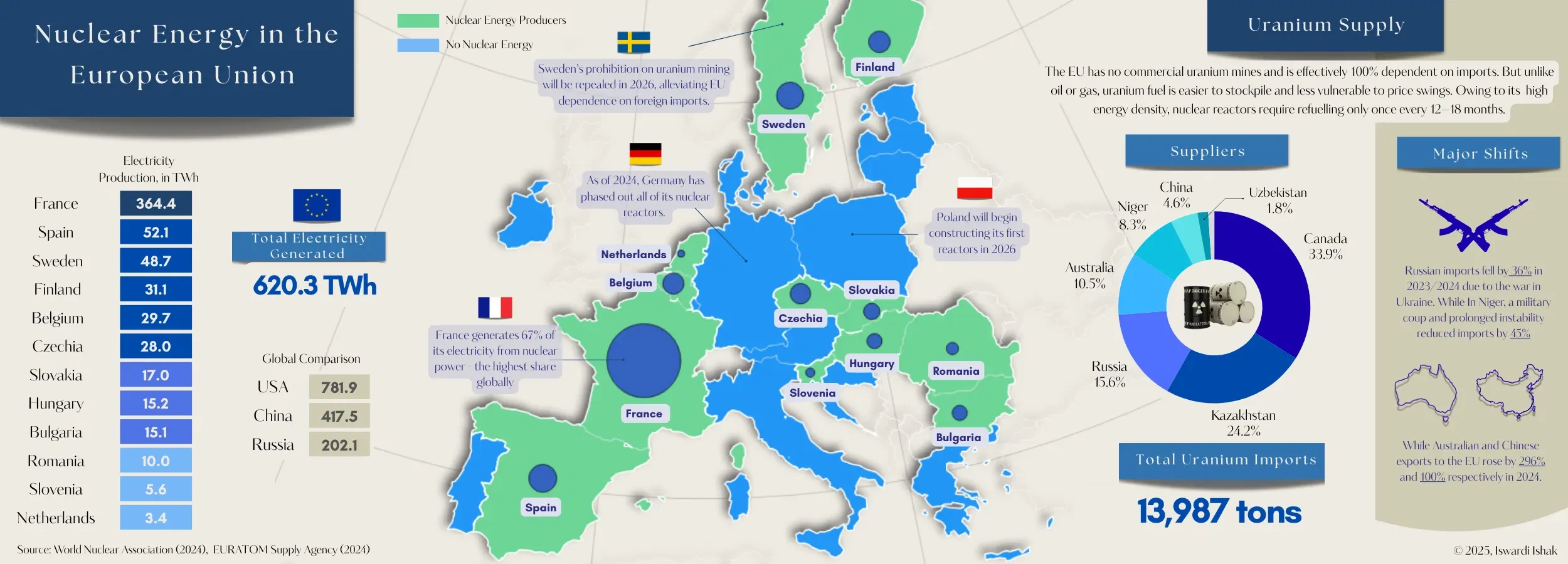
Nuclear power remains a minority source of electricity in the European Union, yet it punches above its weight. France alone accounts for well over half of the bloc’s nuclear generation, producing more electricity from reactors than the rest of the EU combined. A handful of northern and central European countries Sweden, Finland, Belgium and the Czech Republic, round out the club. Much of the continent, meanwhile, has none at all.
This imbalance reflects politics more than physics. Germany has shut its last reactors, betting that renewables and imports can fill the gap. Poland, by contrast, is preparing to build its first nuclear plants, driven by coal dependence and security fears. Sweden, once hostile to uranium mining, is moving to reverse its ban. Across Europe, old certainties about nuclear power are quietly being revisited.
Fuel supply adds another layer of challenges. The EU has no commercial uranium mines and depends entirely on imports. But the upside is that unlike oil or gas, uranium is compact, stockpilable and reactors are refuelled only every year or two, dulling the geopolitical risks. Since Russia’s invasion of Ukraine, European buyers have reduced their reliance on Russian uranium, turning instead to Canada, Kazakhstan and Australia. Diversification, rather than self-sufficiency, is the current strategy.
The picture that emerges is neither a nuclear renaissance nor a terminal decline. Instead, Europe is edging toward a pragmatic middle ground: keeping existing reactors running longer, adding a few new ones at the margins, and treating nuclear less as an ideological battleground than as an insurance policy.