
Where Data Tells the Story
© Voronoi 2026. All rights reserved.

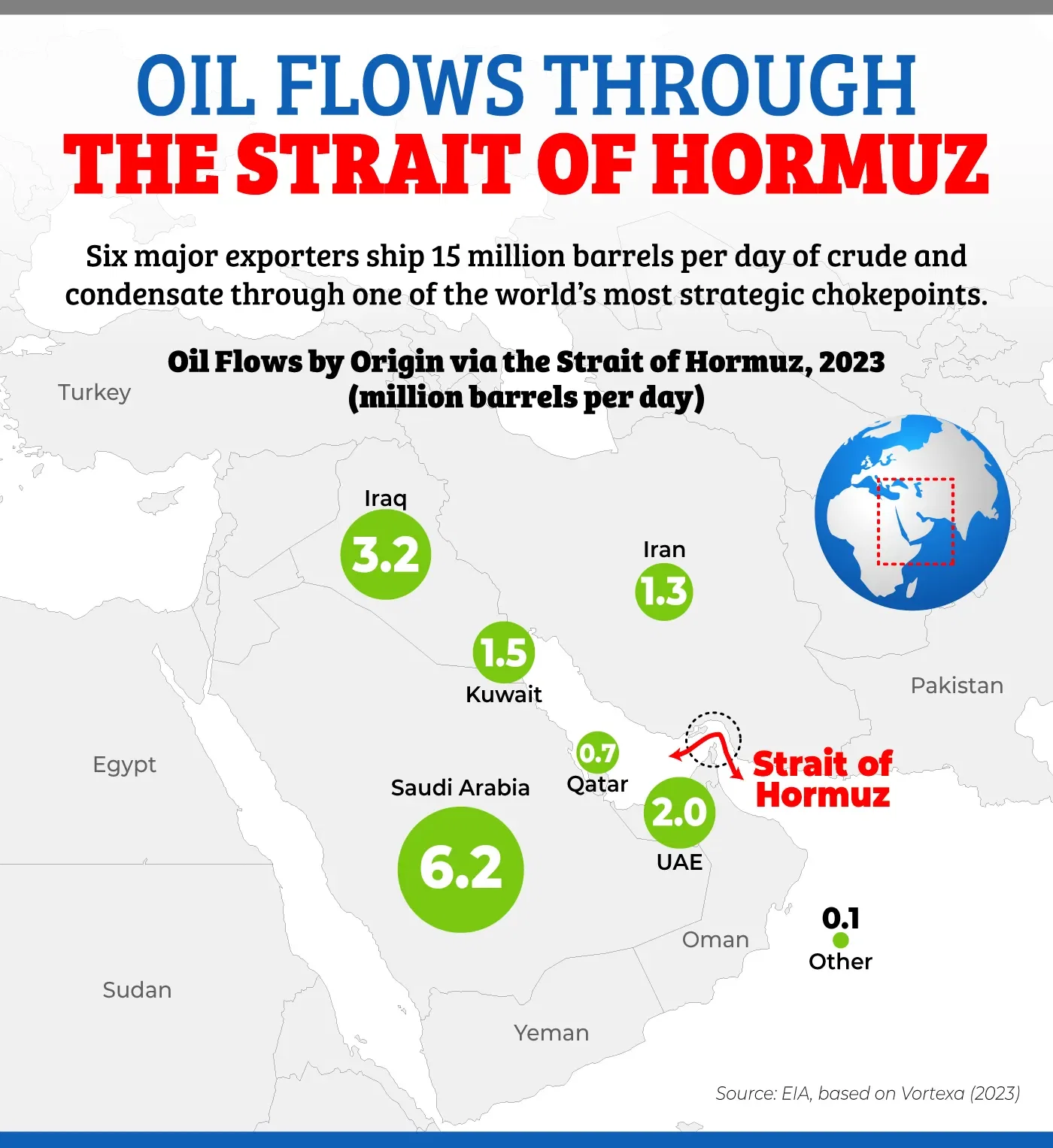
This graphic maps crude oil and condensate exports moving through the Strait of Hormuz, one of the world’s most strategically vital energy chokepoints. In 2023, roughly 15 million barrels per day (mb/d) of oil shipments passed through this narrow maritime corridor, linking Gulf producers to global energy markets.
The strait serves as the primary export route for six major producers across the Middle East. Saudi Arabia dominates flows, shipping 6.2 mb/d, followed by Iraq (3.2 mb/d) and the UAE (2.0 mb/d). Smaller but significant volumes originate from Kuwait (1.5 mb/d), Iran (1.3 mb/d), and Qatar (0.7 mb/d), while other exporters contribute marginal volumes.
As geopolitical tensions rise across the region - particularly amid instability involving Iran and wider Middle East conflicts - the security of Hormuz remains central to global oil price stability. Even without a physical blockade, military escalation or shipping disruptions can quickly ripple through energy markets. With limited alternative routes capable of replacing these volumes, the Strait of Hormuz continues to represent a critical intersection of geopolitics and global energy security.