
Where Data Tells the Story
© Voronoi 2026. All rights reserved.

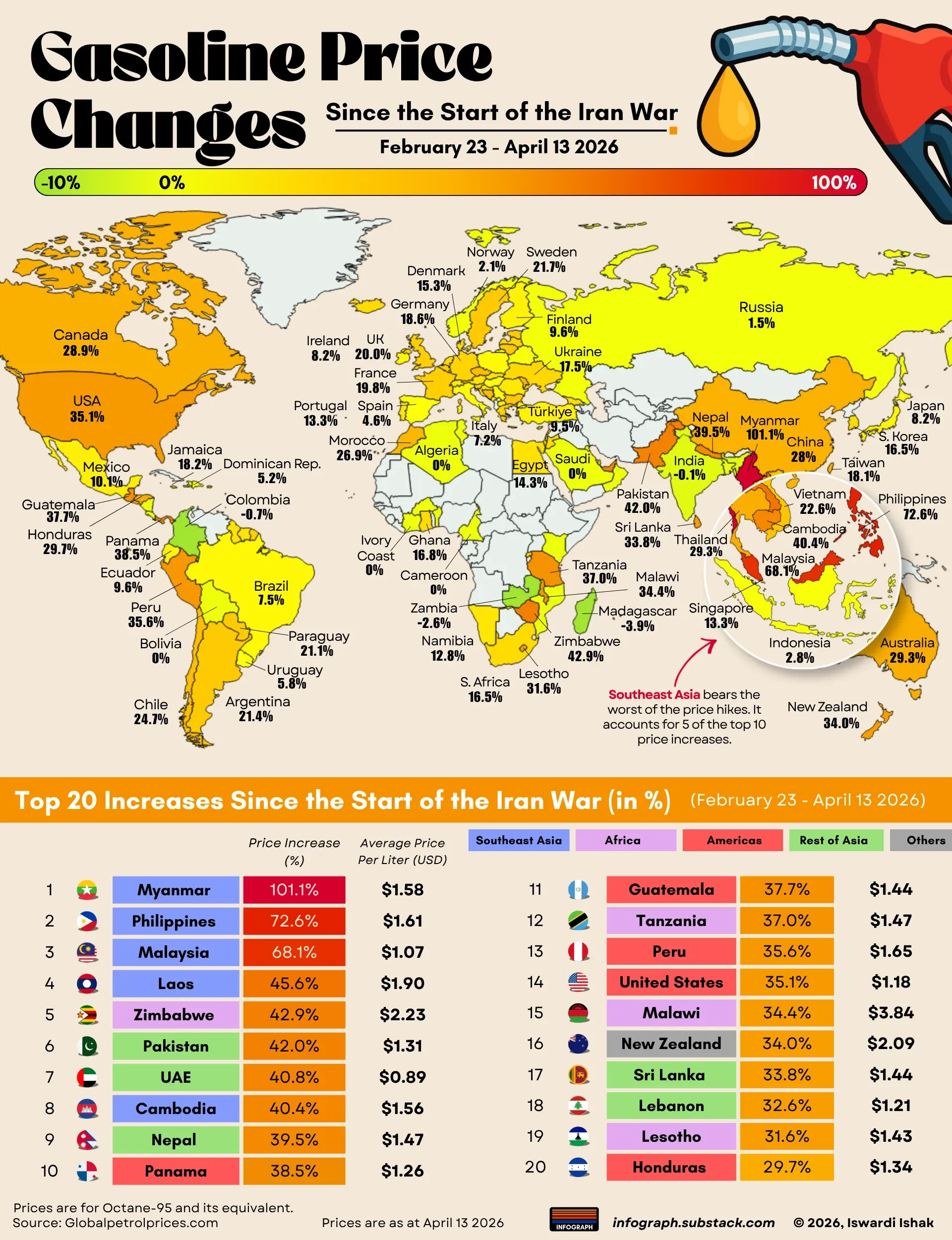
The war premium at the pump
When Israeli and American strikes on Iran began in late February, oil markets braced for disruption. What followed was not the brief spike traders had prepared for. Nearly two months on, the cost of filling a tank has risen sharply across much of the world, and the increases show little sign of reversing.
The hardest-hit countries are not in the Middle East. Myanmar has seen petrol prices more than double since February 23, a 101% rise that reflects both its dependence on imported refined fuel and the weakness of its currency. The Philippines and Malaysia, similarly reliant on seaborne supply chains through the Strait of Malacca, have seen increases of 73% and 68% respectively. Southeast Asia as a whole accounts for five of the top ten price increases globally, an asymmetry that maps neatly onto the region's exposure to Persian Gulf shipping lanes.
The picture elsewhere is more varied. American drivers are paying 35% more per litre than they were in February, a politically uncomfortable figure for an administration that had promised energy independence. Canada and most of Western Europe are somewhere in the 10-25% range, cushioned partly by strategic reserves and partly by fuel-tax structures that dilute the pass-through from crude prices. A handful of countries, including Saudi Arabia and Algeria have recorded no increase at all, a consequence of strong domestic supply and price controls.
What is striking is how unevenly the burden falls. Malawi, one of the world's poorest countries, now pays $3.84 per litre, a 34% increase on prices that were already punishing relative to local incomes. The war's costs, as is often the case, are not distributed according to who caused them.