
Where Data Tells the Story
© Voronoi 2026. All rights reserved.

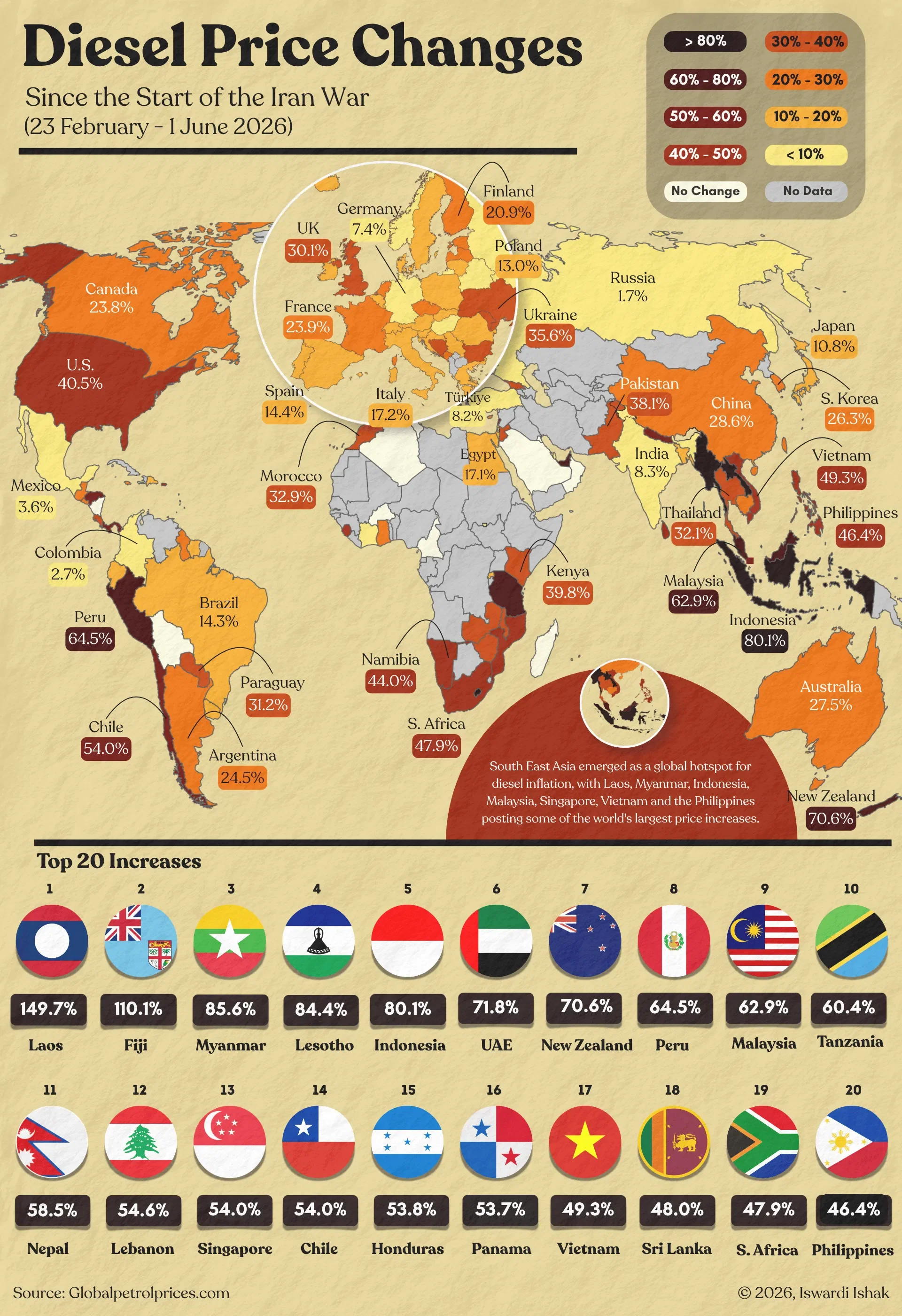
The price of conflict
War has a way of making itself felt at the pump. Since attacks broke out in late February, diesel prices have risen sharply across much of the world, a stark reminder that modern economies run on fuel, and fuel runs on stability in the Middle East.
The increases have not been evenly spread. South East Asia has absorbed some of the heaviest blows. Laos tops the global table with a staggering 149.7% rise, and Myanmar at 85.6%. Indonesia, which has long subsidised fuel to cushion its vast population from price shocks, still saw prices climb 80.1%. Malaysia, another habitual subsidiser, was not spared either, recording a 62.9% jump.
The pattern reflects something structural. Many South-East Asian nations import refined diesel and hold limited strategic reserves. When global prices spiked, the pass through was swift and painful.
Richer economies have fared better, though not comfortably. The United States saw a 40.5% increase, the United Kingdom 30.1%, and France 23.9%. Germany, despite its industrial dependence on diesel, managed a comparatively modest 7.4%, likely a function of its energy hedging arrangements and reserve drawdowns. Russia, still selling oil in grey markets, recorded a rise of just 1.7%.
In Latin America, the picture is mixed. Peru climbed 64.5% and Chile 54%, while Colombia and Mexico barely moved. The divergence hints at differences in subsidy regimes, currency strength, and proximity to alternative suppliers. Africa tells a more sobering story. In South Africa, diesel prices rose 47.9%, Kenya 39.8%, and Namibia 44% Many of these countries are where diesel is not merely a transport cost but the difference between a functioning cold chain and spoiled food, between a hospital with power and one without.
The war's economic shockwaves, it seems, are not falling where the missiles are.