
Where Data Tells the Story
© Voronoi 2026. All rights reserved.

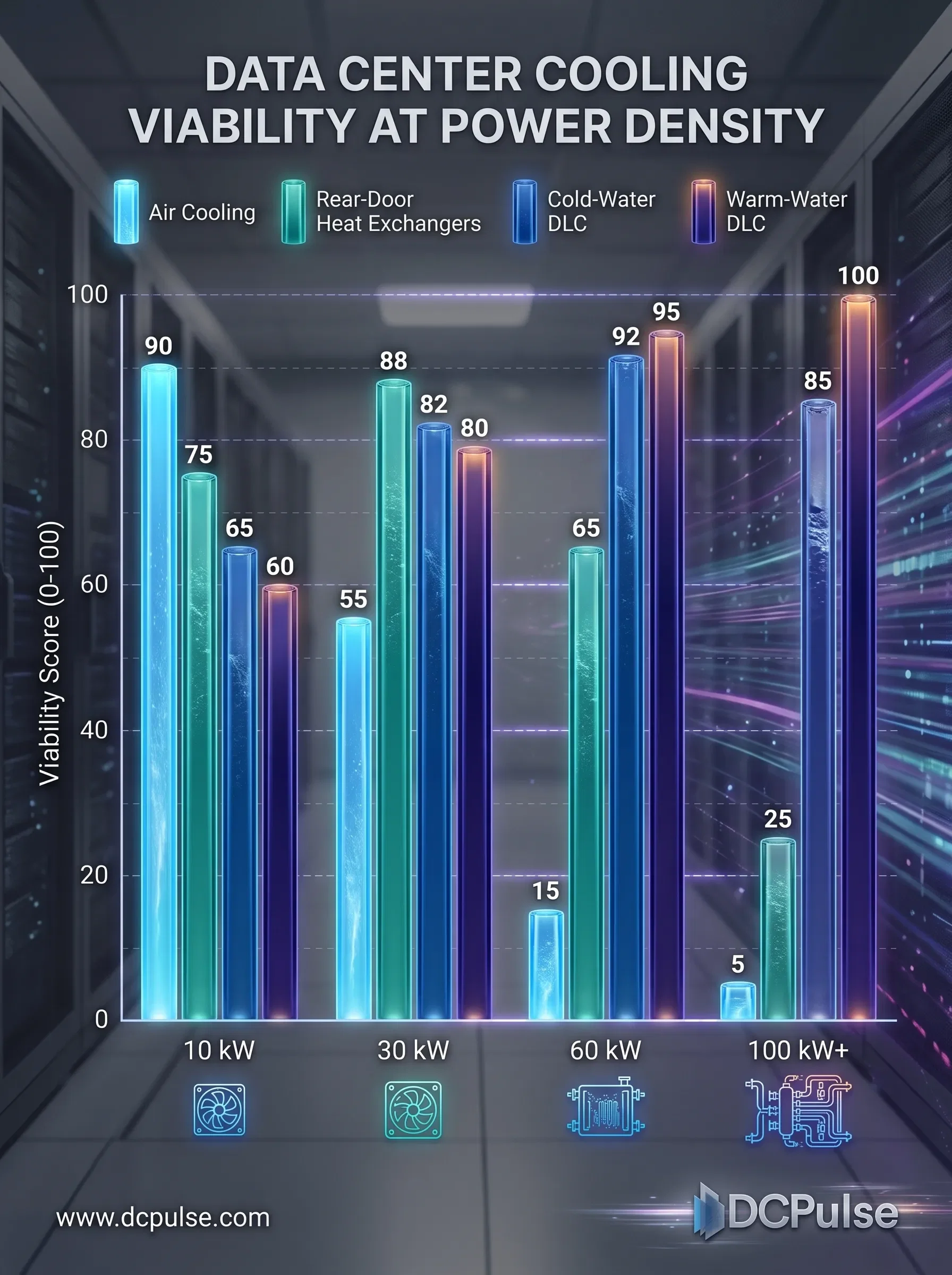
The Cooling Viability Score (CVS) is a practical metric used to evaluate how effectively a cooling technology can support different data center rack power densities. Measured on a scale of 0 to 100, the score indicates the suitability, efficiency, and long-term reliability of a cooling solution for a specific density tier. A higher score represents better thermal performance, lower operational risk, and greater scalability for future workloads.
As rack densities continue to increase due to AI, machine learning, and high-performance computing (HPC), cooling requirements become significantly more demanding. Traditional air cooling performs well for low-density racks, typically below 10–15 kW per rack, earning high viability scores in this range. However, its effectiveness declines rapidly as power densities exceed 30 kW per rack, where airflow limitations and hotspot formation reduce cooling efficiency.
For medium-density deployments between 20–40 kW per rack, hybrid cooling solutions that combine air cooling with liquid-assisted technologies achieve higher cooling viability scores. These systems provide improved heat removal while allowing operators to leverage existing infrastructure.
At high-density levels exceeding 50 kW per rack, advanced liquid cooling technologies including direct-to-chip cooling and immersion cooling receive the highest viability scores, often approaching 90–100. These methods remove heat directly from servers, enabling efficient cooling of AI accelerators and next-generation GPUs while reducing energy consumption and improving Power Usage Effectiveness (PUE).
Cooling Viability Scores help data center designers, operators, and investors compare cooling technologies based on current and future computing demands. As AI workloads continue driving rack densities beyond 100 kW, cooling viability has become a critical factor in designing sustainable, energy-efficient, and scalable data center infrastructure.