
Where Data Tells the Story
© Voronoi 2026. All rights reserved.

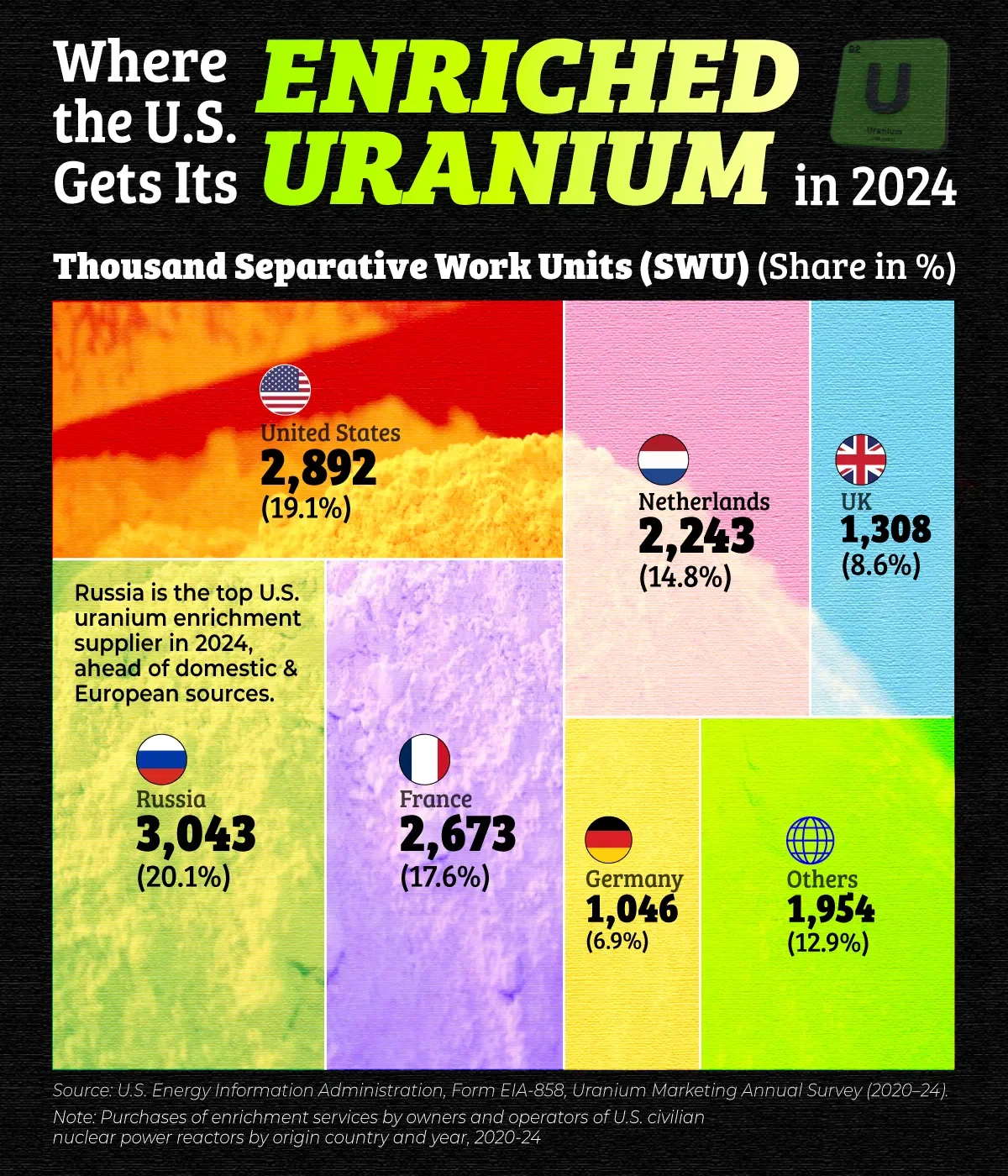
This graphic shows where the United States sourced its enriched uranium in 2024, measured in thousand Separative Work Units (SWU)—the standard unit used to quantify uranium enrichment services required for nuclear reactor fuel. Countries are ranked by their share of U.S. enrichment supply, revealing how America’s nuclear energy system depends on domestic production, allied partners, and geopolitical rivals. The data is sourced from the U.S. Energy Information Administration (EIA), based on enrichment purchases by U.S. civilian nuclear power reactor operators.
The visualization highlights a strategic contradiction in global energy security. While nuclear power generates roughly one-fifth of U.S. electricity, enrichment capacity remains concentrated abroad. Russia continues to supply the largest share of U.S. enriched uranium despite ongoing political tensions, while European allies increasingly act as alternative partners. At the same time, rising instability linked to U.S.–Russia rivalry and potential escalation involving Iran adds new risks to already fragile nuclear fuel supply chains. As geopolitical competition intensifies, enriched uranium is emerging as both an energy necessity and a strategic asset shaping long-term national security planning.
• Russia remains the top supplier, providing 20.1% of U.S. enriched uranium demand in 2024 despite worsening bilateral relations.
• Domestic production is rebounding, accounting for 19.1%, signaling efforts to reduce long-term foreign dependence.
• European allies form a critical supply buffer, led by France, the Netherlands, the UK, and Germany.
• Geopolitical conflicts matter for nuclear energy, as tensions involving Russia or a potential U.S.–Iran escalation could disrupt uranium markets.
• Control over enrichment capacity is strategic, making nuclear fuel supply a growing pillar of energy security and geopolitical influence.
Note: Purchases of enrichment services by owners and operators of U.S. civilian nuclear power reactors by origin country and year, 2020-24