
Where Data Tells the Story
© Voronoi 2026. All rights reserved.

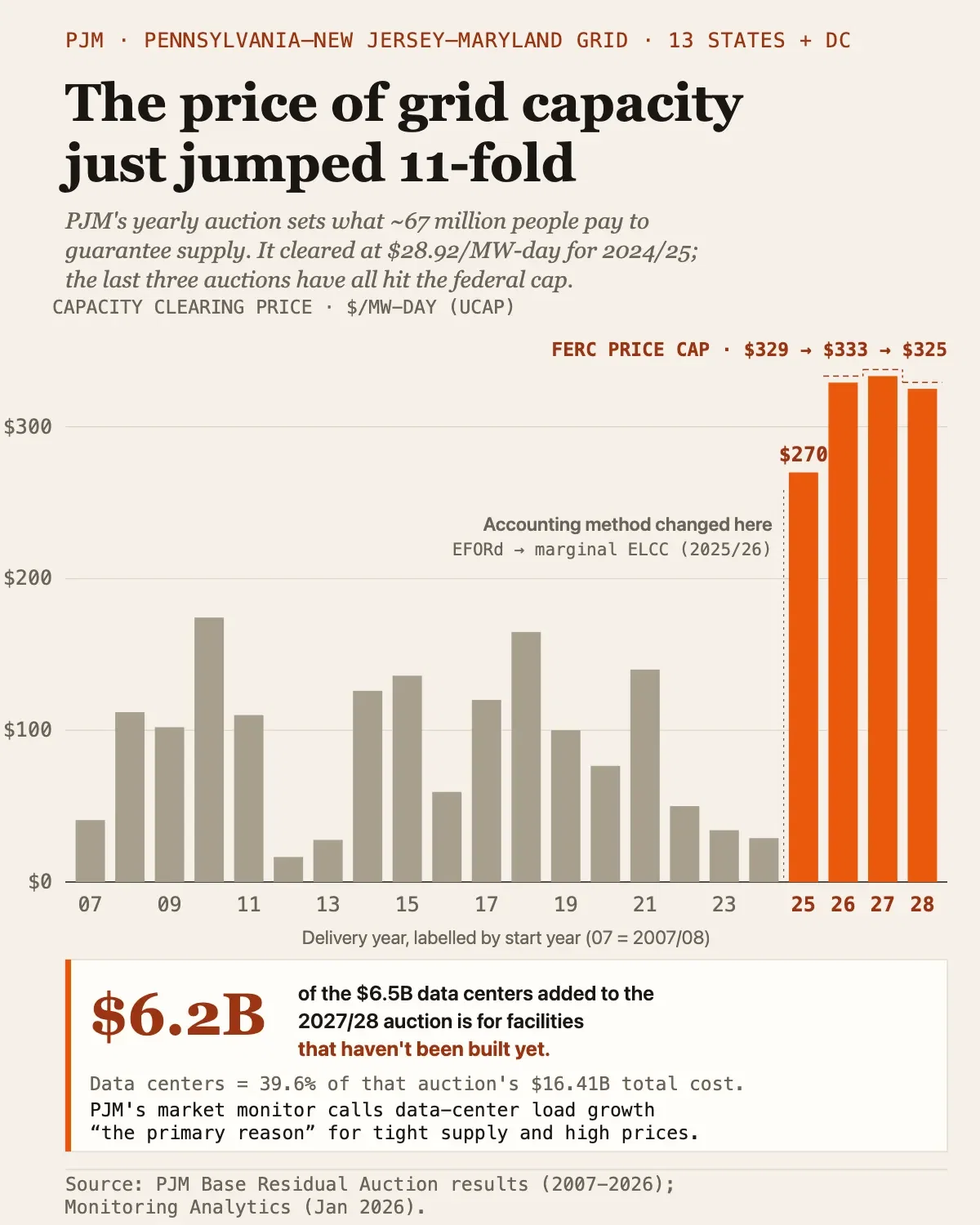
PJM Interconnection — named for the Pennsylvania–New Jersey–Maryland grid it began as, now grown to 13 states — runs the largest electricity market in the United States, coordinating power for more than 67 million people across those states and Washington, DC. Once a year it holds a capacity auction: a payment to generators to guarantee they will be available years ahead. For most of the past decade that payment cleared near $100/MW-day. It has now cleared at the federal price cap three auctions in a row.
The most recent, announced July 14, 2026, cleared at $325/MW-day for the 2028/29 delivery year — roughly 11 times the $28.92 the same auction cleared for 2024/25. The two before it came in at $329.17 and $333.44. The cap is recalculated every year, and this time it fell 2.5%, so the ceiling came down rather than the market cooling. Supply is why: PJM procured 138,318 MW and, counting resources committed outside the auction, still came up 6,831 MW short of its own reliability requirement.
PJM's independent market monitor attributes the pressure to data centers. In its January 2026 analysis of the 2027/28 auction, it found data-center demand accounted for $6.5B, or 39.6%, of that auction's $16.4B total cost, and that $6.2B of that was for data centers that had been forecast but not yet built, resting on load the monitor itself flags as carrying "extreme uncertainty." It calls data center load growth "the primary reason" for the market's tight supply and high prices.
Capacity is one line item on an electricity bill, not the whole bill. But it is the one rising fastest, and it is already arriving: costs from the $329.17 auction started reaching customers on June 1, 2026, and the $333.44 auction follows on June 1, 2027.
Two caveats on the size of the jump. PJM changed how it accredits capacity beginning in 2025/26, which lowered the basis these prices are measured against and amplifies the multiple. And 2024/25 was an unusually cheap year: measured against the pre-surge high of $174.29 in 2010/11, today's cap is about 1.9 times, not 11. The direction is not in dispute.