
Where Data Tells the Story
© Voronoi 2026. All rights reserved.

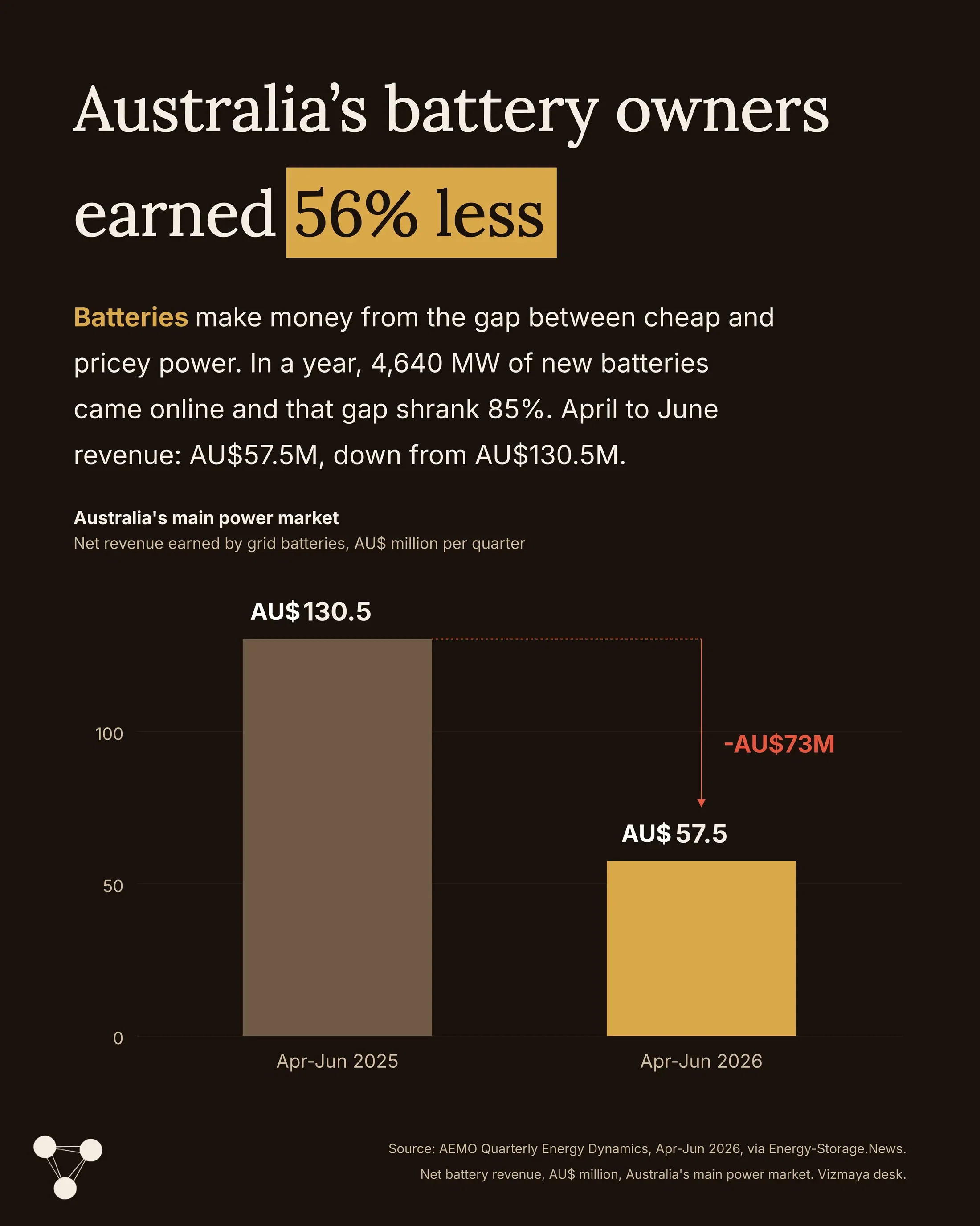
Australia's battery owners earned 56% less this year.
They just got what they asked for.
I put the full analysis, with every source and the claims we could and could not confirm, here: https://www.vizmaya.fyi/s/grid-batteries-owners-pay-for-oversupply-households-pay-for-scarcity#s=7
Here is how a grid battery makes money. It charges when power is cheap and sells when power is expensive. The gap between those two prices is the whole business.
In April to June 2025, that gap averaged AU$342 per MWh. In April to June 2026, it was AU$51. That is an 85% drop.
Net battery revenue followed. AU$130.5M a year earlier, AU$57.5M now. A loss of AU$73M in one quarter, according to AEMO, the market operator.
In the same twelve months, 4,640 MW of new batteries started commissioning on Australia's main grid. Spot prices also fell 47%, and the report points to more renewables and lower evening demand.
So batteries were not the only cause. But they are part of the story. Every battery that arrives fights for the same evening peak, and each one makes that peak a little smaller.
Here is what I take from it:
1. That is a good result for the grid. It is a hard result for whoever owns the asset.
2. Revenue forecasts built on today's price gap are fragile.
If your model assumes the spread stays where it is while the fleet grows, you have built a bet on scarcity.
3. It is also not proof of a trend. In January to March 2026, revenue was AU$96.9M against AU$44M a year before, more than double. One quarter does not settle it.
The question I keep coming back to: if success lowers the price signal, who pays to build the next battery?