
Where Data Tells the Story
© Voronoi 2026. All rights reserved.

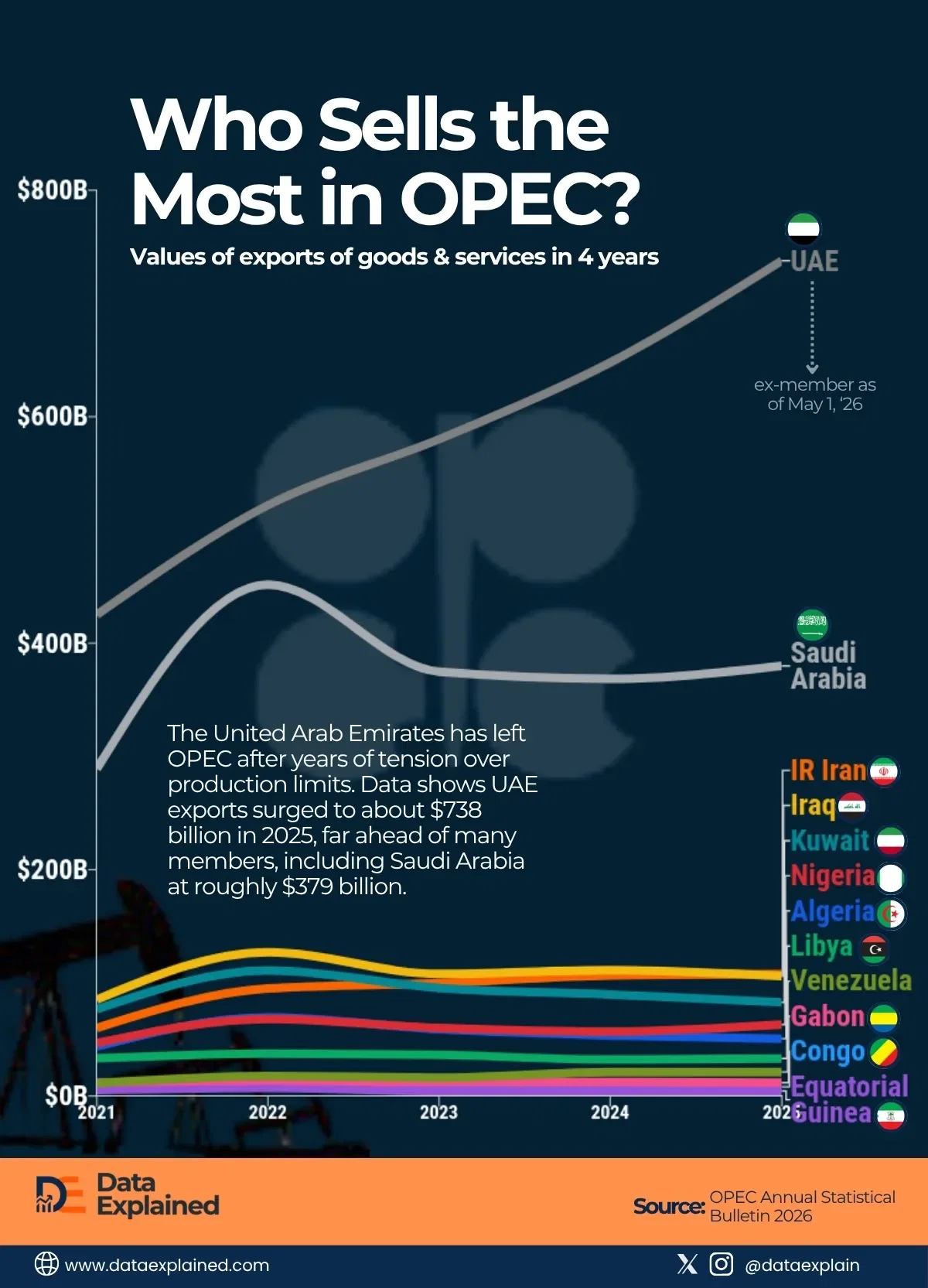
The UAE’s decision to exit OPEC has sent ripples through global energy markets, but the underlying reasons become clearer when looking at the numbers behind the group’s internal dynamics.
Data published by OPEC on member countries’ exports of goods and services from 2021 to 2025 shows a bloc that has grown overall, but unevenly.
Total OPEC exports rose from about $1.10 trillion in 2021 to $1.61 trillion in 2025.
Beneath that headline growth, however, the balance of power inside the group has shifted significantly.
The UAE stands out as the fastest-growing major exporter in the dataset.
Its total exports climbed from roughly $425 billion in 2021 to $738 billion in 2025, showing consistent year-on-year growth.
By contrast, Saudi Arabia, long considered OPEC's dominant force, followed a different trajectory.
Its exports rose sharply to about $452 billion in 2022, then declined and stabilized at around $379 billion by 2025.
That means that by the end of the period, the UAE’s total export value was nearly double that of Saudi Arabia.
NOTE: