
Where Data Tells the Story
© Voronoi 2026. All rights reserved.

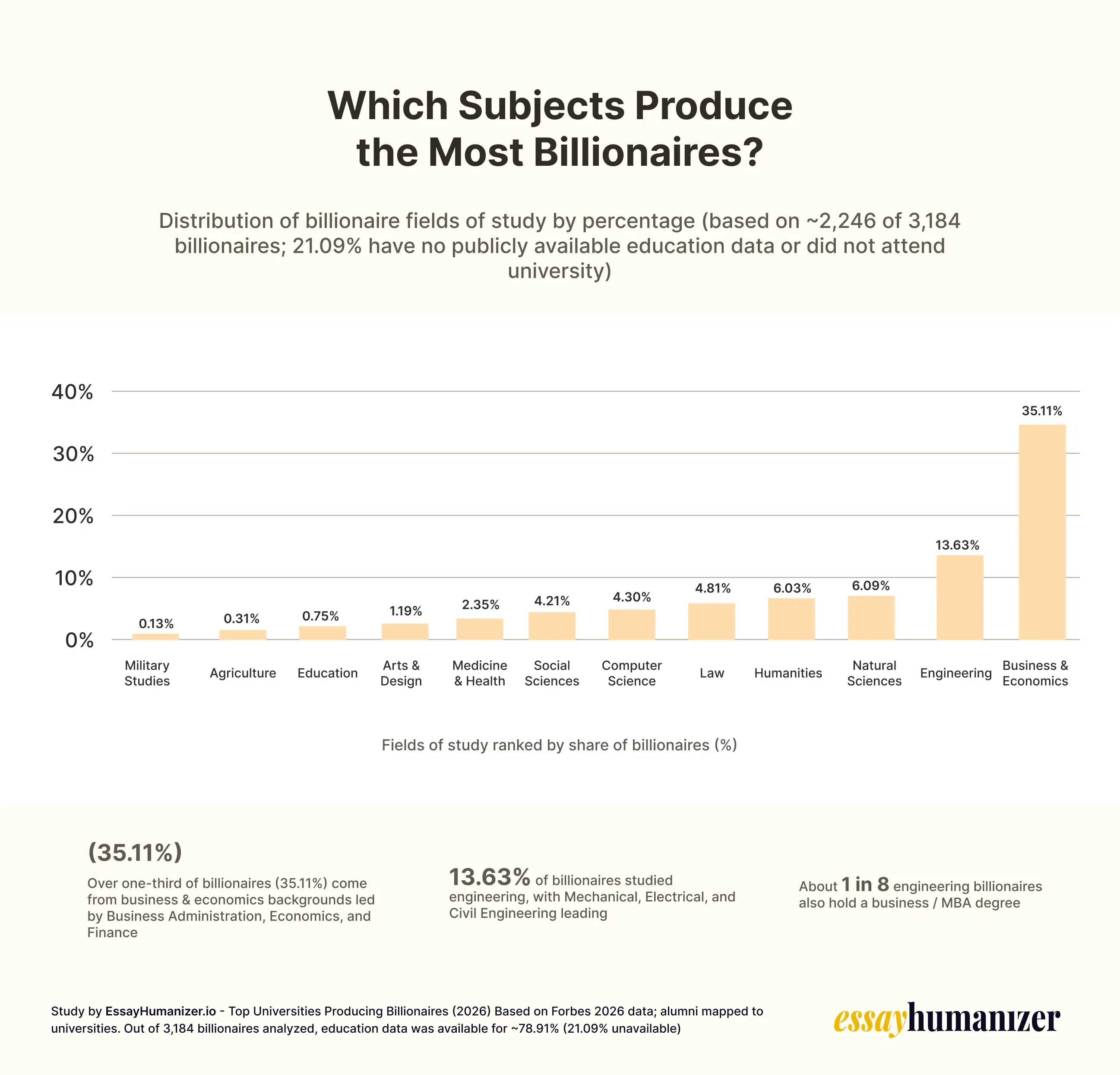
The study of 3,184 billionaires shows that wealth is heavily concentrated in a few fields, led by business & economics (35.11%), followed by engineering (13.63%).
Business-related degrees place individuals closer to markets and capital, while engineering often leads to wealth when combined with business knowledge; around 1 in 8 engineering billionaires also holds an MBA.
Beyond these, all other fields contribute much smaller and less consistent shares, suggesting that wealth tends to cluster around disciplines tied to decision-making, scalability, and financial systems.
Business & Economics: The Dominant Pathway
At the center of this pattern is Business & Economics, which accounts for 35.11% of all billionaires (1,118 individuals).
This dominance is not driven by a single degree but by a cluster of closely related fields. Business Administration (11.21%), Economics (6.39%), and Finance (4.42%) lead the way, forming the most reliable pathway into wealth creation.
What connects these fields is their direct link to how money, markets, and companies operate, which naturally positions graduates closer to high-value decision-making.
Engineering: Strong, But Often Paired with Business
Engineering ranks second at 13.63% (434 billionaires), with major contributions from mechanical (3.24%) and electrical engineering (3.00%).
However, the pattern here is more layered. Technical expertise alone rarely explains the outcome. Many individuals transition into business roles over time. In fact, around 1 in 8 engineering billionaires also pursued a business or MBA degree, showing that combining technical skill with commercial understanding significantly strengthens the path to wealth.
Mid-Tier Fields: Present but Less Consistent
After these two dominant categories, the distribution drops noticeably.
Fields like natural sciences (6.09%) and humanities (6.03%) still contribute a meaningful number of billionaires, followed by law (4.81%), computer science (4.30%), and social sciences (4.21%).
These disciplines do produce successful individuals, but they lack the same level of consistency and concentration seen in business-related fields.
Lower Representation Fields
At the lower end, the contribution becomes more limited.
Medicine (2.35%), arts & design (1.19%), and education (0.75%) account for a relatively small share of billionaire backgrounds. Even less common are Agriculture (0.31%) and Military Studies (0.13%), which appear only rarely in the dataset.
What This Pattern Actually Means
The takeaway is not that certain fields guarantee success. Instead, it shows where wealth tends to concentrate over time.
Disciplines tied to markets, capital, and decision-making consistently produce more billionaires. Technical fields remain powerful but often reach similar outcomes only when paired with business knowledge.
Everything else contributes, but at a much smaller and less predictable scale.
To understand that fully, the complete study goes deeper into the following: