
Where Data Tells the Story
© Voronoi 2026. All rights reserved.

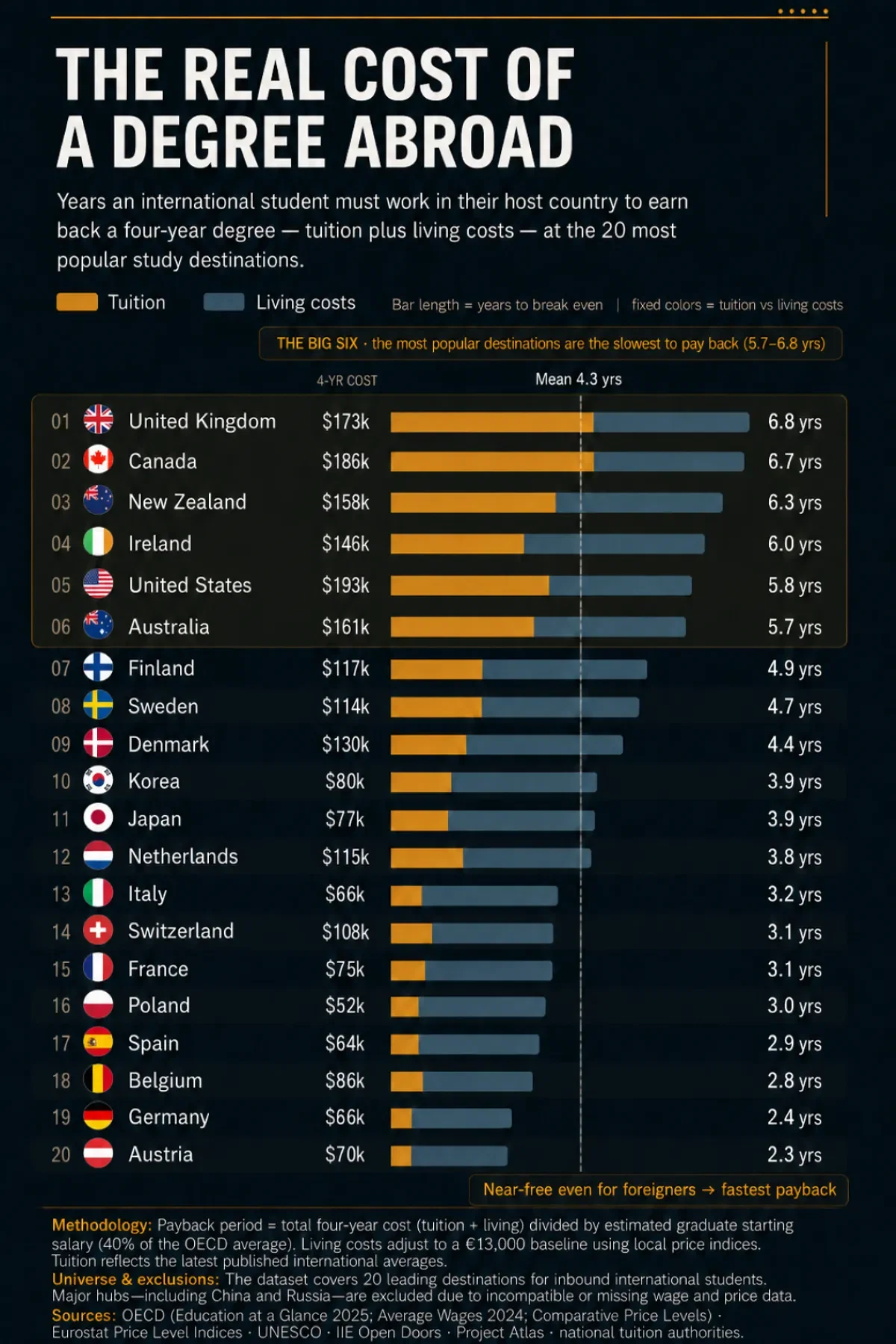
Studying abroad is often framed as a prestige decision. But financially, some destinations take far longer to pay off than others.
This ranking shows how many years an international student would need to recover the cost of a four-year degree through local graduate earnings. The result is counterintuitive: the world’s most popular study destinations are often the slowest to break even.
The UK has the longest payback period at 6.8 years, followed closely by Canada at 6.7. New Zealand, Ireland, the U.S., and Australia complete the slow end of the ranking, forming a clear “Anglosphere premium” driven by high international tuition.
At the other end, Germany and Austria offer the fastest payback at 2.4 and 2.3 years. Their low-tuition systems mean total cost is driven far more by living expenses than by fees.
The broader lesson is simple: sticker price alone can mislead. The real cost of a degree abroad depends on three things at once — tuition, cost of living, and what graduates can realistically earn afterward.
Methodology: Four-year cost equals annual international tuition plus living costs, multiplied by four. Payback is calculated by dividing that total by an estimated graduate salary set at 40% of the OECD average annual wage.
Sources: OECD Education at a Glance 2025; OECD Average Annual Wages 2024; Eurostat Price Level Indices 2024; UNESCO; Project Atlas; IIE; national tuition authorities.
Analysis by Dr. Muhammad Rizwan Hussain (StudyinEU.online)