
Where Data Tells the Story
© Voronoi 2026. All rights reserved.

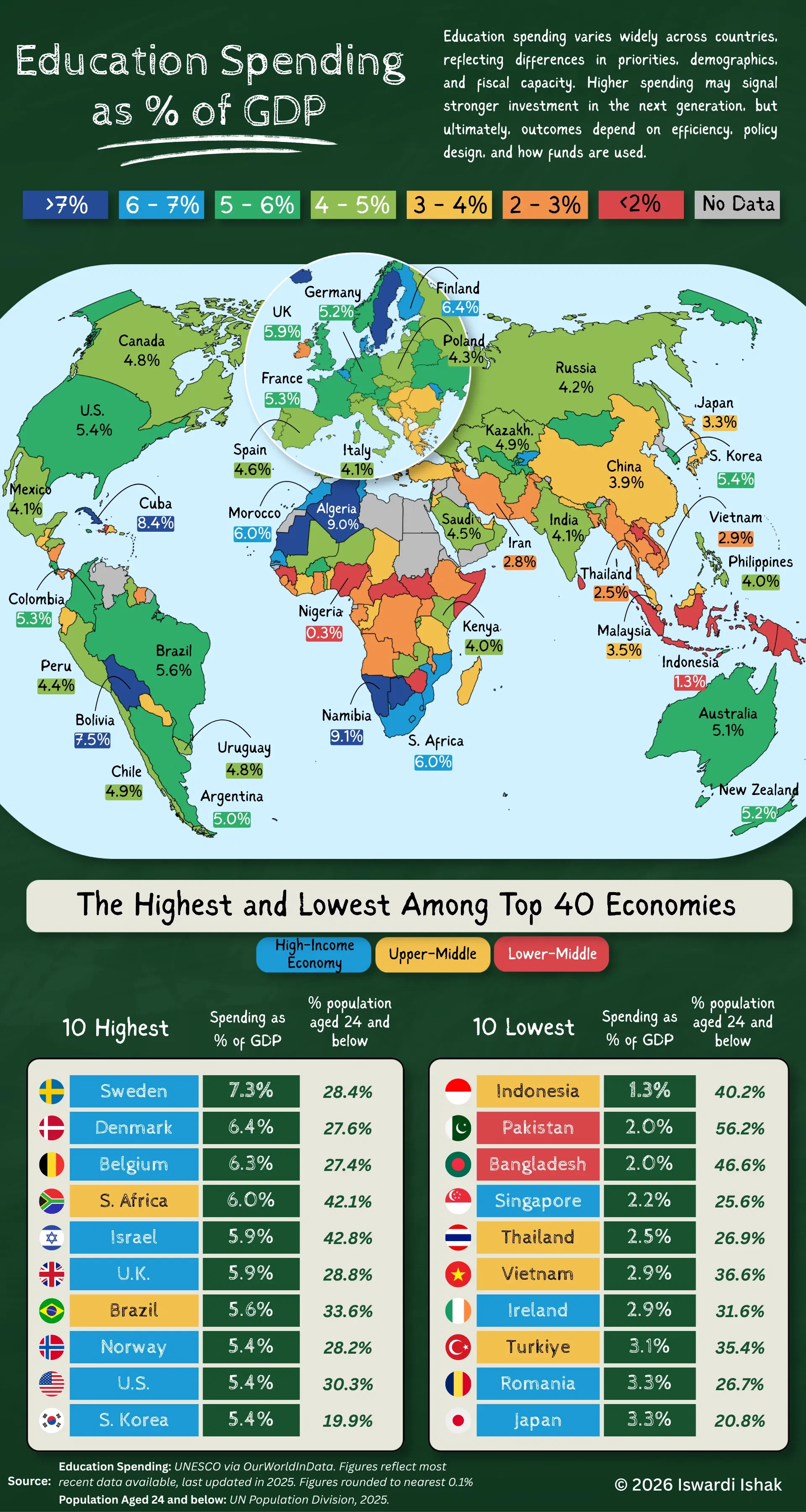
Governments love to boast about education budgets but few explain what the money actually buys, and the gap between spending and results is often the more interesting story.
Namibia ploughs 9.1% of GDP into schools, a share nearly unmatched globally, alongside Cuba and Algeria. Sweden, the supposed Scandinavian gold standard, spends less, at 7.3% but nobody mistakes Windhoek for Stockholm on outcomes.
Indonesia is at the opposite with spending dipping to a low point of just 1.3% of GDP on education, among the lowest rates recorded anywhere despite a constitution that mandates a fifth of the state budget to go to schools. The explanation is duller than it sounds: government spending overall is small relative to GDP, so even a generous budget share looks thin by comparison.
Wealthy countries mostly cluster together, Denmark, Belgium and Britain sit between 5.9% and 6.4%. Among major developing economies, South Africa and Brazil now match or beat several rich European peers, even as their systems still struggle with inequality and patchy results.
Chronic underspending is clearly a problem. Nigeria's 0.3% leaves little room for argument. But past a certain point, the real question stops being how much a country spends and starts being who decides where it goes.