
Where Data Tells the Story
© Voronoi 2026. All rights reserved.

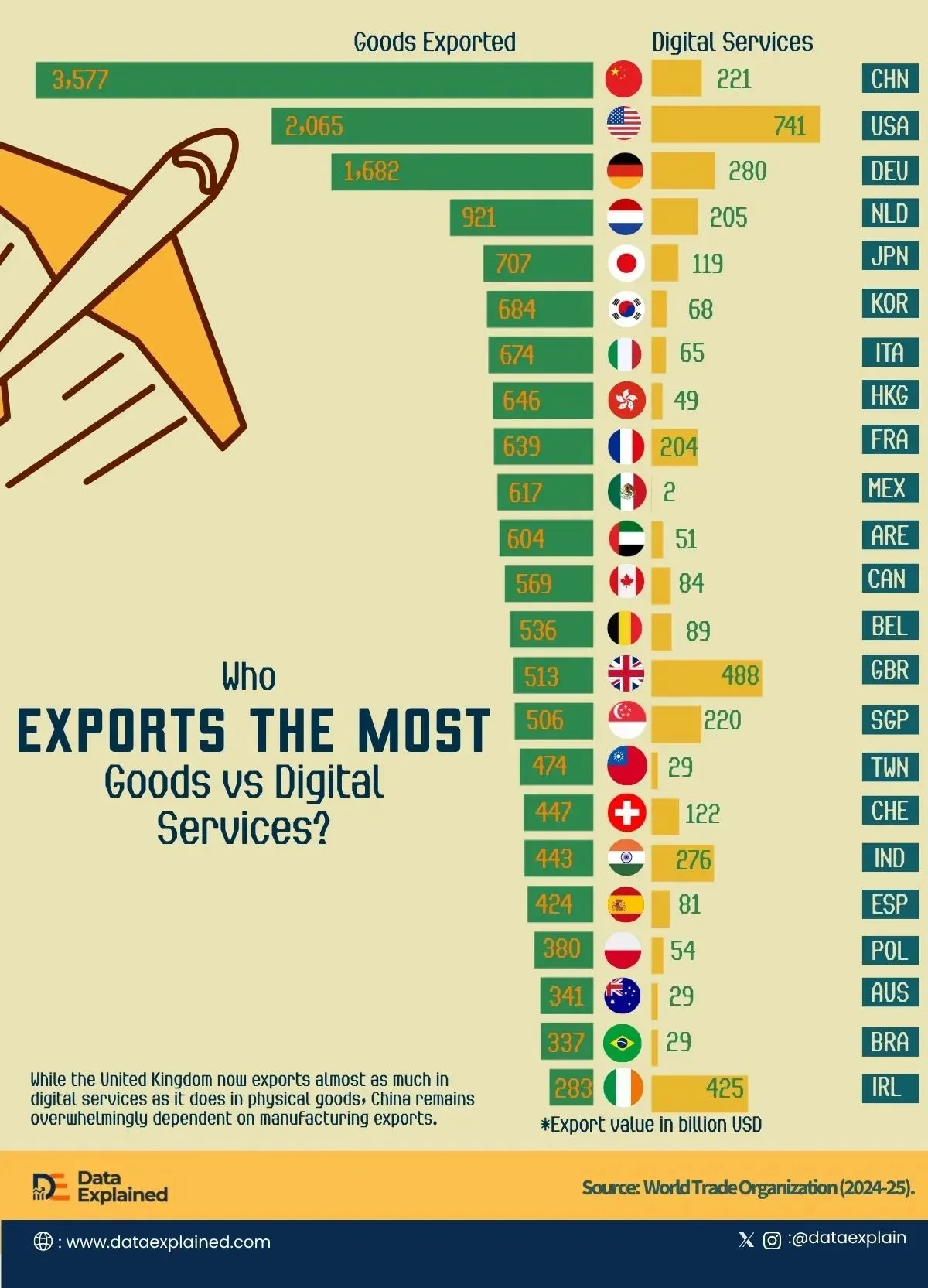
In today’s economy, global power is not just measured by factories or ships, but also by data, software, and digital platforms.
The visualization above reviews major economies by their goods and digital service export value.
It’s based on data from the World Trade Organization on merchandise and commercial services trade for 2024–2025.
While the United Kingdom now exports almost as much in digital services as it does in physical goods, China remains overwhelmingly dependent on manufacturing exports.
The contrast reveals how uneven the global shift toward digital trade has become.
ALSO READ: World’s Largest Exporters of Refined Petroleum
In 2024, the UK exported $513 billion worth of goods and $488 billion in digital services. Digital exports are now worth 95% as much as physical exports, an almost perfect parity that few major economies can match.
China presents the opposite picture. The world’s largest exporter shipped $3.58 trillion in goods, but only $221 billion in digital services. That means digital exports account for just 6% of the value of its goods exports.
The contrast reveals two very different paths to economic power.
Britain’s economy increasingly depends on “invisible exports”—financial services, software, intellectual property and professional services. China, despite its growing technology sector, still derives the overwhelming majority of its export strength from factories and global supply chains.
The numbers also show that the world’s biggest economies are not necessarily the biggest digital players.
The United States remains the undisputed leader, exporting $741 billion in digital services—more than any other country—alongside $2.07 trillion in goods. America has managed to dominate both worlds at the same time.