
Where Data Tells the Story
© Voronoi 2026. All rights reserved.

GLOBAL RESERVE REGIME SHIFT (1980–2026)
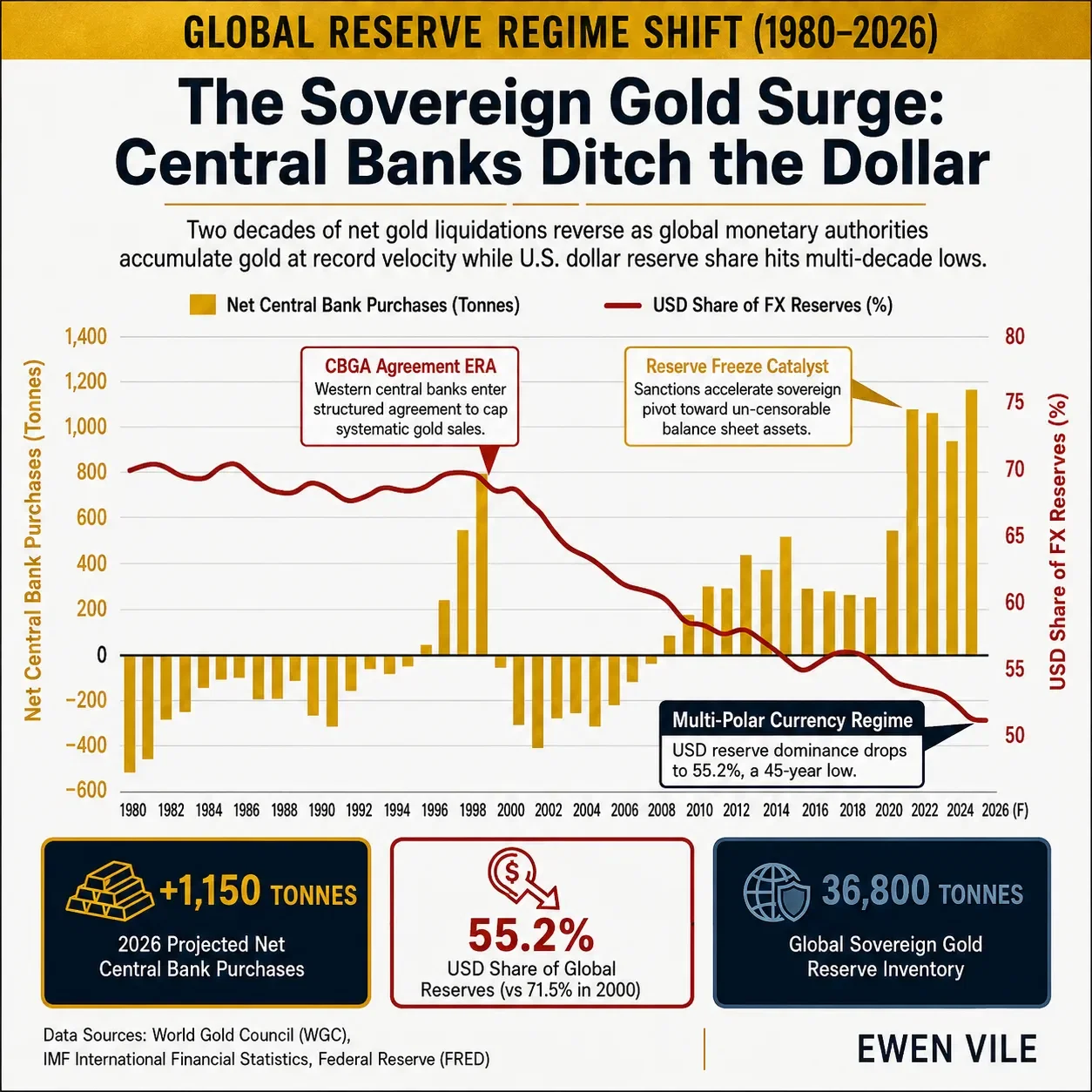
A fundamental restructuring of global reserve architecture is underway. For nearly thirty years following the collapse of the Bretton Woods system in 1971, central banks—predominantly in Western Europe and North America—were persistent net sellers of gold bullion. The prevailing consensus viewed sovereign gold as a non-yielding relic, culminating in the 1999 Central Bank Gold Agreement (CBGA) designed to cap orderly institutional gold dumps onto open markets.
That paradigm permanently inverted in the aftermath of the 2008–2009 Global Financial Crisis. Central bank behavior pivoted from net distribution to aggressive net accumulation, driven by emerging market monetary authorities seeking un-cencorable, counterparty-risk-free sovereign balance sheet protection.
The transition accelerated into a full structural regime shift in 2022 following the freezing of foreign-denominated sovereign assets. Global central bank net gold purchases exploded past 1,000 net tonnes annually in 2022–2024 and are projected to reach a record 1,150 net tonnes in 2026. Simultaneously, the U.S. dollar’s share of global foreign exchange reserves dropped from 71.5% in 2000 to a multi-decade low of 55.2% in 2026, marking the rise of a multi-polar sovereign reserve framework anchored in physical gold.