
Ranked: Inflation Forecasts Across G20 Economies
The global economic outlook in 2026 remains marred by multiple headwinds. Tariff disruptions, energy supply constraints following the disruption to the Strait of Hormuz, supply-chain pressures and a stronger El Niño are adding to the challenges confronting economies worldwide.
G20 economies are not insulated from these pressures. A combination of domestic price dynamics and external shocks continues to shape inflation trajectories, although the scale of price pressures varies considerably across countries.
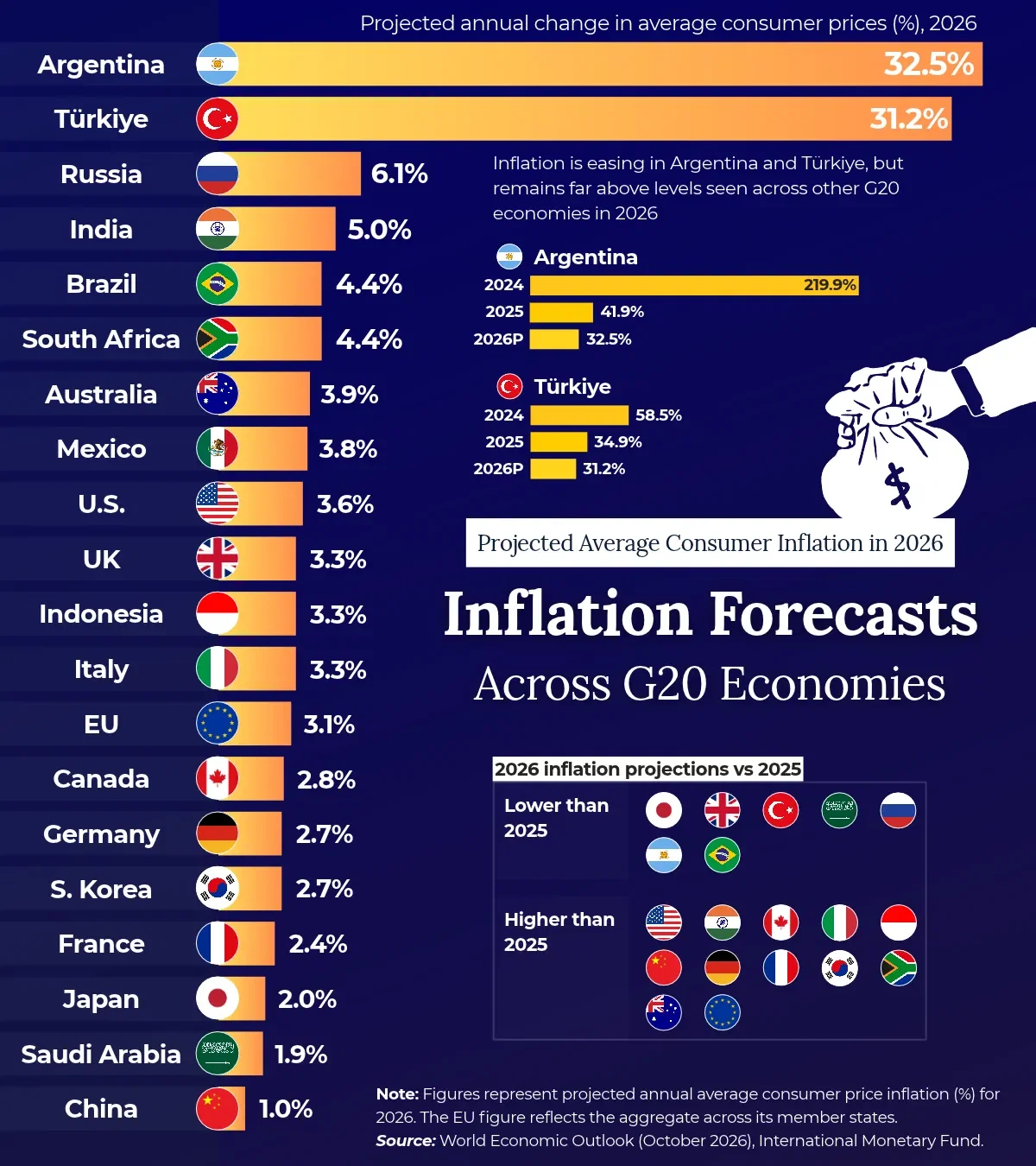
According to the International Monetary Fund's October 2026 World Economic Outlook, Argentina and Türkiye are projected to record the highest average annual consumer inflation in the G20 in 2026, at 32.5% and 31.2%, respectively. Both are expected to see inflation moderate from 2025, but remain significant outliers. Russia follows at 6.1%, while India is projected at 5%.
At the other end, China is forecast to record the lowest inflation at 1%, followed by Saudi Arabia at 1.9% and Japan at 2%. The divergence highlights how differently major economies are navigating the inflationary environment.
The chart ranks G20 economies by projected average annual consumer price inflation in 2026, measured as the annual percentage change, and compares whether inflation is expected to rise or ease relative to 2025.
Key Takeaways:
- Argentina and Türkiye remain inflation outliers: Despite easing from 41.9% and 34.9% in 2025, inflation is projected at 32.5% and 31.2%, respectively, in 2026.
- Inflation is rising across most economies: 12 of the 20 economies are projected to record higher average consumer inflation in 2026, while seven are expected to see moderation. Mexico is forecast to remain unchanged at 3.8%.
- India records the sharpest increase: Average inflation is projected to climb from 2.0% in 2025 to 5.0% in 2026, a rise of 3 percentage points.
- France and Italy see notable increases: Inflation in France is projected to rise from 0.9% to 2.4%, while Italy's nearly doubles from 1.6% to 3.1%.
- Russia sees the steepest moderation after the two inflation outliers: Inflation is projected to fall from 8.7% to 6.1%, while Brazil also sees a decline, from 5.0% to 4.4%.
- China sees modest inflation: China’s inflation rate is set to touch 1% after facing disinflationary pressure due to weak domestic demand and property-sector dragdown.
Note: Figures represent projected annual average consumer price inflation (%) for 2026. The EU figure reflects the aggregate across its member states.
Source: World Economic Outlook (October 2026), International Monetary Fund.
