
Where Data Tells the Story
© Voronoi 2026. All rights reserved.

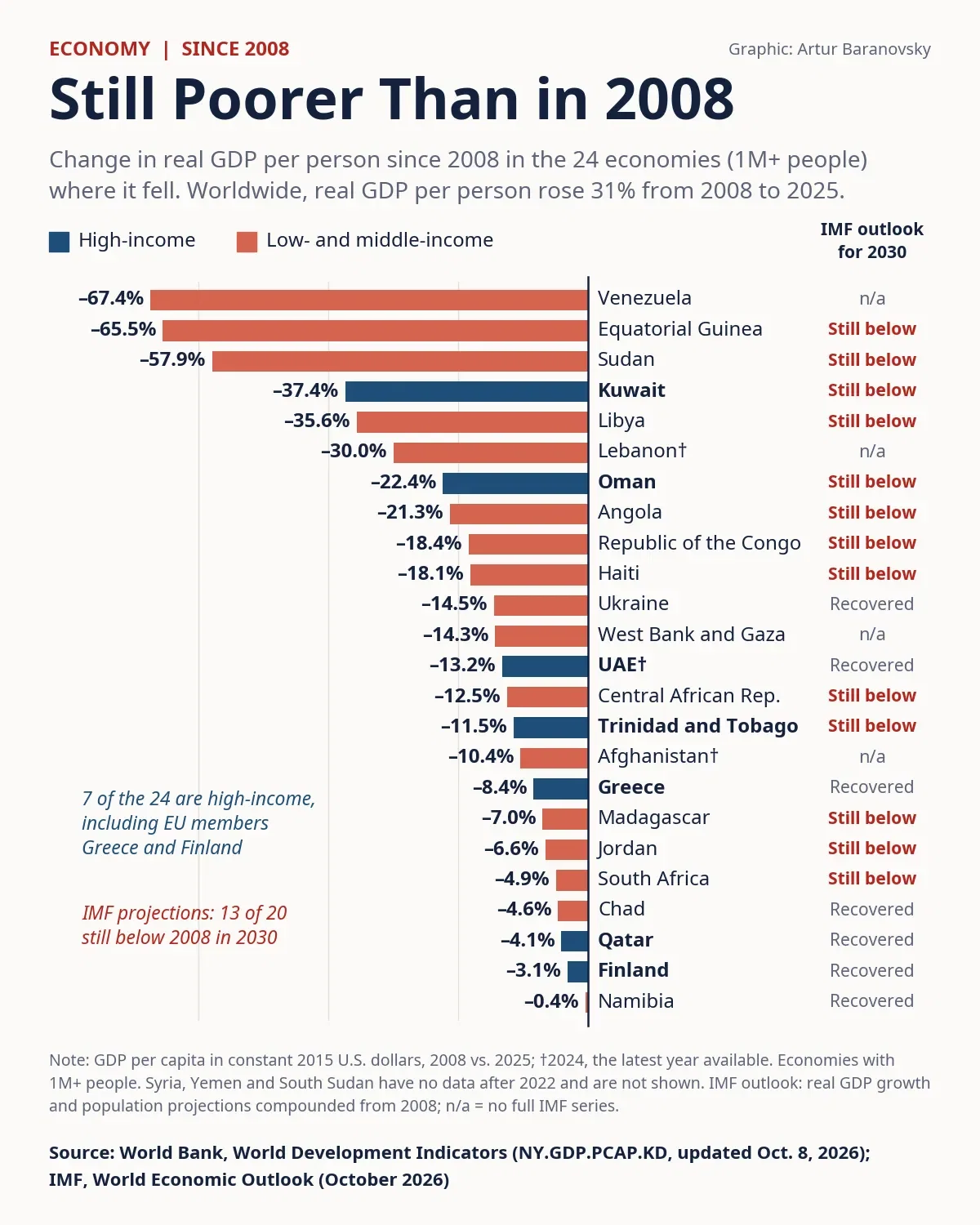
Seventeen years after the global financial crisis, 24 economies with at least 1 million people still produce less per person than they did in 2008. They are home to about 420 million people, or 5.1% of the world's population.
This graphic, created by Artur Baranovsky, ranks them by the change in real GDP per capita, using World Bank data through 2025 (2024 where 2025 is not yet available). The right-hand column adds the outlook from the IMF's October 2026 World Economic Outlook, released Oct. 13.
Key Takeaways
Economic collapse in Venezuela and Lebanon and conflict in Sudan and Libya account for several of the deepest declines. Oil exporters such as Equatorial Guinea and Angola also sit near the top.
Seven of the 24 are high-income. Kuwait (–37.4%) and Oman (–22.4%) saw their populations grow 83% and 109%, so output per person fell even as their economies expanded. The UAE (–13.2%, 2024 data), whose population rose 74%, follows the same pattern. In Europe, Greece is 8.4% below its 2008 level and Finland 3.1% below.
The outlook uses IMF data. Ukraine shows as recovered because the IMF projects its 2030 population to be 27% smaller than in 2008, while total output stays about 22% lower.