
Where Data Tells the Story
© Voronoi 2026. All rights reserved.

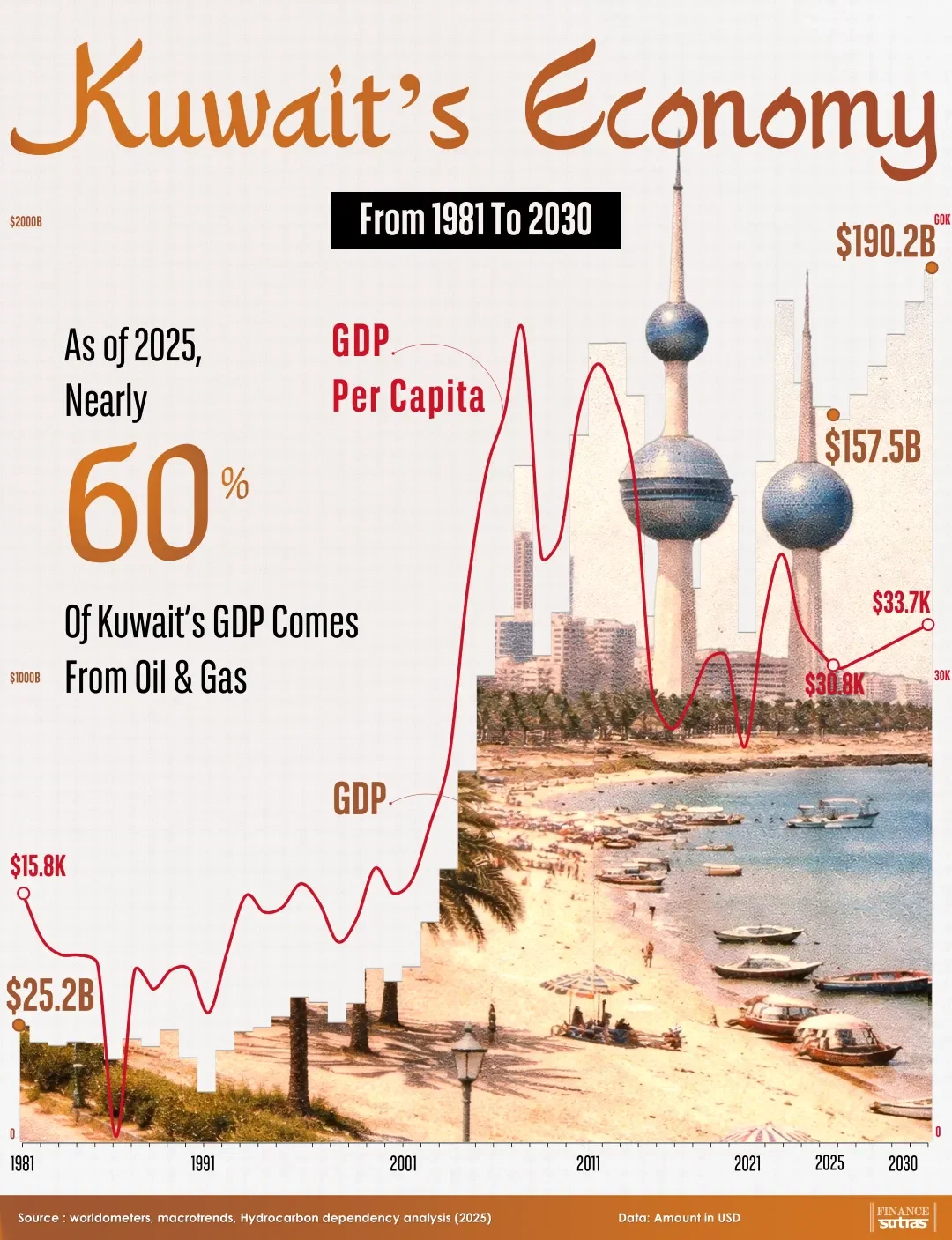
Since 1981, Kuwait’s economy has followed one dominant variable:
Oil.
As of 2025, nearly 60% of GDP comes from Oil & Gas.
That concentration explains the volatility:
📉 Early 80s oil crash
📉 Gulf War disruption
📉 2008 global crisis
📉 2020 pandemic oil shock
And yet—
📈 GDP: $25B (1981) → $190B+ (2030 est.)
📈 Per Capita Income: $15.8K → $33.7K
This is the paradox of hydrocarbon economies:
Extreme cyclicality.
But structurally high income levels.
When oil rises → fiscal surplus expands → spending accelerates.
When oil falls → deficits widen → growth compresses.
Unlike diversified economies, Kuwait’s growth curve mirrors the oil price chart.
The key macro question:
Can sovereign wealth, fiscal reform, and non-oil expansion reduce that 60% dependency before global energy demand peaks?
Because long-term stability isn’t about revenue size.
It’s about revenue mix.
Is Kuwait positioned for structural diversification… or prolonged energy dependence?