
Where Data Tells the Story
© Voronoi 2026. All rights reserved.

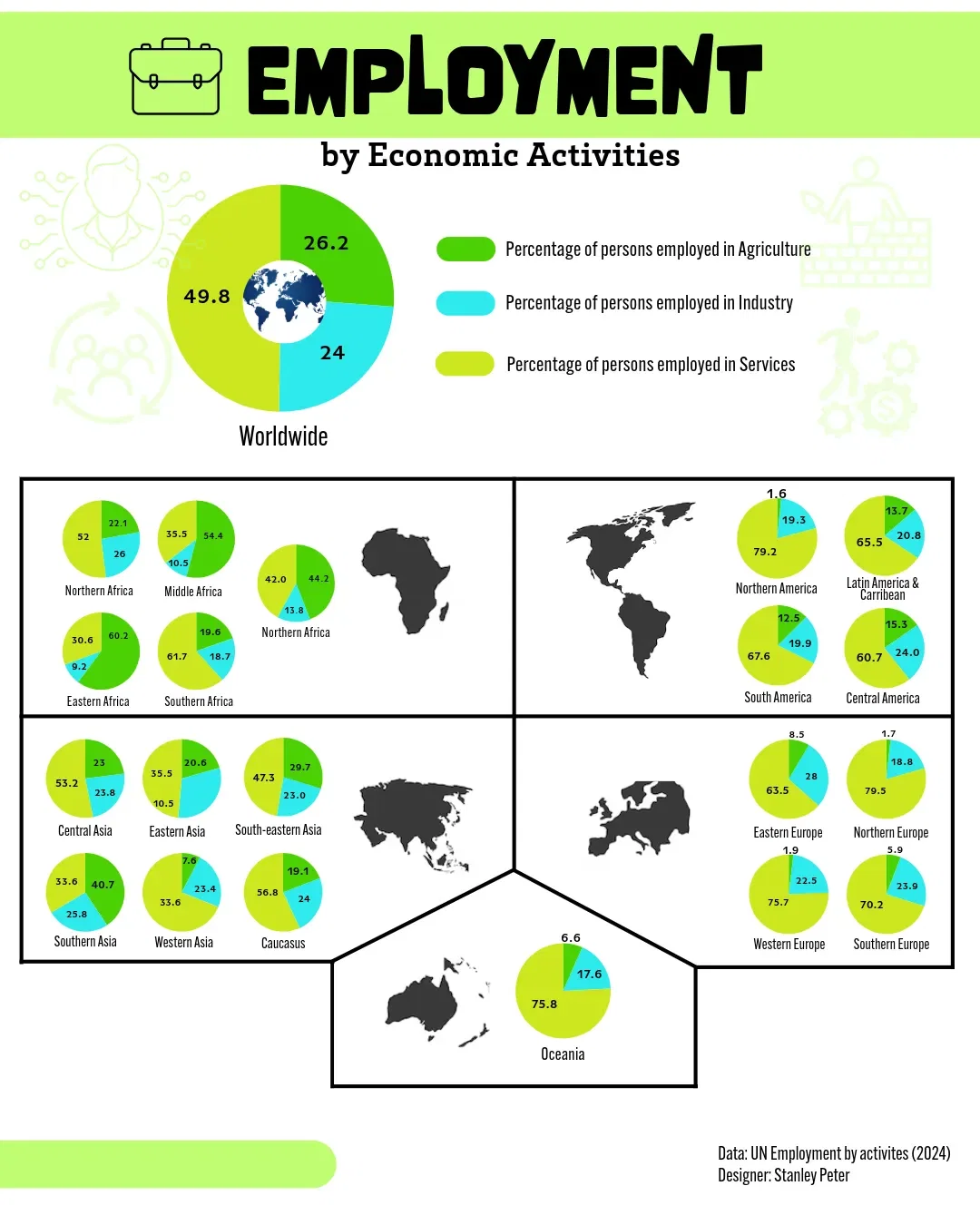
Work is at the heart of every society. The way people earn their living—whether through farming, factories, or services—tells us a lot about their culture, history, and stage of economic development. Imagine lining up a farmer in Eastern Africa, a factory worker in Northern Africa, and a software engineer in Europe. Even though they live on the same planet, their economic worlds look very different. This is exactly what the dataset on Employment by Economic Activity helps us understand.
The file breaks down employment across three major sectors: Agriculture, Industry, and Services. Each region or subregion of the world shows a unique mix of these three. Some areas are still heavily dependent on farming, others are more industrial, while the most advanced economies are dominated by services like banking, healthcare, and IT.
In this essay, we’ll walk through what each sector means, analyze the dataset in detail, explore regional differences, and reflect on what this tells us about development, inequality, and the future of work.
Before diving into the numbers, it’s important to understand what “economic activity” means in this context. Economists usually divide work into three broad categories:
This includes farming, fishing, forestry, and related activities. Historically, almost everyone in the world worked in agriculture—growing food to survive. Even today, in many parts of Africa and Asia, a large share of people are employed in this sector. However, agricultural jobs often mean low income, low productivity, and vulnerability to weather and climate change.
Industry refers to manufacturing, construction, mining, and energy production. The industrial revolution in the 18th and 19th centuries shifted millions of workers from farms to factories. Industry is associated with rising productivity, urbanization, and economic transformation. Countries like China, South Korea, and Germany owe much of their growth to a strong industrial base.
The service sector is broad. It includes everything from teachers, doctors, and bank employees to IT specialists, hotel staff, and Uber drivers. In advanced economies, services dominate employment because agriculture and industry become increasingly efficient and need fewer workers. Services also tend to pay better and create more diverse career opportunities.
So, when we look at the dataset, we’re essentially looking at where people are in this economic journey—are they still largely farming, have they industrialized, or are they mainly service-oriented?
The dataset covers 22 regions and subregions, listing the percentage of workers in agriculture, industry, and services. Here’s a simplified snapshot from some entries:
These numbers already reveal something powerful: Africa as a continent is still agriculture-heavy, but within Africa, regions like the north are already transitioning toward services, while the east remains mostly dependent on farming.
Now, let’s explore these trends in detail.
The story of employment by sector is also the story of economic development.