
Where Data Tells the Story
© Voronoi 2026. All rights reserved.

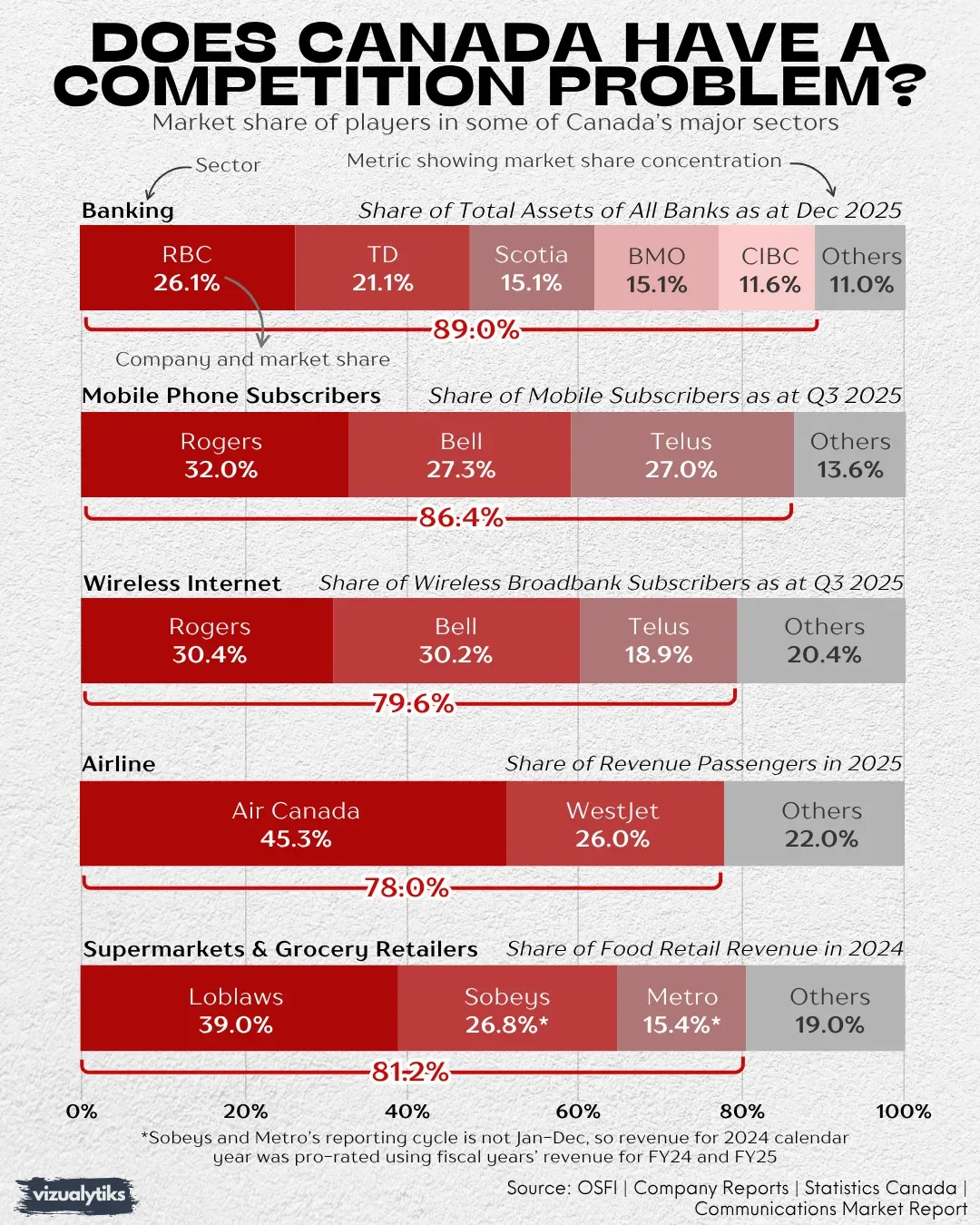
Many of Canada’s largest industries are dominated by a handful of players. In banking, the Big Five control about 89% of total banking assets, while the telecom sector shows similar concentration with Rogers, Bell, and Telus accounting for more than 86% of mobile subscribers and 80% of wireless broadband subscribers, respectively. 78% of airline passengers are controlled by the top 2 players while the top 3 control 81% of grocery retail revenue.
From the lens of Porter’s Five Forces (factors that analyze the how competitive an industry is including competitive rivalry within the industry, threat of new entrants, bargaining power of suppliers, bargaining power of customers and the threat of substitute products or services), this structure reflects high barriers to entry and limited competitive rivalry. Capital-intensive infrastructure, strict regulatory requirements, and economies of scale make it difficult for new entrants to challenge incumbents in sectors like banking, telecommunications, and aviation. At the same time, supplier and infrastructure control such as telecom networks or airport access can reinforce the dominant position of existing firms.
The result is a market environment where competition exists but is often concentrated heavily among a small group of players. While this structure can create stability and scale, it also raises ongoing debates about pricing power, consumer choice, and the role of policy in fostering stronger competition in Canada’s economy.