
Where Data Tells the Story
© Voronoi 2026. All rights reserved.

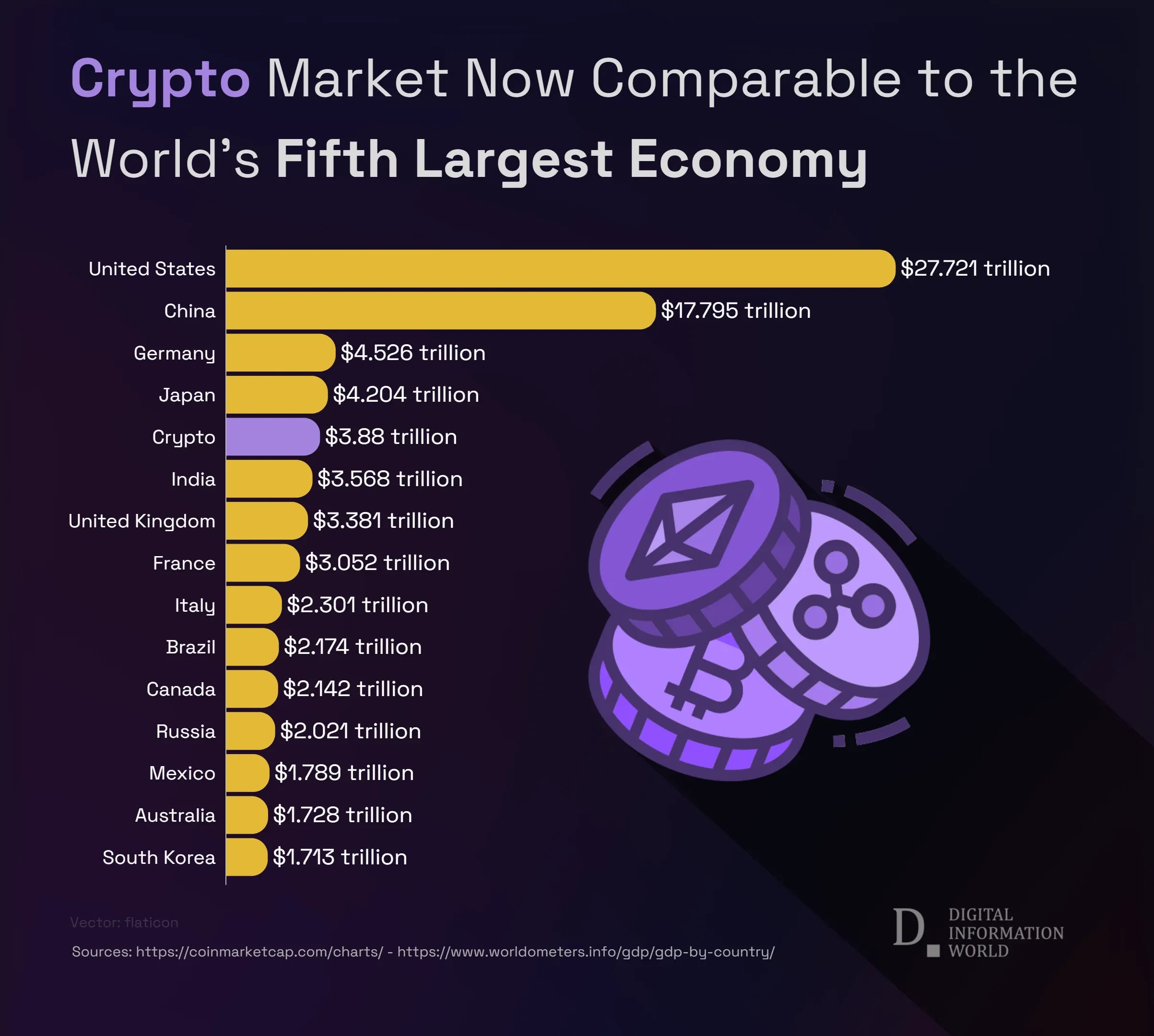
The value of cryptocurrencies has climbed to levels that place the sector within the rankings of national economies. Combined estimates show coins and tokens now worth about 3.88 trillion dollars, which positions digital assets above India in size and just short of Germany and Japan. What began as a small experiment in online finance has become large enough to be compared with the output of entire countries.
Growth has been particularly sharp over recent years. Compared with 2023, the market is nearly three times higher, while in the past twelve months alone its size has more than doubled. Measured against 2020, the total value has expanded almost tenfold, a rise that underscores how quickly this sector has moved from the margins into the center of financial discussion.
Placed alongside national economies, the comparison is striking. Digital assets now measure around 80 percent higher than the production of Italy, Brazil, Canada, or Russia. They are more than twice the scale of South Korea, Spain, and Australia, and several times larger than Switzerland or Poland. This puts cryptocurrencies among the ranks of middle to upper-tier economies.
In relation to stock markets, the picture is different. At current levels, crypto stands ahead of exchanges in London and Toronto, yet remains far smaller than the New York Stock Exchange, which exceeds 25 trillion dollars. The sector therefore sits in an unusual space, larger than many national bourses but still far behind the world’s biggest trading platforms.
Despite the headline figures, the industry remains uneven in structure. Out of more than nine thousand tokens in circulation, only the top ten account for more than ninety percent of total value. The vast majority trade for less than a single dollar, while only a few reach prices in the hundreds or thousands. This concentration leaves most of the influence in the hands of a small group of leading currencies.
The first half of 2025 has shown both resilience and vulnerability. Regulatory frameworks are taking shape, institutional investors are stepping in, and volatility continues to dominate price movements. Together these factors leave cryptocurrencies operating at a global scale while still carrying the uncertainty of a market in transition.