
Where Data Tells the Story
© Voronoi 2026. All rights reserved.

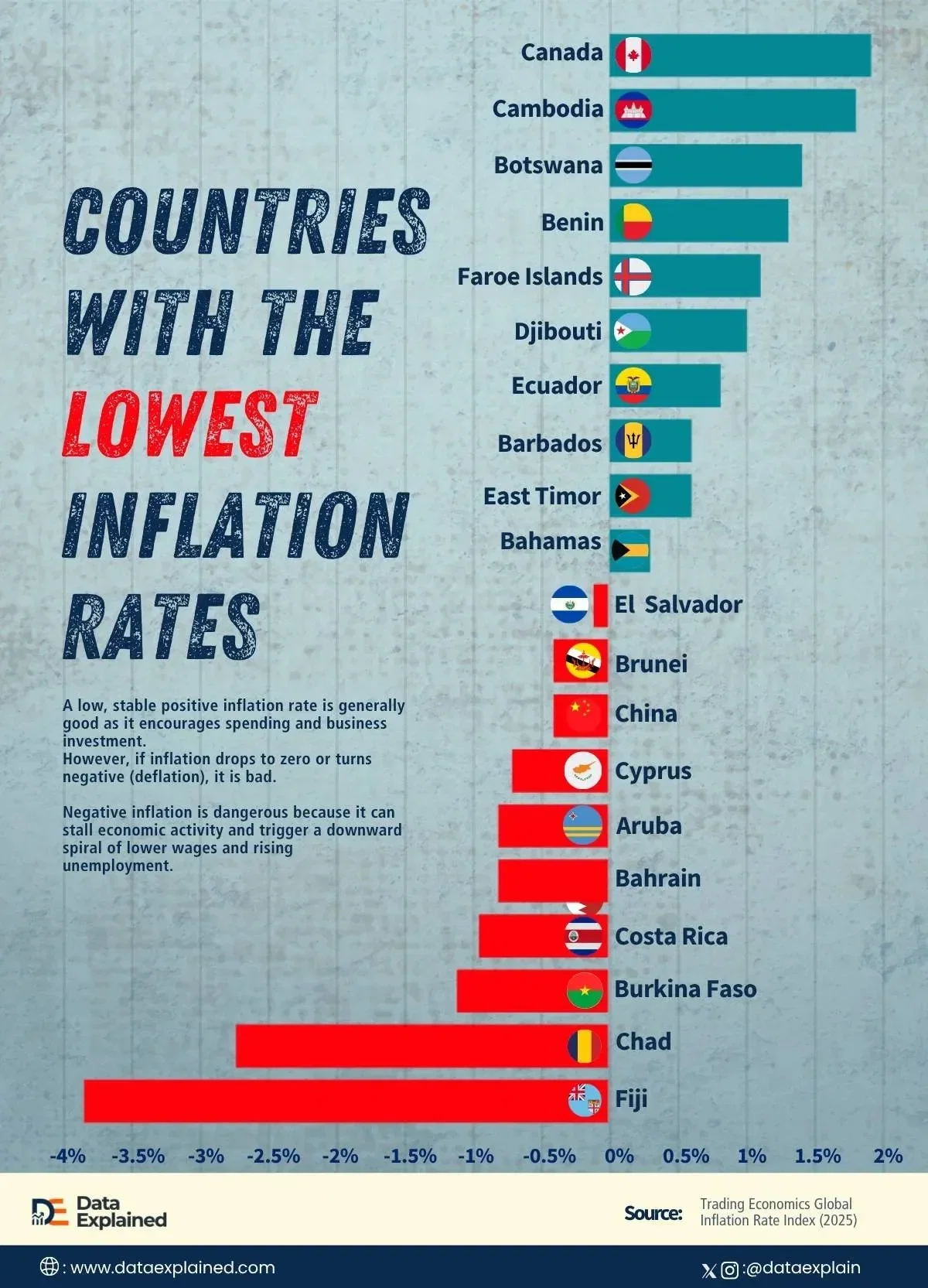
Inflation means a general increase in the prices of goods and services over time, which also causes a loss of purchasing power.
Data from Trading Economics, which tracks inflation rates worldwide, reveals that Europe is home to most countries where prices for goods and services are not rising rapidly.
As of the second half of 2025, countries such as Canada have an inflation rate of 1.9%, which is among the lowest in the world.
Technically, this should mean a stable and predictable economic environment. However, there’s more than meets the eye.
Low inflation often reflects a mix of strong monetary discipline, stable exchange rates, and efficient supply chains.
According to the IMF’s 2025 Global Outlook, economies with credible central banks and transparent policy communication, such as Switzerland and Denmark, maintain price stability by adjusting interest rates early and avoiding excessive fiscal expansion.
Currency strength also plays a significant role.
Nations with resilient currencies, such as the Swiss franc and the Singapore dollar, experience less imported inflation because their currencies retain their purchasing power against the dollar and the euro.
The World Bank notes that exchange rate stability shields consumers from volatile global commodity prices, particularly those of energy and food.