
Where Data Tells the Story
© Voronoi 2026. All rights reserved.

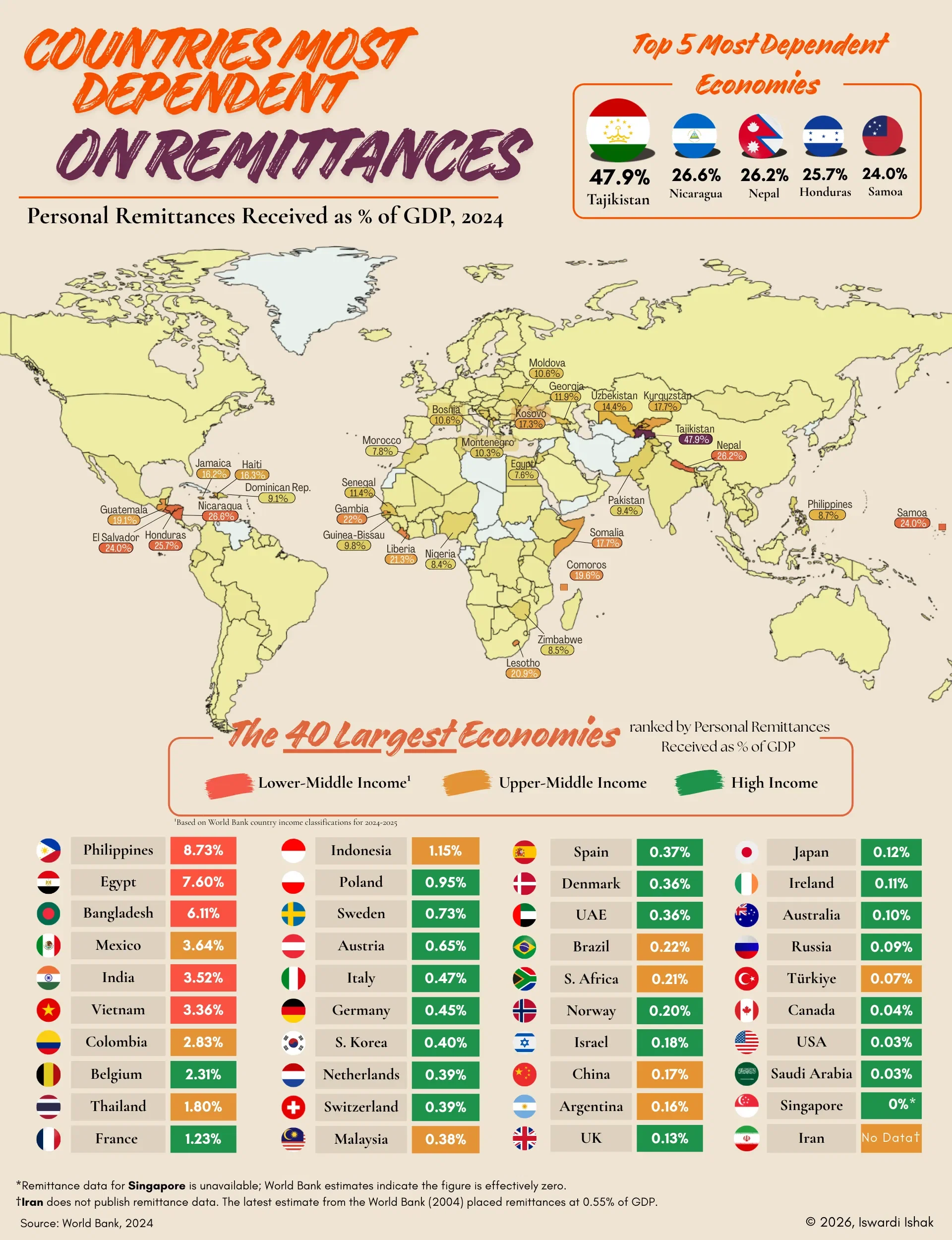
Remittances remain a vital economic lifeline for many developing economies, in some cases rivaling exports or foreign investment as a source of national income. In several smaller and lower-income countries, money sent home by migrant workers accounts for a striking share of economic output.
Nowhere is this reliance more pronounced than in Tajikistan, where remittances amounted to roughly 48% of GDP in 2024. Much of this money flows from Tajik workers employed abroad, particularly in Russia. Similar dependence can be seen in Nicaragua and Nepal, where remittances account for over a quarter of national output, as well as in Honduras and Samoa.
The pattern reflects a broader reality of global labour mobility. Workers from poorer economies often migrate to richer ones, sending a portion of their earnings back to support families and communities. In many cases these transfers exceed foreign aid and help stabilise domestic consumption during economic downturns.
Yet heavy reliance on remittances also carries risks. Economies that depend heavily on income earned abroad can be vulnerable to downturns in host countries or changes in migration policy. Even so, for millions of households across the developing world, the steady flow of money from relatives overseas remains an indispensable pillar of economic life.