
Where Data Tells the Story
© Voronoi 2026. All rights reserved.

The Society for Worldwide Interbank Financial Telecommunication (SWIFT) has become a cornerstone of global financial communications, connecting more than 11,500 institutions across over 200 countries and territories. Founded in 1973 as a cooperative to replace the telex system, SWIFT provides the messaging infrastructure that banks use to exchange payment instructions across borders.
Its central role in international finance has also given the network geopolitical significance. Following Russia’s invasion of Ukraine in 2022, the EU disconnected designated Russian banks from SWIFT as part of a wider sanctions package. Iranian banks had also been disconnected under EU sanctions in 2012. These measures highlighted how access to global financial infrastructure can become an instrument of economic pressure.
Efforts to diversify cross-border payment systems have gained traction amid calls to reduce reliance on Western financial infrastructure and the U.S. dollar. Initiatives such as BRICS Pay seek to facilitate cross-border transactions and the use of national currencies, although they do not yet constitute a comprehensive replacement for SWIFT.
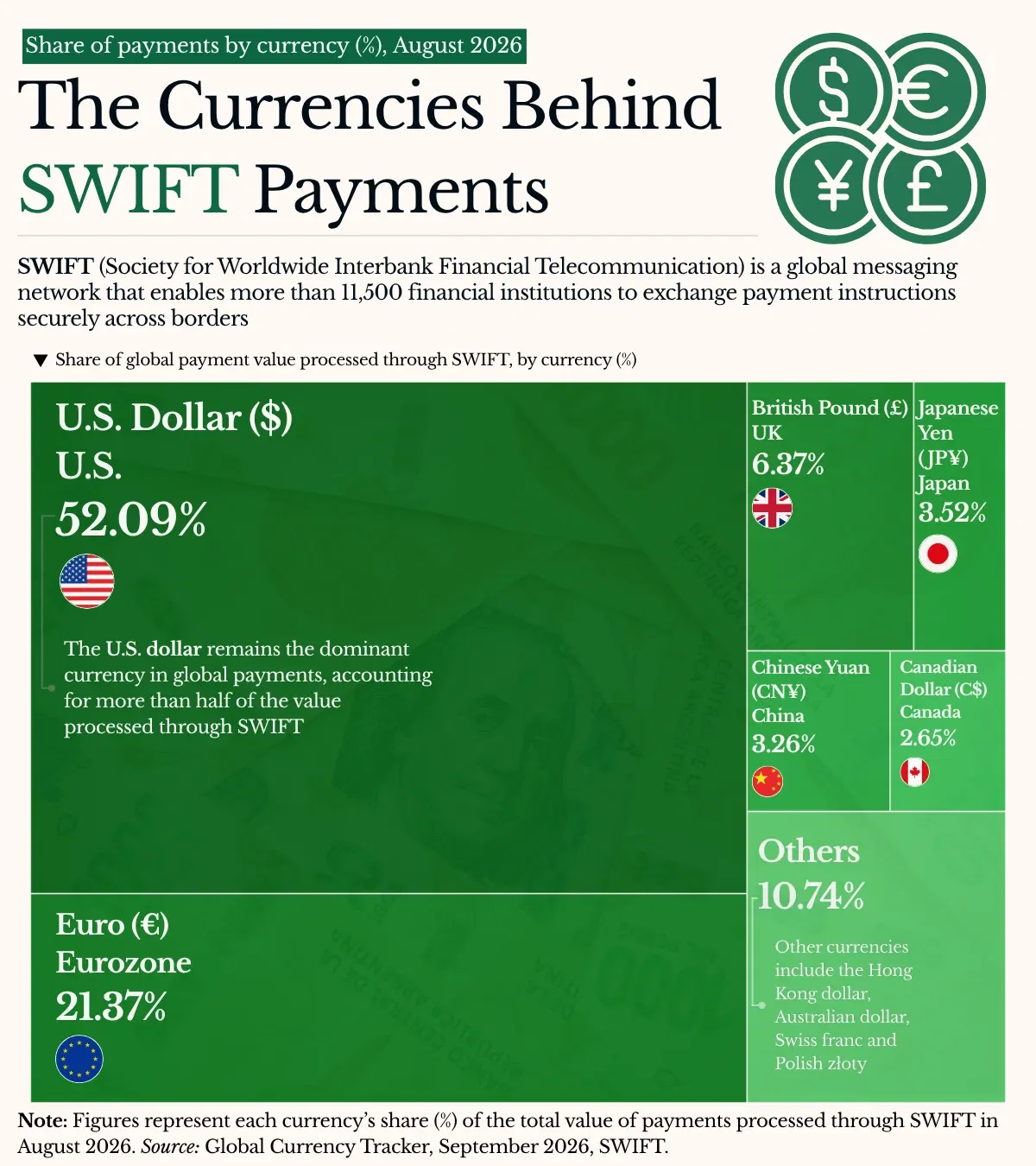
Yet reducing the dollar’s dominance in international payments remains a formidable challenge. SWIFT’s Global Currency Tracker shows that the U.S. dollar accounted for 52.09% of global payment value processed through its network in August 2026, far ahead of the euro at 21.37%.
This chart shows the share of global payment value processed through SWIFT by currency in August 2026.
Note: Figures represent each currency’s share (%) of the total value of payments processed through SWIFT in August 2026. Source: Global Currency Tracker, September 2026, SWIFT.
Access data here: https://www.swift.com/sites/default/files/files/global-currency-tracker_september-2026.pdf