
Where Data Tells the Story
© Voronoi 2026. All rights reserved.

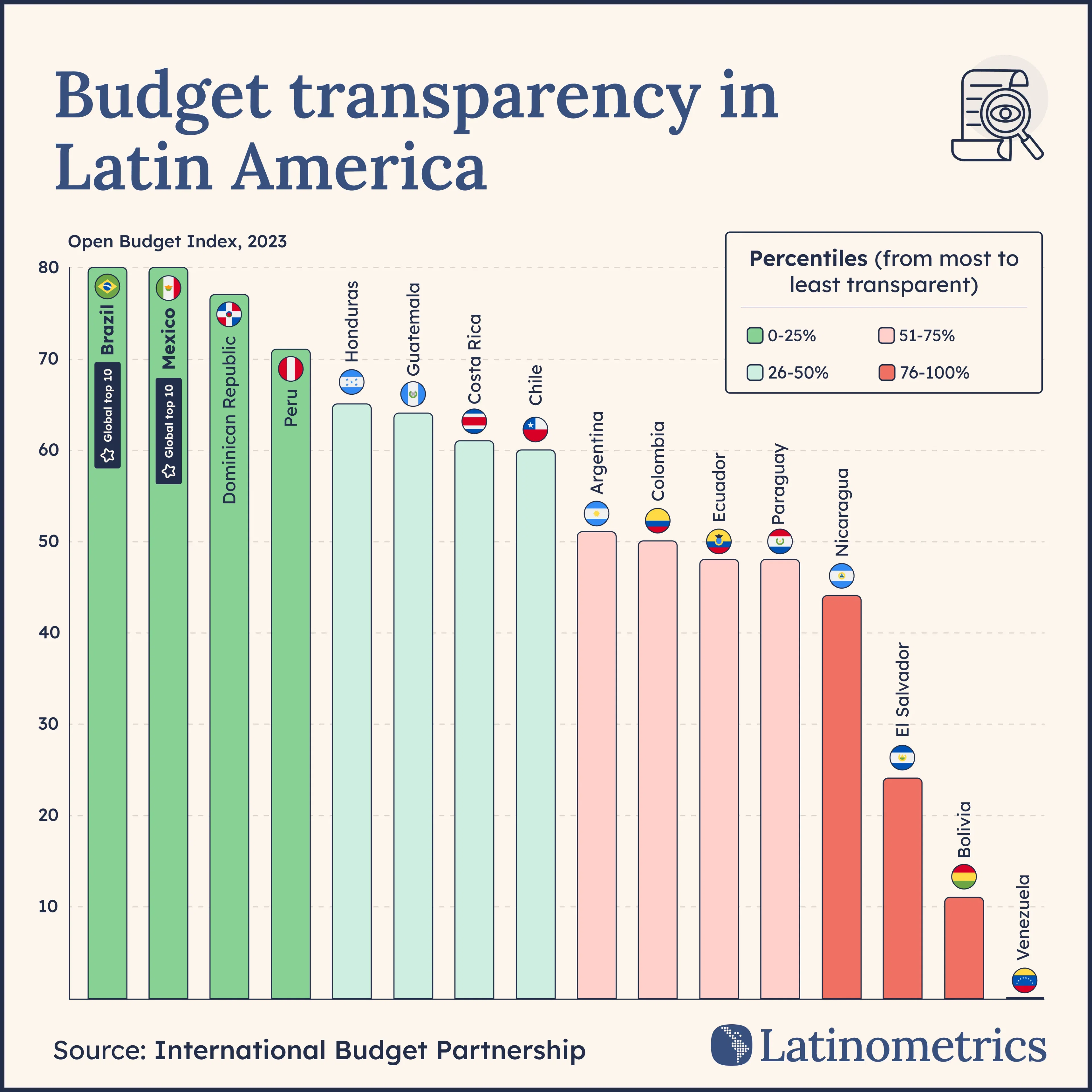
🔍💡 Ever wondered why some Latin American countries hide their budgets while others showcase every penny spent? Let's explore ↓
Let's talk about one of Latinometrics' favorite values the human race has ever come up with: transparency.
The term literally describes a physical property that allows light to pass through materials, enabling clear visibility. Starting with the Enlightenment, this term developed into a societal aspiration.
"Secrecy, being an instrument of conspiracy, ought never to be the system of a regular government."
— Jeremy Bentham, late 18th century.
Although English philosopher Bentham used the term "publicity" for similar ideals, he is known as the grandfather of modern transparency and also for the more controversial notion of utilitarianism.
The push for modern open governance started in the West, but much before then, ancient Eastern wisdom promoted similar ideas through inner moral development or spirituality. Their focus was on the leader's character as a source of natural transparency.
"Sincerity and truth are the basis of every virtue."
— Confucius (551-479 BCE)
So, where are we today? Latinometrics would not exist without a key byproduct of transparency ideals: access to free and public data.
Among countless worldwide initiatives to promote transparency, there's our chart's source today, the International Budget Partnership (IBP). Founded in 1997 in Washington, DC, with the goal of promoting access to government budget information and enabling public engagement in the process.
Mirroring Bentham's belief that "publicity" prevents evil, IBP created systematic tools to force disclosure through measurement. Their Open Budget Survey, first launched in 2006, evaluates 125 countries using 240+ standardized questions.
And what does the 2023 survey tell us about our region?
Latin America has quite the range. First, the incredibly impressive news: Brazil and Mexico tied for 6th place in 2023's Survey.
Brazil demonstrates the payoff of a two-decade push, which began when President Lula gave his anti-corruption chief, Jorge Hage, a clear mandate: publish all federal spending online. Hage's 2004 Transparency Portal still attracts 900K visitors per month and has survived four presidents and one impeachment.
Mexico's score is the product of an unlikely marriage between reformist technocrats and watchdog NGOs that in 2011 built the Budget Transparency Portal and later hard-wired audit data into public dashboards. But a 2025 legal overhaul now threatens to shutter the independent information authority (INAI) and even scrap CompraNet, the procurement window—proof that openness is never a finished job.
story continues... 💌