
Where Data Tells the Story
© Voronoi 2026. All rights reserved.

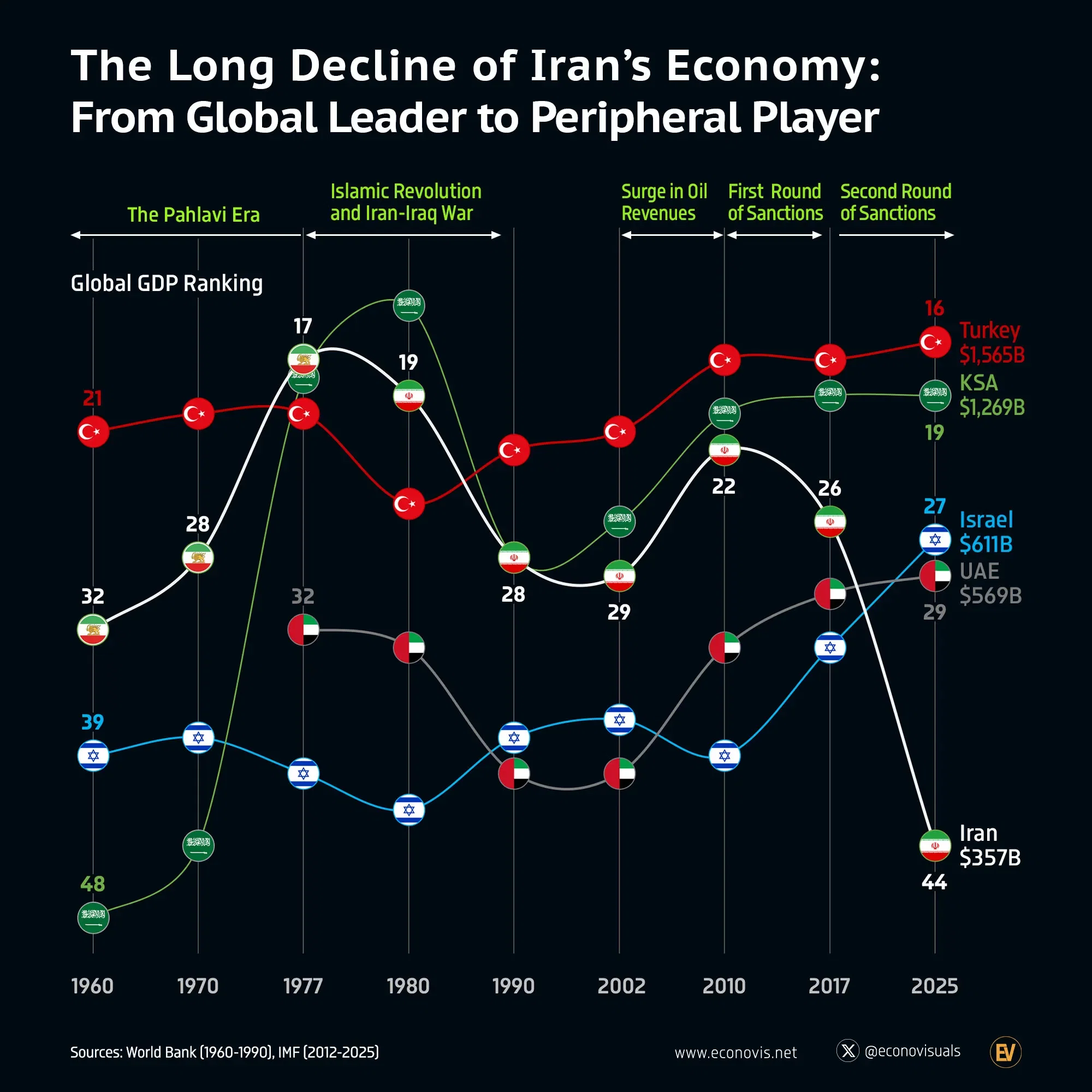
Iran ranked as the world’s 17th-largest economy in 1977—one year before the Islamic Revolution—following rapid economic expansion averaging 10.8% annually between 1960 and 1976. At the time, Iran’s economy was larger than those of Saudi Arabia (18th), Turkey (20th), the United Arab Emirates (32nd), and Israel (40th).
In the aftermath of the Islamic Revolution and during the eight-year Iran–Iraq War, Iran’s economy contracted sharply. As a result, Iran fell to 28th place globally by the late 1980s, slipping behind Turkey.
A surge in oil revenues temporarily improved Iran’s global ranking from 29th in 2002 to 22nd in 2010. However, the imposition of severe U.S. and international sanctions reversed these gains. The first round of sanctions pushed Iran’s economy down to 26th place by 2017, while the second round contributed to a further collapse to 44th place globally by 2025—after Turkey (16th), Saudi Arabia (19th), Israel (27th), and the United Arab Emirates (29th). During the sanctions period, Iran’s economy recorded weak average annual growth of just 1.6% between 2011 and 2025.
The prolonged decline reflects a combination of international sanctions, persistent political tensions, economic mismanagement, corruption, and the fiscal burden of regional proxy conflicts, all of which weighed heavily on economic performance from 2012 to 2025.