
Where Data Tells the Story
© Voronoi 2026. All rights reserved.

The web is changing fast.
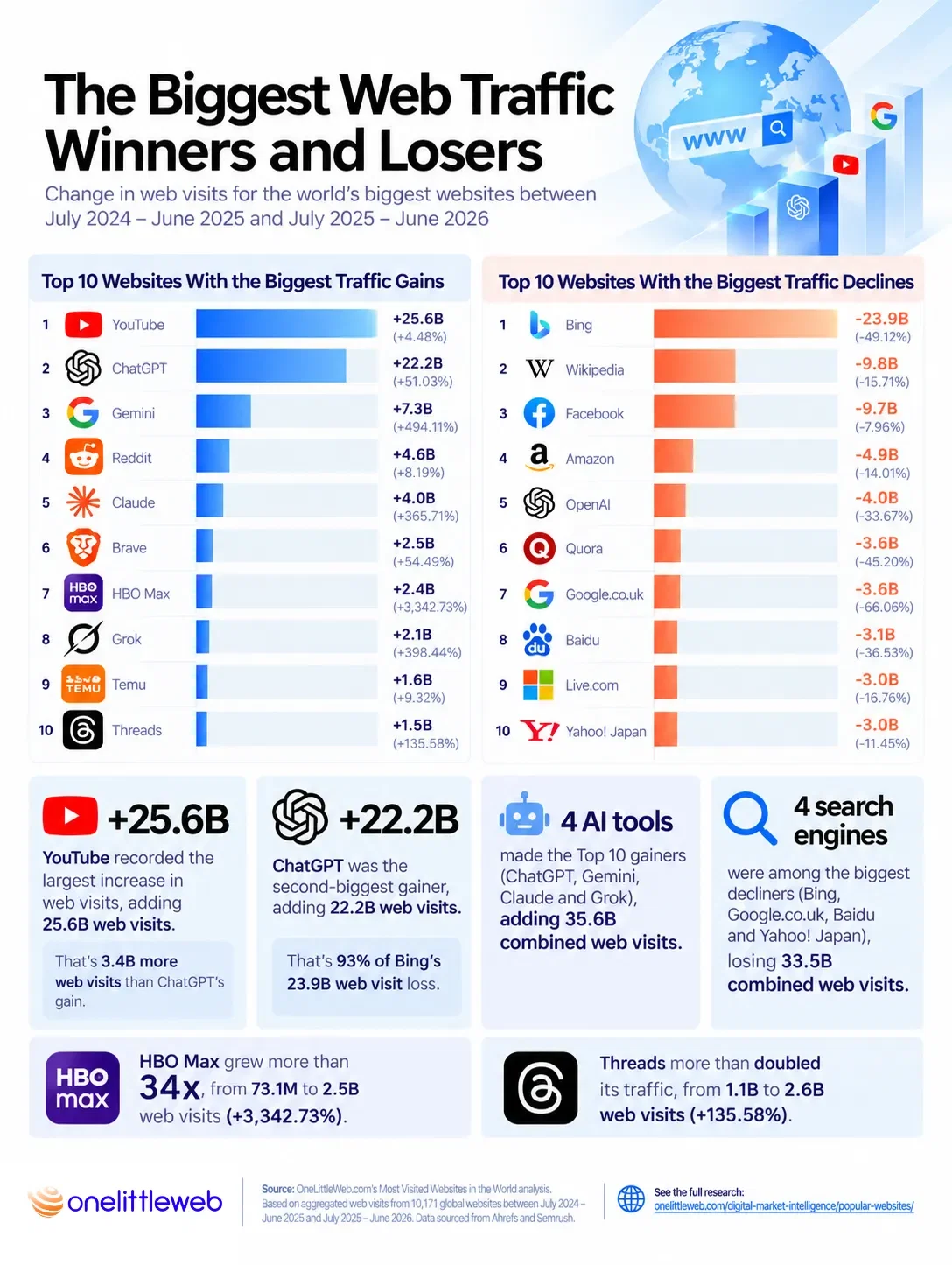
We analyzed 10,171 of the world's biggest websites and compared their web visits between July 2024–June 2025 and July 2025–June 2026.
The biggest gains were striking.
YouTube added 25.6B web visits, the largest increase among the websites we tracked.
ChatGPT added another 22.2B, followed by Gemini at +7.3B.
Four AI tools made the Top 10 gainers:
ChatGPT, Gemini, Claude and Grok
Together, they added 35.6B web visits.
But the other side of the list tells a very different story.
Bing lost 23.9B web visits, the largest decline in the dataset.
Wikipedia and Facebook each lost roughly 9.8B and 9.7B visits, while Amazon lost 4.9B.
Search engines appeared four times among the biggest decliners:
Bing, Google.co.uk, Baidu and Yahoo Japan
Together, they lost 33.5B web visits.
One comparison stands out:
ChatGPT gained 22.2B visits.
Bing lost 23.9B.
That's a difference of just 1.7B visits.
The data doesn't establish that traffic moved directly from Bing to ChatGPT. It simply shows how large these changes were over the same period.
There's another interesting shift within OpenAI's domains.
ChatGPT gained 22.2B visits, while OpenAI.com lost 4.0B.
These are separate domains in our dataset, so this shouldn't be interpreted as a direct transfer of traffic.
The broader picture is clear:
Some of the internet's biggest platforms are gaining billions of visits while others are losing them at a similar scale.
AI platforms are gaining substantial attention.
Search engines are showing some of the largest declines.
Social media, information, commerce and other categories are moving in different directions.
This infographic breaks down the 10 biggest traffic gainers and 10 biggest decliners across the world's largest websites.