
Where Data Tells the Story
© Voronoi 2026. All rights reserved.

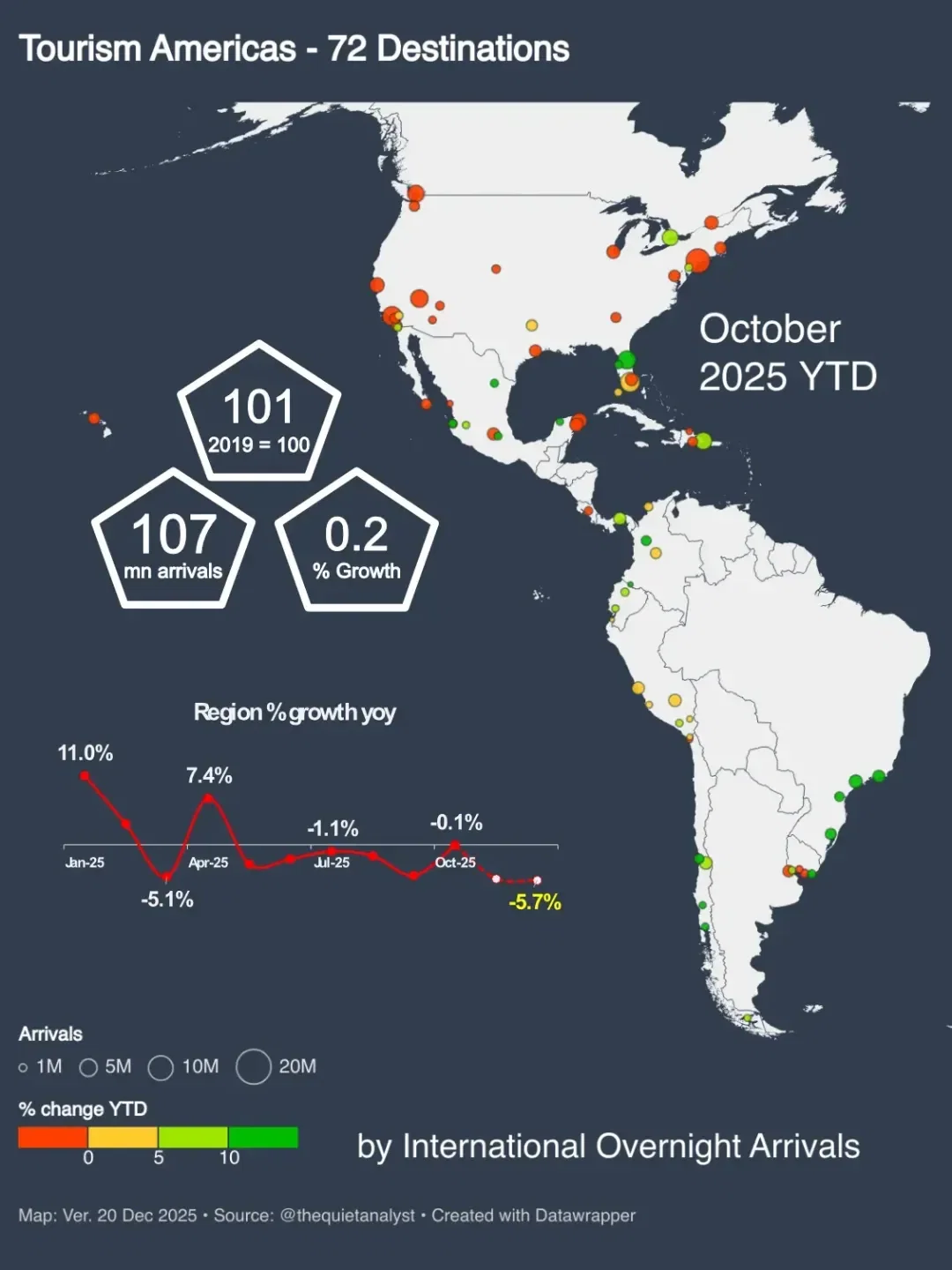
At an aggregate level, international overnight arrivals across the Americas through October 2025 appear broadly stable year-on-year. The region collectively received 107 million international overnight arrivals, representing virtually no growth (+0.2%) compared with the same period last year and sitting just 1.1% above 2019 levels.
This headline stability masks widening divergence driven less by recovery dynamics and more by differences in exposure to U.S. outbound travel.
Unlike earlier post-pandemic years, 2025 performance is no longer shaped by reopening effects, pent-up demand, or base distortions. Instead, outcomes increasingly reflect structural differences in demand exposure and market maturity:
For the full report and an interactive map please visit:
https://thequietanalyst.substack.com/p/americas-tourism-2025-ytd-when-the
Note: An additional seven Americas destinations are currently available only at the annual level and will be incorporated in the full-year report to be published between March and June 2026.
U.S. Cities: Scale Retained, Momentum Weak
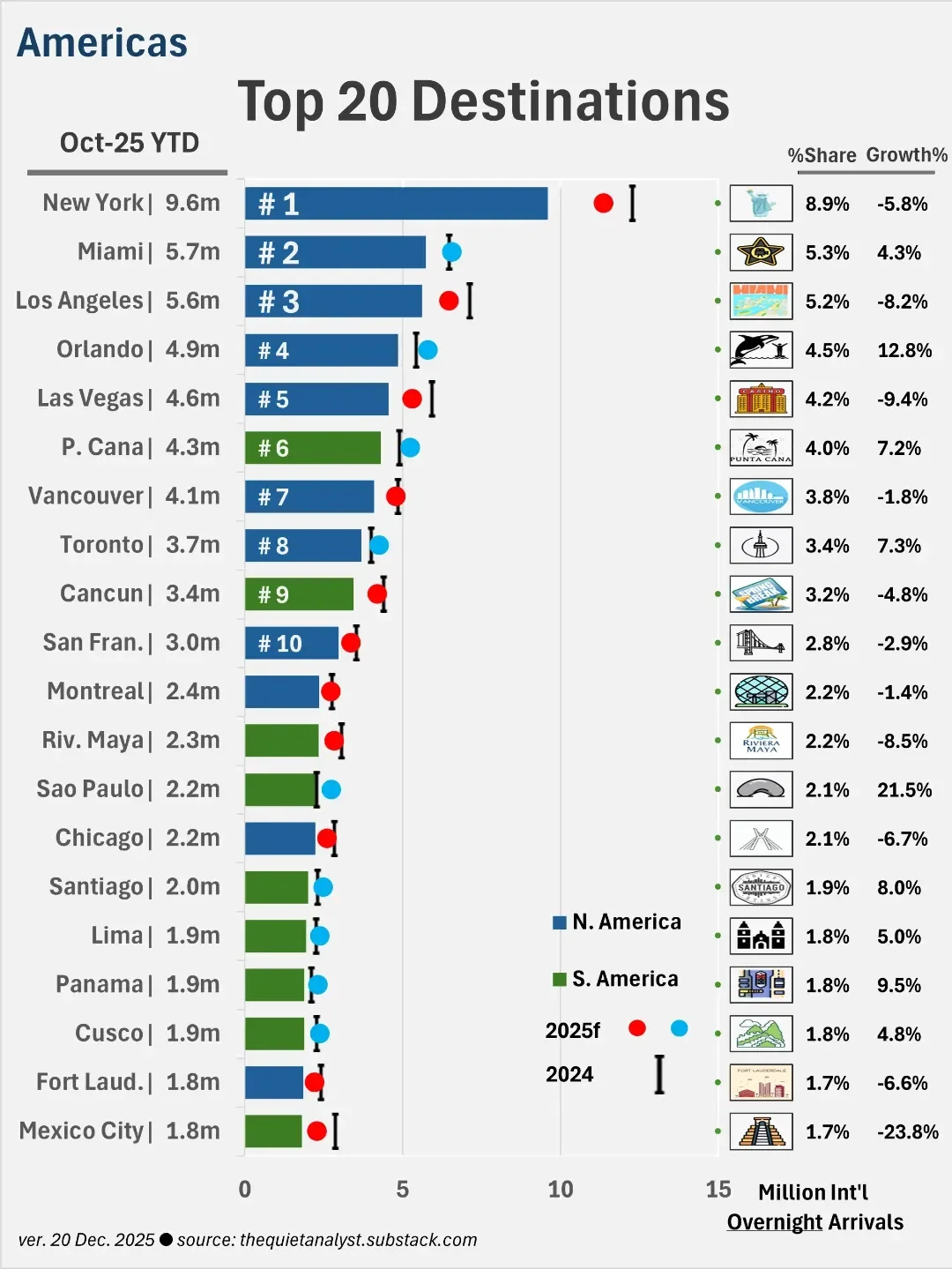
The Top 20 destinations list remains heavily U.S.-centric, led by New York, which continues to rank as the Americas’ largest international destination.
However, beneath this scale leadership, most major U.S. urban destinations are experiencing soft YTD performance in 2025 and remain clustered close to their pre-pandemic ceiling.
Several remain below 2019 levels:
Others have exceeded 2019 volumes only marginally:
In these markets, scale has been retained, but buffers against demand shocks have thinned. With volumes operating near their effective ceiling, policy friction, higher costs, and negative perception translate more directly into demand loss.
Canada and Mexico face a related but distinct challenge. Here, the dominant issue is unfinished recovery, which is now actively constraining growth.
Several flagship destinations remain well below their 2019 benchmarks:
Toronto stands out as a partial exception, re-entering positive YTD territory following a late-year recovery in U.S. inbound demand — potentially an early signal of stabilisation once U.S. outbound momentum improves.
The clearest growth signals in 2025 come from leisure-oriented Caribbean destinations and South America.
Lower exposure to below-trend U.S. outbound travel remains a defining advantage.
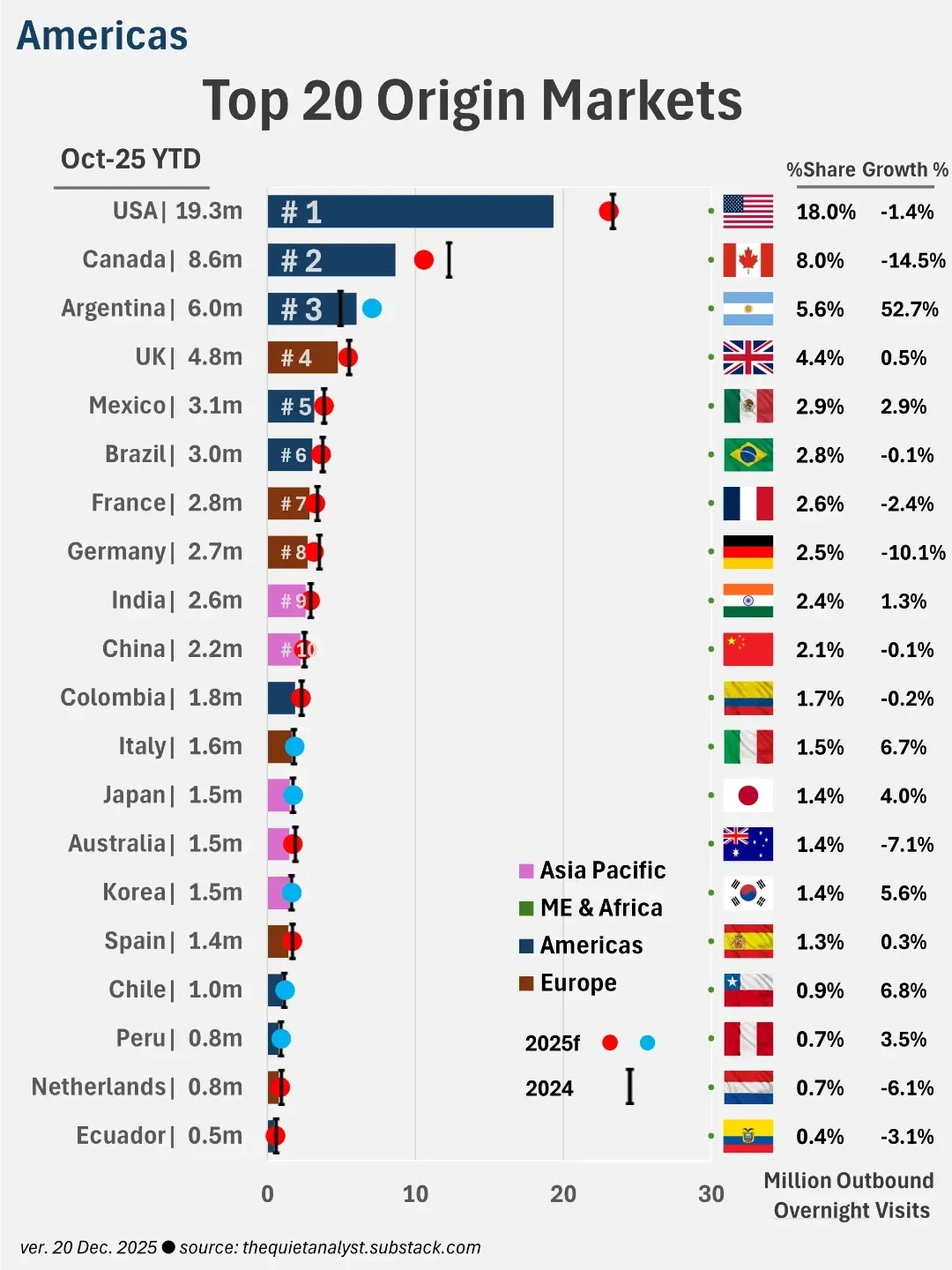
The Americas remain a predominantly intra-regional tourism system, anchored by a small number of large source markets.
Canada’s contraction is particularly consequential. For nearly all major U.S. destinations, Canada is the largest origin market, except for New York and Orlando, where it ranks second. During the recovery phase, several U.S. destinations became more reliant on Canadian demand as short-haul travel led the rebound, increasing exposure in 2025 as Canadian outbound volumes weakened.
Long-haul markets remain stagnant or contracting, offering little offset.
Tourism in the Americas entered a new phase in 2025, defined less by recovery mechanics and more by demand composition.
Recovery alone is no longer sufficient to generate growth. Destinations that exited the pandemic with heavy reliance on U.S. outbound travel now find that exposure constraining rather than supportive, while destinations with lower U.S. dependence retain room to expand.
Growth is no longer a function of size or recovery status, but of exposure — marking a structural shift in how tourism performance across the Americas should be interpreted.