
Where Data Tells the Story
© Voronoi 2026. All rights reserved.

Global Tourism in 2025: Growth Is No Longer Even
At the aggregate level, tourism appears stable. Beneath the surface, growth is deeply uneven. By 2025, international overnight arrivals are no longer shaped by reopening dynamics or pent-up demand. Instead, outcomes increasingly reflect differences in demand composition, origin-market dynamics, geopolitics, and currency movements. At the global level, the system looks stable. At the destination and regional level, it is anything but.
The Global Top 100: Scale Still Dominates
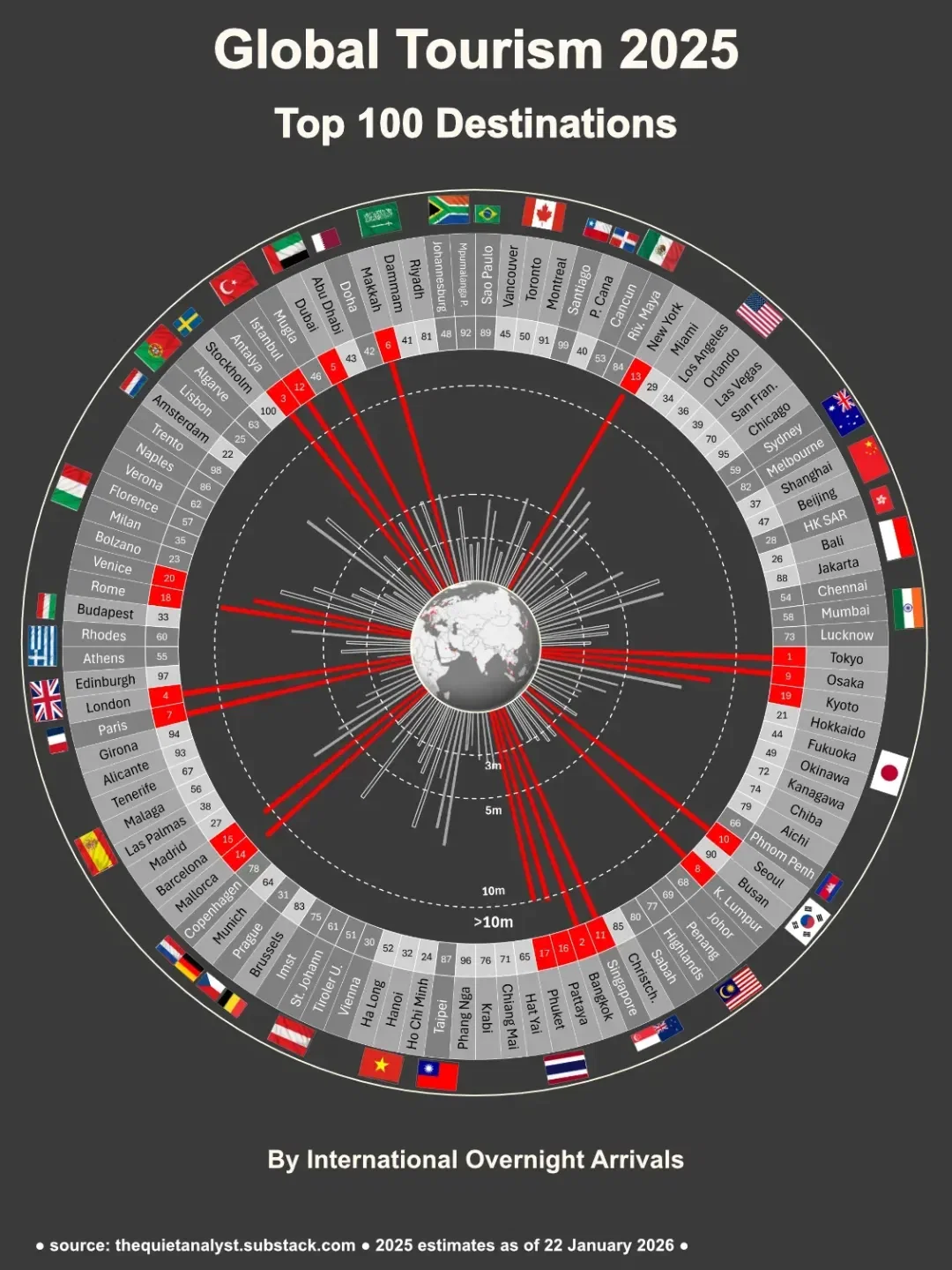
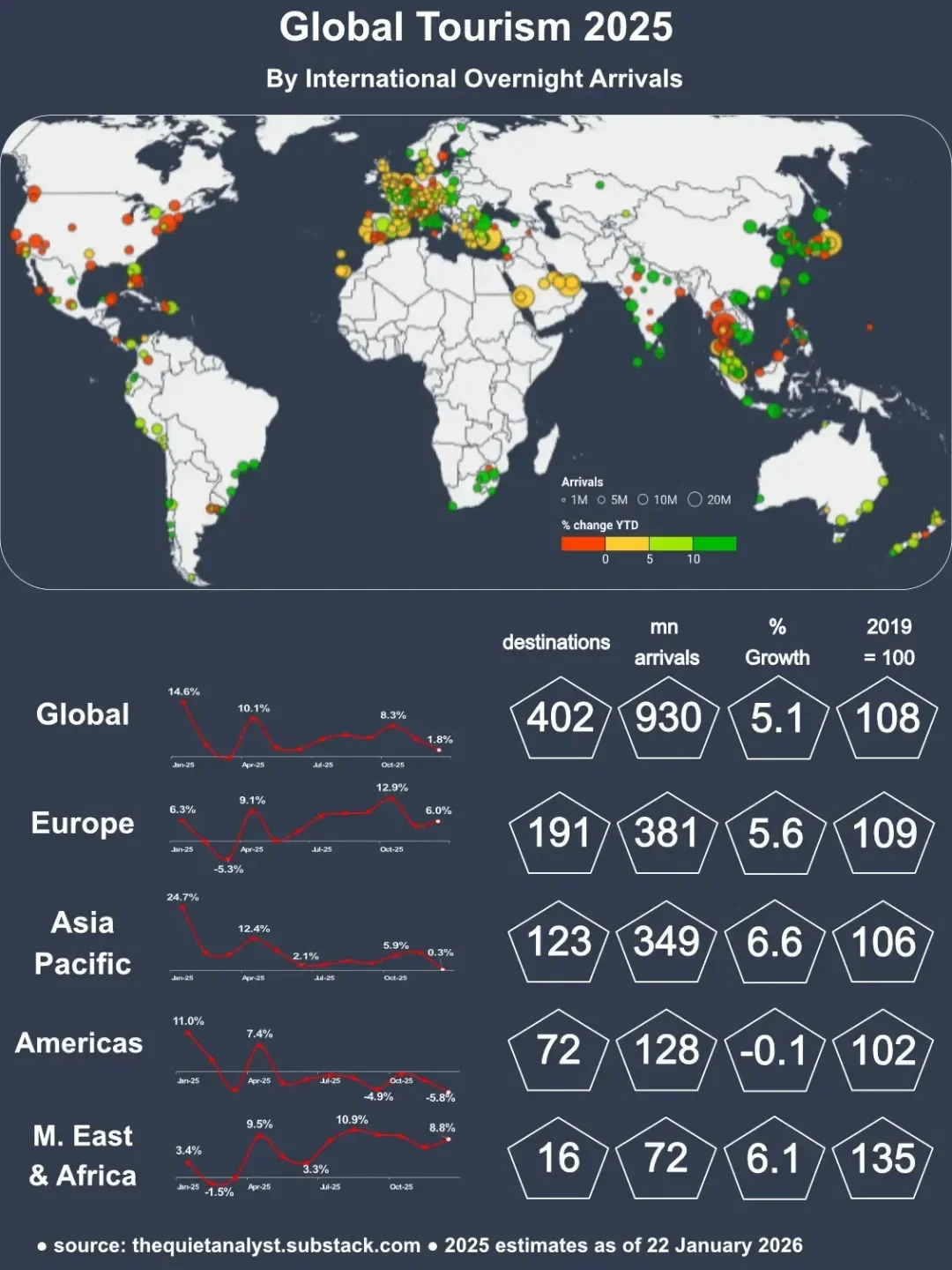
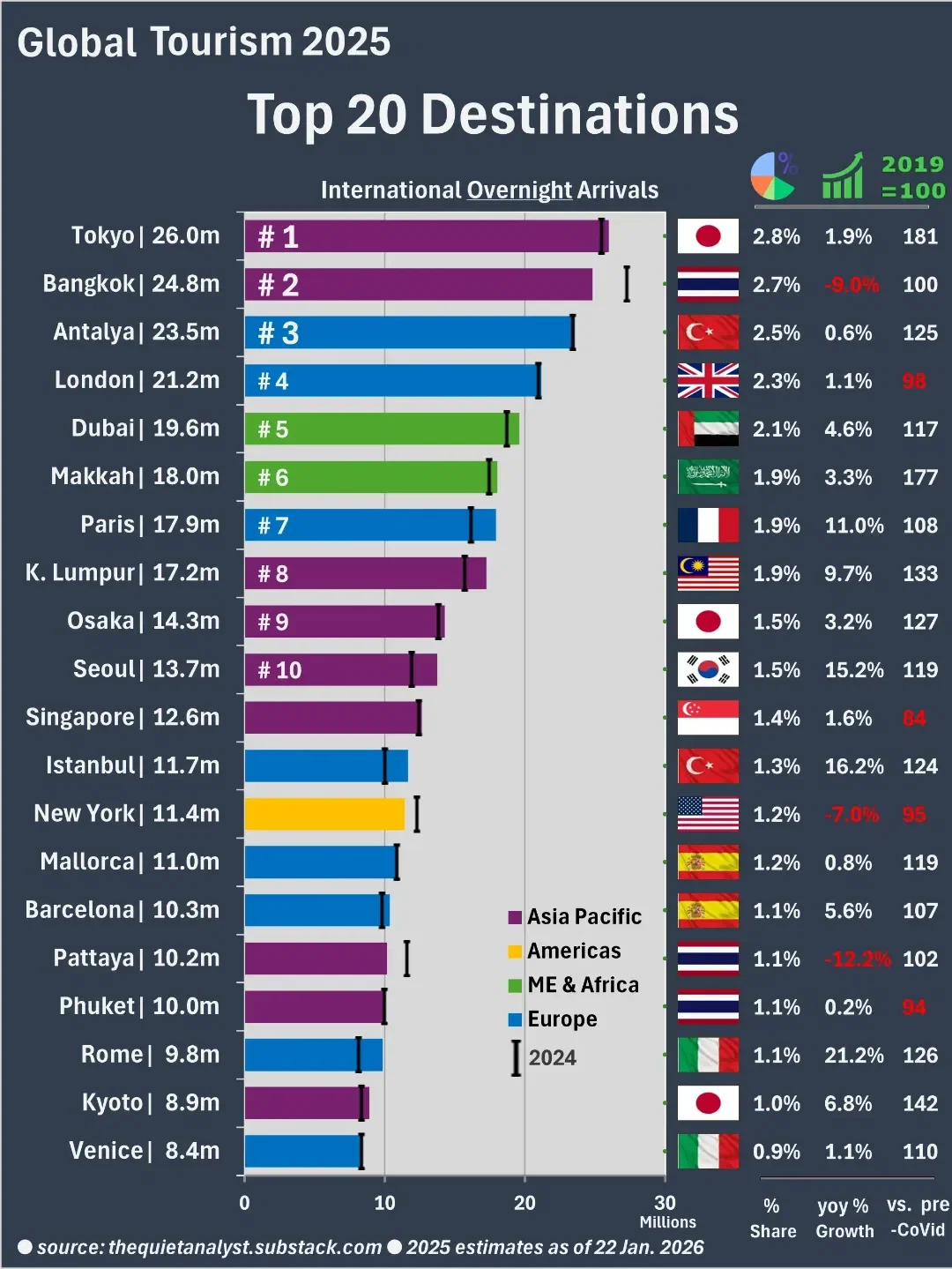
In 2025, the world’s 100 largest tourism destinations recorded roughly 930 million international overnight arrivals, around 8% above pre-pandemic 2019 levels. Tourism remains highly concentrated: the top 20 destinations alone account for roughly one-third of all arrivals. 16 “superscale” destinations—around 3% of those covered—each attract more than 10 million international visitors annually, while a further 26 destinations fall into the 5–10 million range. This concentration matters. Rankings are sticky, scale confers visibility, and the largest destinations continue to anchor global tourism flows. But scale alone no longer guarantees momentum.
Tokyo Overtakes Bangkok: Currency and Geopolitics Reshape the Rankings
At the very top of the ranking, Tokyo overtook Bangkok in 2025, becoming the world’s largest international destination for the first time. This was not driven by rapid expansion in Tokyo. Arrivals grew by only around 2% year on year. The shift instead reflects Bangkok’s contraction, with arrivals falling by nearly 9%, returning it to roughly its pre-pandemic level. Currency dynamics and geopolitics played a decisive role. A weak yen boosted Japan’s competitiveness, while a strong baht and deteriorating China–Thailand travel flows weighed on Thailand’s largest destinations.
Regions Are No Longer Moving Together
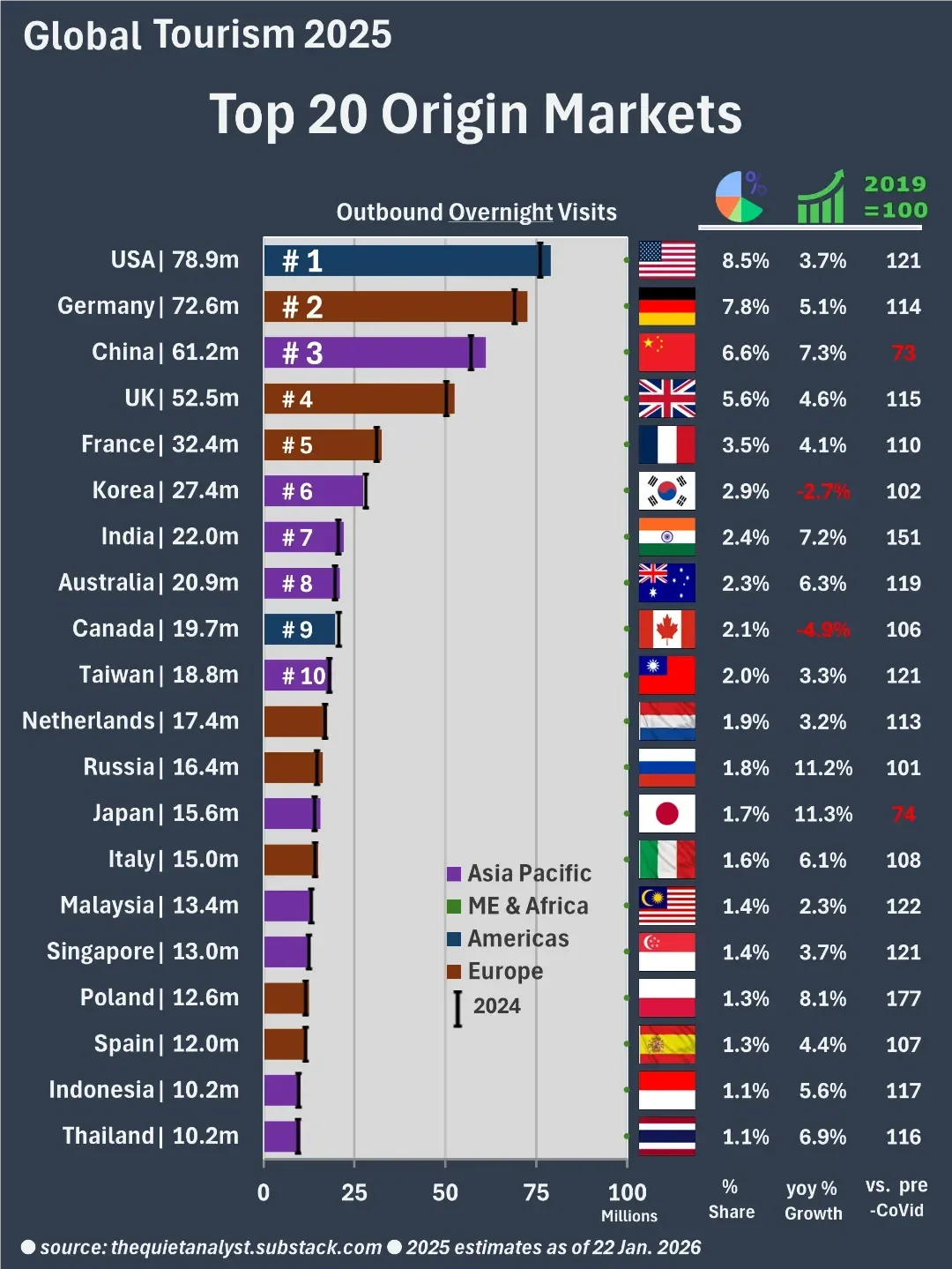
Aggregate recovery masks sharply divergent regional paths. Europe is the most stable tourism region. Strong intra-regional travel and a diversified base of source markets have returned the region to structural, trend-level growth. Asia Pacific has fully recovered in volume terms, operating at around 106% of 2019 levels, but inbound growth remains below potential. Incomplete outbound recovery from China and Japan continues to suppress regional performance.The Americas have barely moved beyond recovery. Growth has stalled, and outcomes are now shaped by the failure of U.S. outbound travel to re-accelerate, rather than by residual recovery gaps. In short, global tourism is no longer synchronised. Regions are increasingly moving at the speed of their dominant origin markets.
Growth After Recovery: Who Is Still Expanding Fast?
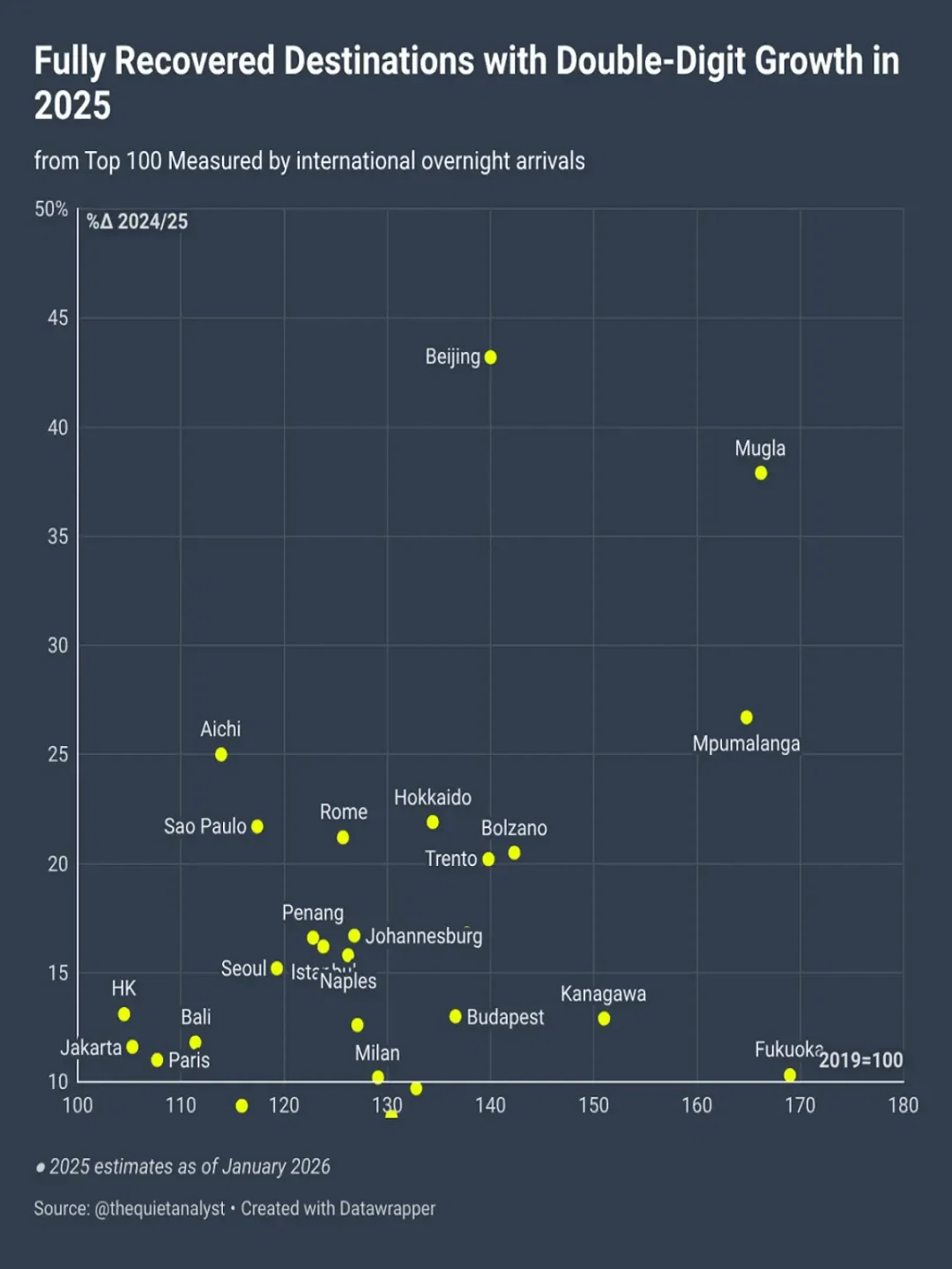
One of the clearest signals in 2025 comes from destinations that are already fully recovered—operating above their 2019 levels—yet still recording double-digit growth. More than 20 destinations fall into this category. They include:
This pattern shows that growth in 2025 is no longer about “catching up.” It is increasingly shaped by who attracts redirected demand when shocks occur elsewhere—whether from currency shifts or geopolitical disruption.
What This Tells Us About Global Tourism in 2025
By 2025, recovery is no longer the defining story. Divergence is.
Growth now depends less on how fast volumes return, and more on:
Destinations and regions that can absorb redirected demand are pulling ahead. Others are stalling, even at scale.
For the full Global Tourism in 2025 report — including the full Top 100 rankings, origin-market analysis, and detailed regional breakdowns — read the complete analysis on Substack:
👉 https://thequietanalyst.substack.com/p/global-tourism-in-2025