
Where Data Tells the Story
© Voronoi 2026. All rights reserved.

Europe Has Moved Beyond Recovery
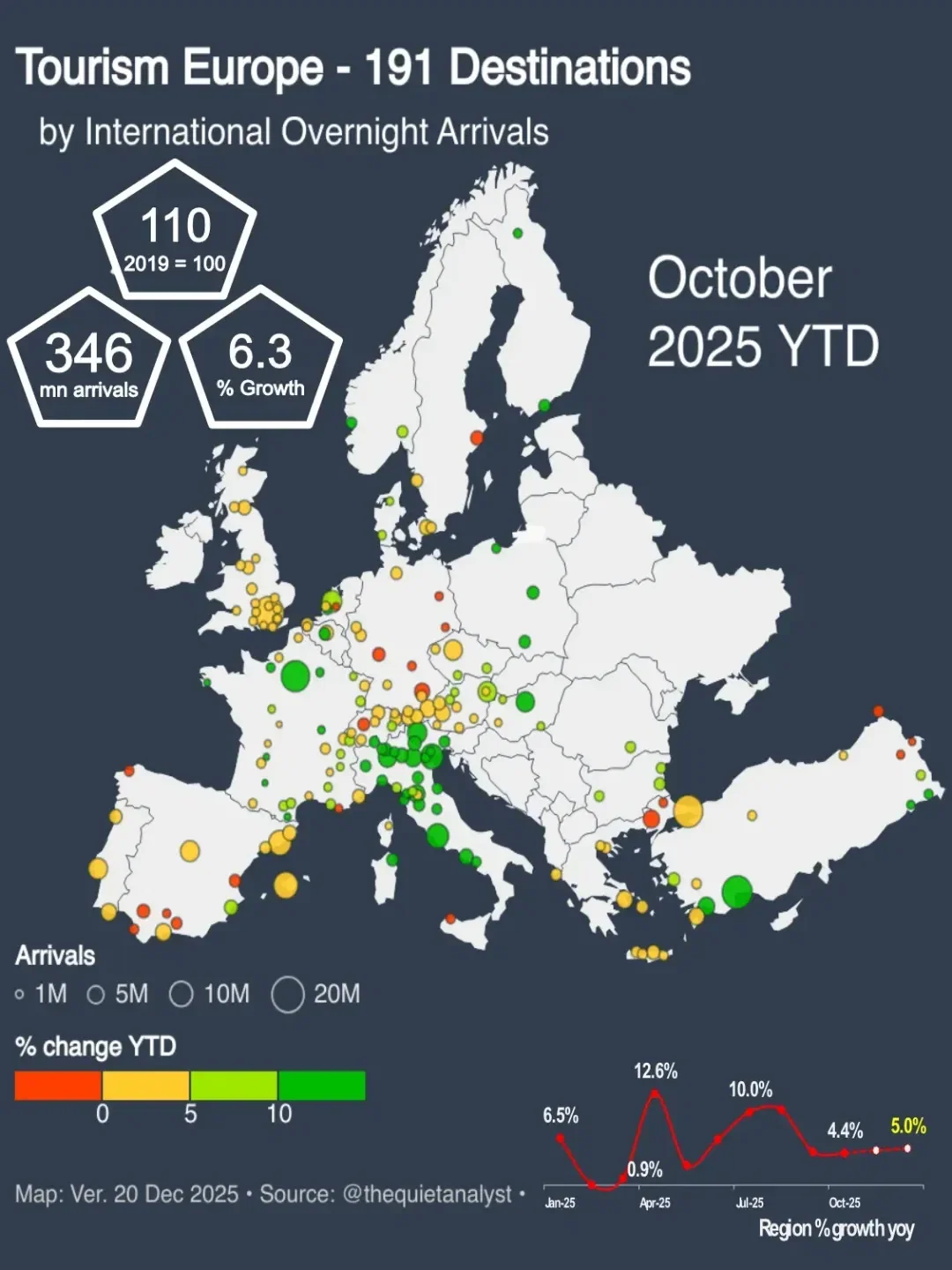
Europe’s tourism performance in 2025 is no longer shaped by reopening dynamics, pent-up demand, or border normalisation. By October 2025, the region recorded 346 million international overnight arrivals across 191 destinations, representing 6.3% year-on-year growth and standing 10% above pre-COVID 2019 levels for the same period.
For an interactive version of the map please visit :
https://thequietanalyst.substack.com/p/europe-tourism-2025-ytd-london-leads
The Top 20 Destinations: Leadership, Scale, and Maturity
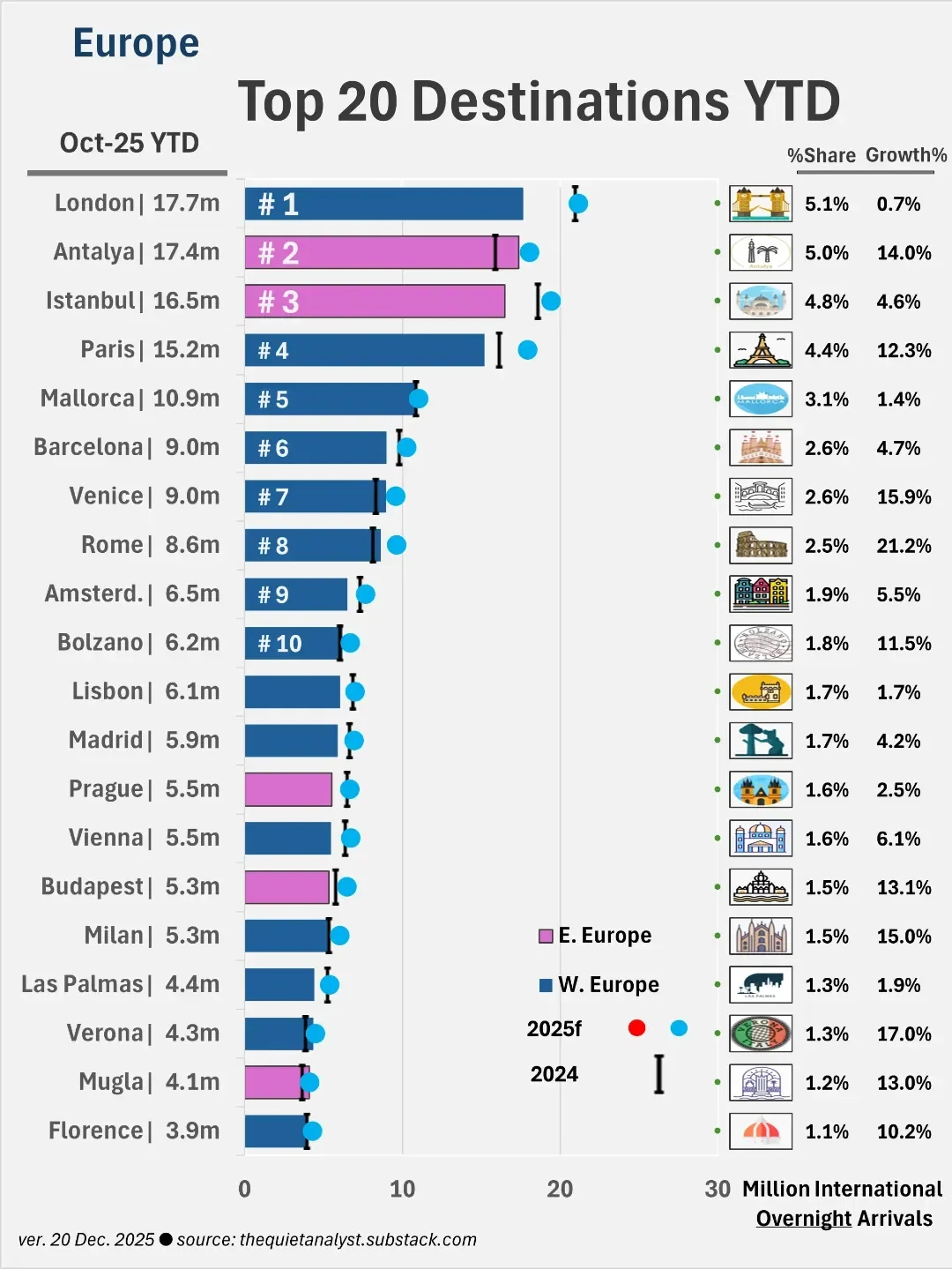
London (#1, 17.7m) remains Europe’s largest destination by international overnight arrivals. However, +0.7% year-on-year growth signals maturity and scale rather than momentum.
Turkey’s Twin Engines: Antalya and Istanbul
Antalya (#2, 17.4m) stands out as one of Europe’s strongest structural performers, posting +14.0% growth from an already record base. With 2024 itself a peak year and 2025 set to surpass it, Antalya’s expansion reflects sustained competitiveness rather than post-pandemic rebound.
Istanbul (#3, 16.5m) occupies a different strategic position. Functioning simultaneously as a European city-break destination and a global gateway, it recorded steadier +4.6% growth, supported by diversified travel purposes and strong connectivity rather than resort-driven scale.
Paris: Normalisation After a Temporary Dip
Paris (#4, 15.2m) remains firmly entrenched in Europe’s top tier. Its +12.3% growth in October 2025 YTD follows a contraction in 2024 (–2%), driven by temporary pressures including elevated prices, crowding concerns, and Olympic-related travel deferrals.
Southern Europe and the Power of Familiarity
Southern European destinations are heavily represented throughout the Top 20. Mediterranean hubs benefit from a combination of short-haul accessibility, traveller familiarity, and the ability to absorb large volumes efficiently, particularly during periods of heightened cost sensitivity.
Destinations such as Mallorca (#5, 10.9m), Las Palmas (#17, 4.4m), and Mugla (#19, 4.1m) consistently capture discretionary demand without relying on long-haul recovery.
Growth Performance: Structural Winners vs Cyclical Effects
Growth across Europe’s Top 20 destinations in 2025 is uneven — a defining feature of a region transitioning from recovery to structural performance.
Antalya’s expansion is clearly structural, building on already elevated volumes. Paris’s rebound reflects cyclical normalisation. London’s muted growth reinforces its maturity.
One of the most notable features of the 2025 data is the performance of Italian destinations. Six Italian cities appear in the Top 20, all posting growth above 9% despite already exceeding pre-COVID levels in 2024 leading to calls to control over-tourism.
In response, Italy — alongside Spain and Portugal — has intensified its focus on capacity discipline, including tourist taxes, accommodation controls, and visitor-management measures aimed at managing flows rather than maximising volumes.
This shift underscores a broader reality: capacity discipline is becoming a defining feature of mature tourism markets, not just in Europe but globally.
Origin Markets: Europe’s Structural Advantage
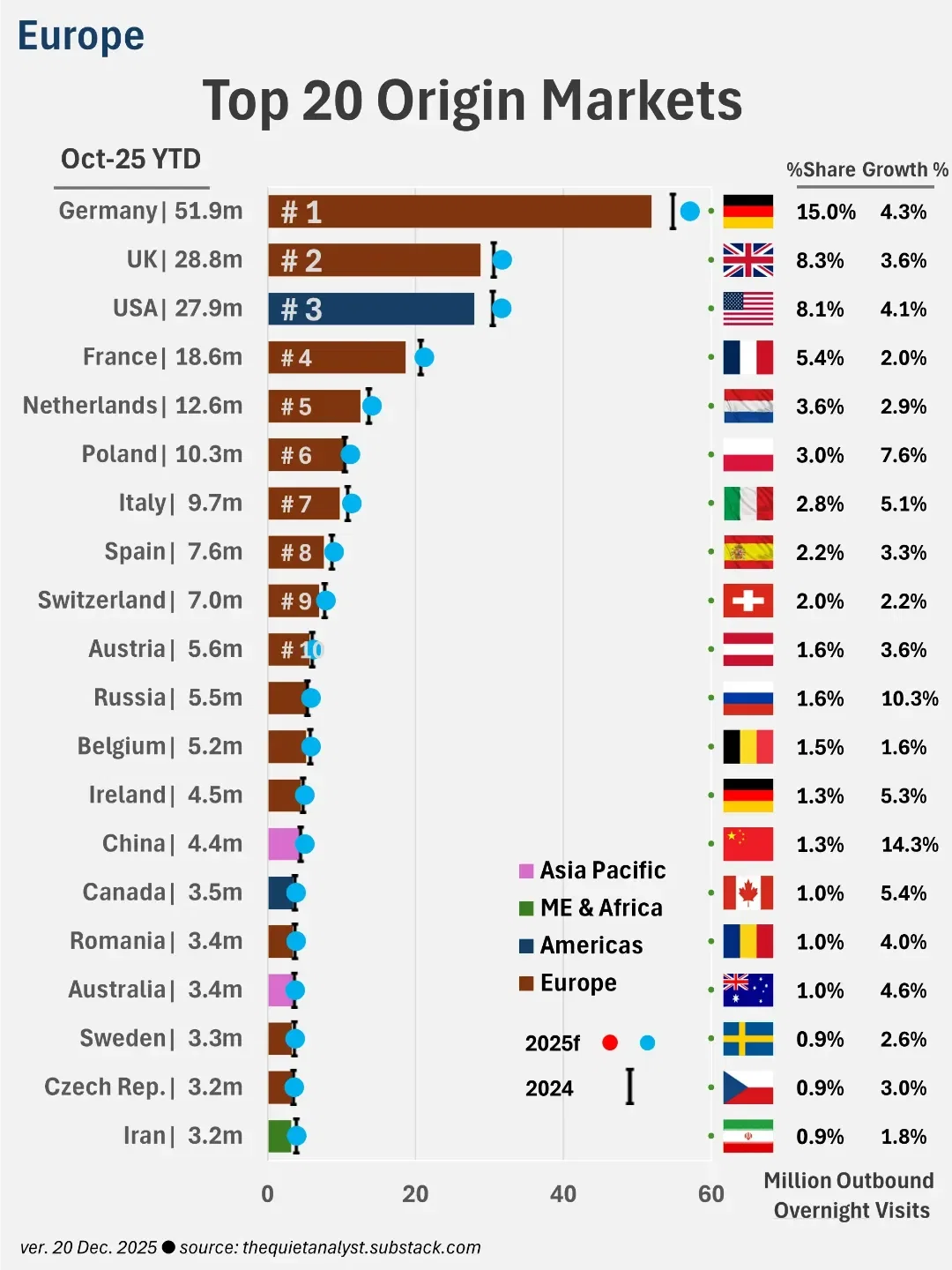
Europe’s tourism demand remains overwhelmingly intra-regional. The Top 20 origin markets account for 63.4% of all international overnight arrivals, with European source markets dominating.
The Backbone and its Reinforcement Layer.
Germany (#1, 51.9m), the United Kingdom (#2, 28.8m), and France (#4, 18.8m) form the backbone of outbound travel within Europe, together generating nearly one-third of all arrivals to the region.
A second tier of European origin markets — including the Netherlands, Poland, Italy, Spain, and Switzerland — further reinforces regional demand. Individually contributing 2–4% each, these markets highlight the depth, diversification, and resilience of Europe’s intra-regional travel base.
Long-Haul: Complementary, Not Foundational
The United States remains Europe’s most important long-haul origin market, with outbound travel 31% above 2019 levels. US demand provides meaningful uplift to major gateway cities but remains complementary rather than foundational.
Other long-haul markets show divergent dynamics. China (#14, 4.4m), despite +14.3% growth, remains in cyclical recovery at just 54% of 2019 levels. Australia (#17, 3.4m), by contrast, is already structurally above pre-COVID benchmarks.
This contrast highlights a key distinction from Asia Pacific: Europe’s performance is anchored in a broad, internally driven demand base rather than reliance on a single recovering origin market.
What This Tells Us About Europe’s Next Phase
Europe’s October 2025 YTD data confirms the region has entered a structurally different phase of tourism growth. Destinations able to reallocate marketing, airlift, and policy quickly to capture redirected demand — rather than waiting for volume to return organically — are now best positioned to outperform.