
Where Data Tells the Story
© Voronoi 2026. All rights reserved.

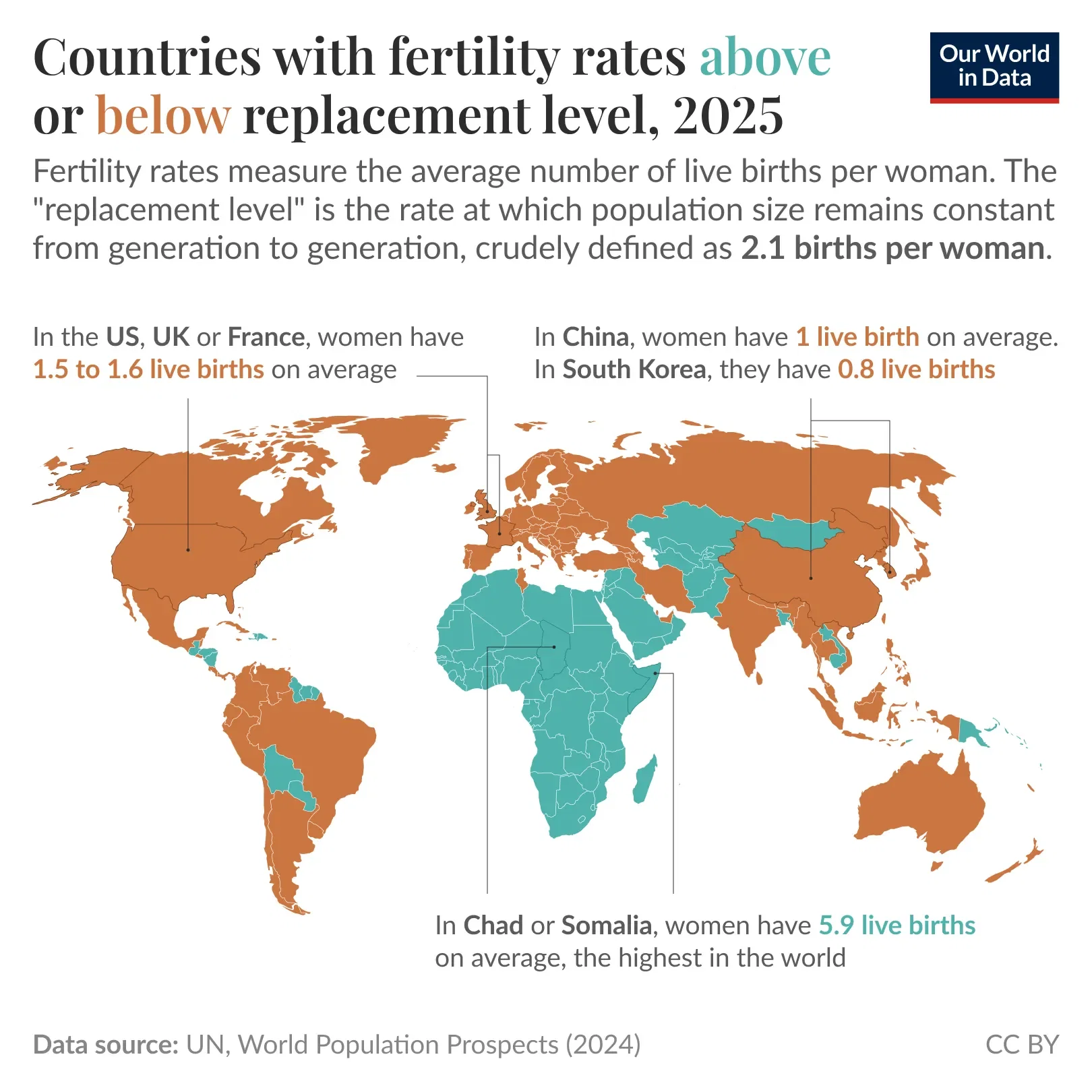
Fertility rates — which measure the average number of children per woman — have been falling worldwide. Since 1950, global fertility rates have halved, from almost 5 children per woman to 2.2.
As a result, global population growth has slowed dramatically, and many countries' populations are expected to decline by the end of the century.
This is because fertility rates in many countries have fallen below the “replacement level”. This is the level at which a population replaces itself from one generation to the next. It’s generally defined as a rate of 2.1 children per woman.
The map shows which countries had fertility rates above and below this level in 2025. This is based on projections from the UN World Population Prospects.
East Asia has some of the world’s lowest fertility rates
Countries such as South Korea and China are far below replacement level, with fertility rates of around 0.8 and 1.0 children per woman respectively — among the lowest globally.
Most advanced economies are now below replacement level
The U.S., UK, France, Japan, and Australia all have fertility rates below 2.1 births per woman, highlighting how low fertility has become widespread across high-income countries.
Sub-Saharan Africa remains the center of global population growth
Countries such as Chad, Somalia, Nigeria, and the Democratic Republic of the Congo still have fertility rates far above replacement level, with some averaging around 5 to 6 children per woman.