
Where Data Tells the Story
© Voronoi 2026. All rights reserved.

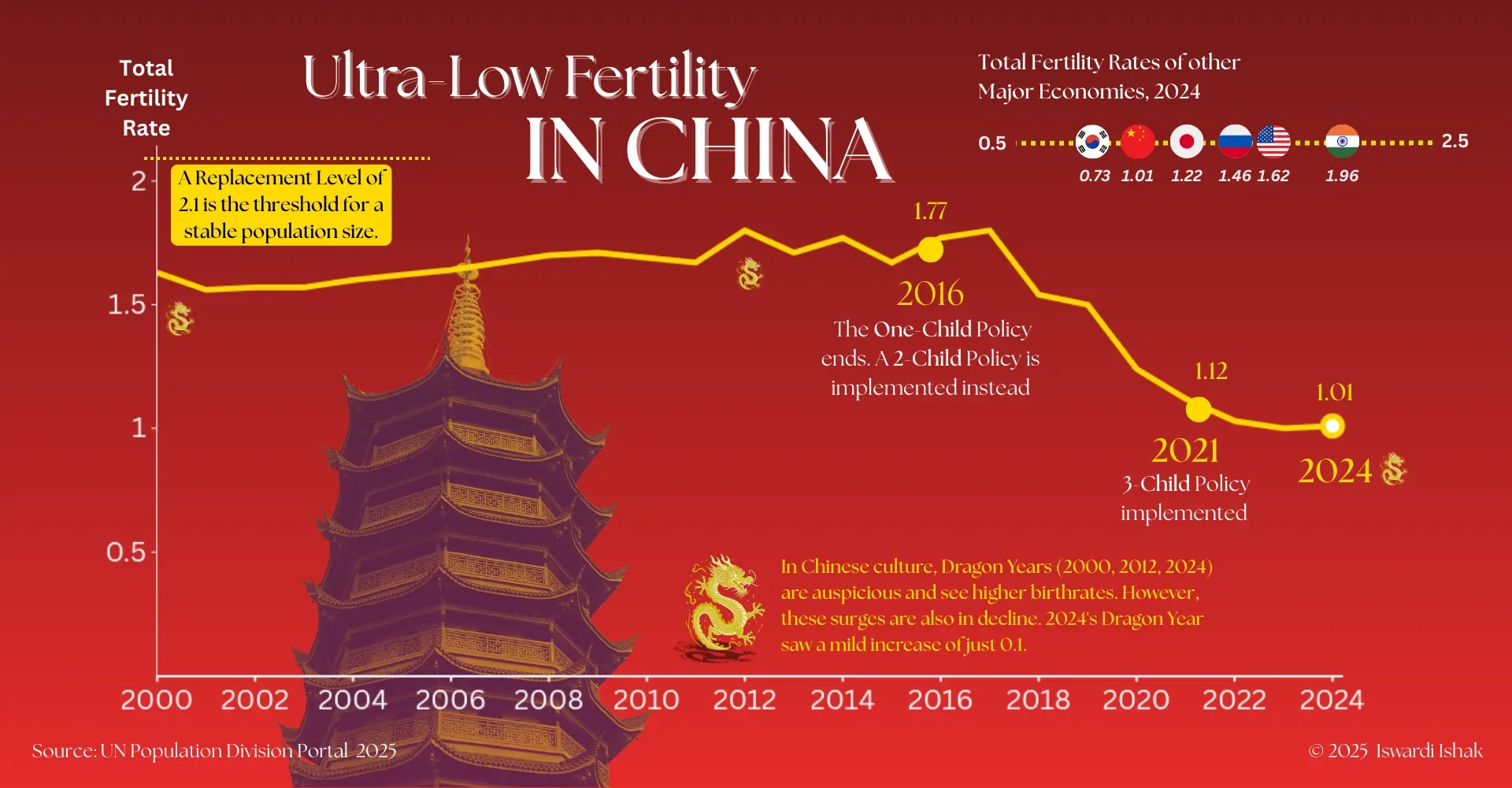
China’s fertility rate has slipped to one of the lowest in the world, falling to just 1.01 births per woman in 2024, far below the replacement level of 2.1 needed to sustain a stable population. Even a decade of policy reversals, from the end of the one-child rule in 2016 to the introduction of a three-child policy in 2021, has failed to stem the decline. Births briefly ticked up during auspicious Dragon Years, long considered favourable for starting families, but the effect has grown increasingly faint: the 2024 Dragon Year lifted fertility by a mere 0.1.
China’s demographic slump is part of a broader trend across advanced economies, yet its fall is steeper than most. South Korea remains the world’s lowest at 0.73, while Japan, Europe and America all sit well below replacement. India, though higher at 1.96, is also trending downward.
The consequences for China are profound. A shrinking workforce, rising pension burdens and slowing economic dynamism threaten to reshape the country’s long-term prospects. Despite generous subsidies, tax breaks and exhortations to “have more children”, Chinese families remain deterred by high living costs, intense academic pressures and precarious economic conditions. Policymakers may have relaxed restrictions, but the appetite for larger families has not returned.