
Where Data Tells the Story
© Voronoi 2026. All rights reserved.

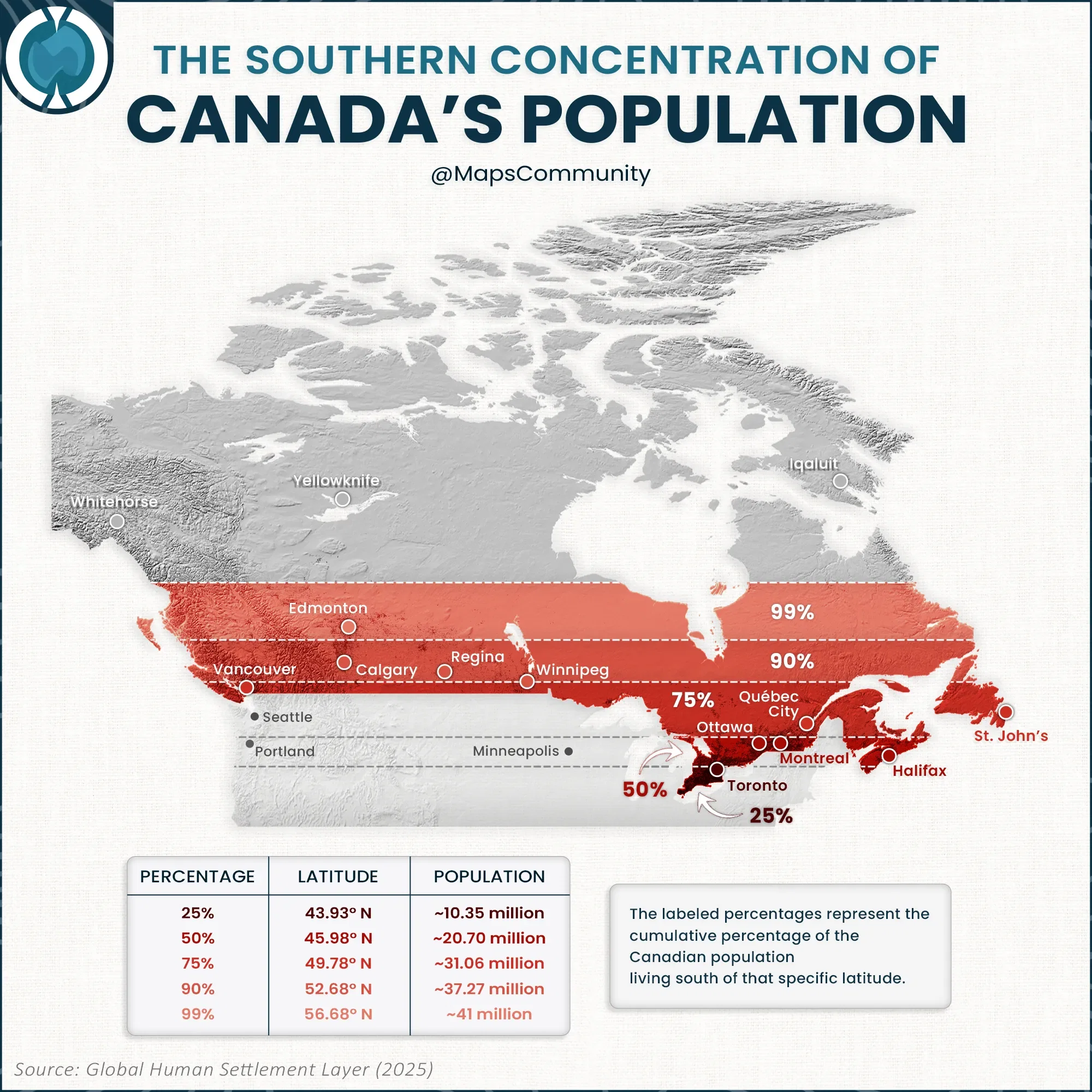
Canada’s demographic reality presents a stark contrast to its geographic footprint. Exactly half of the national population is consolidated south of the 45.98°N parallel, a hyper-concentrated economic corridor that sits geographically lower than the US city of Seattle. This dense southern clustering creates immense efficiencies for cross-border supply chains, logistics networks and retail distribution, primarily flowing through the Windsor-Quebec City corridor.
Conversely, the spatial distribution reveals a profound infrastructure challenge: 99% of Canadians reside south of 56.68°N. The remaining 1% (roughly 410,000 individuals) are dispersed across the vast northern expanse that constitutes the absolute majority of Canada's sovereign landmass. This extreme bifurcation dictates national infrastructure spending, resource extraction logistics and northern energy distribution strategies, requiring an asymmetric approach to territorial management.