
The Gender Gap on the Map: Gender Ratios Around the World
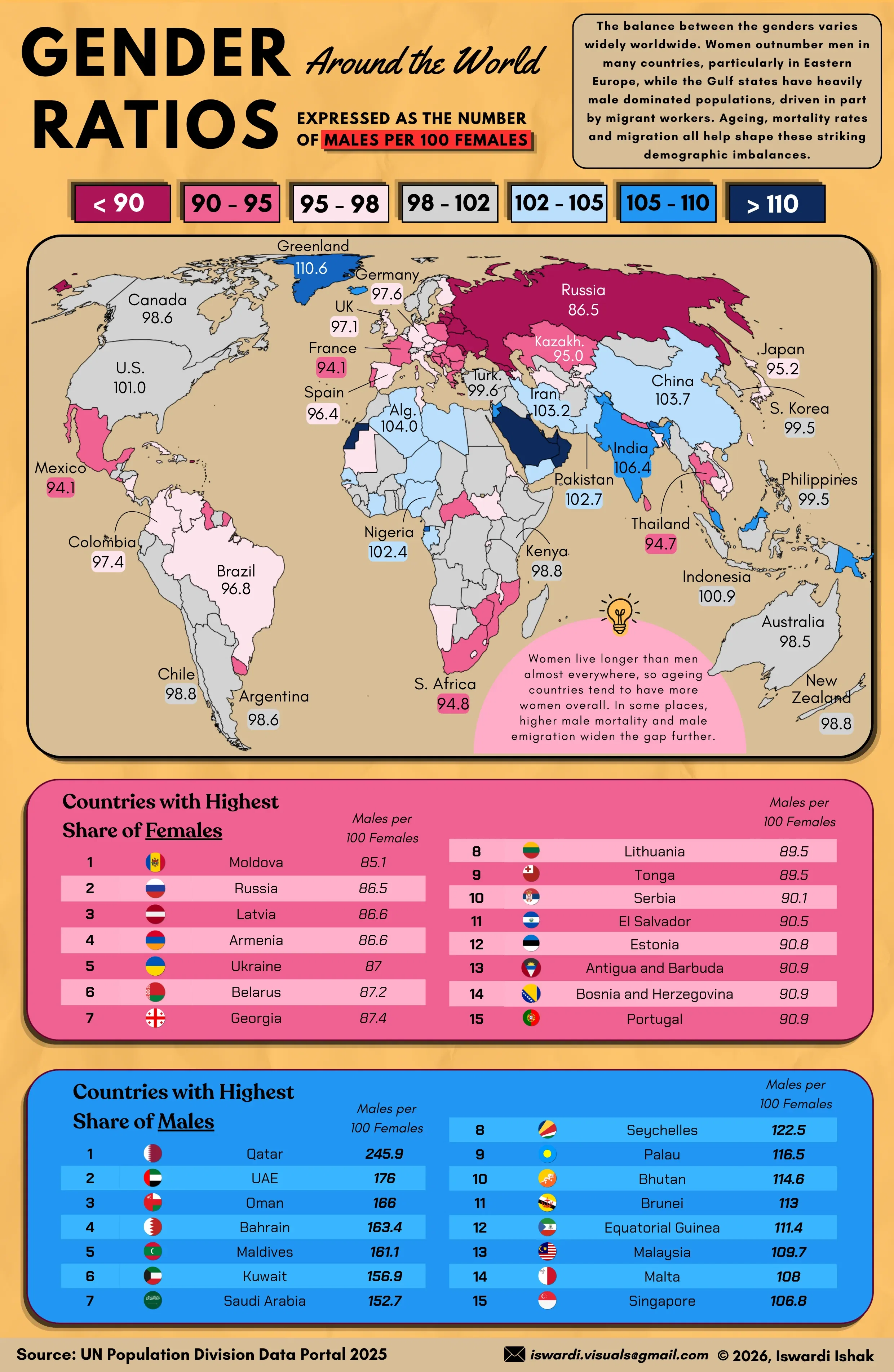
Nature is fairly even-handed. Slightly more boys than girls are born in nearly every country, and women then live longer, so the two roughly cancel out. Across the world as a whole, there are about 101 men for every 100 women. The map above shows how far countries stray from that balance, and the reasons for the straying are rarely biological.
Start with the women's end of the table. Moldova has just 85 men for every 100 women, followed by Russia, Latvia, Armenia and Ukraine. The pattern is a post-Soviet one. Men in the region die early, thanks to heavy drinking, smoking, heart disease, accidents and war and the gap in life expectancy between the sexes can stretch beyond ten years. Women are left to outlive their husbands, brothers and sons by a wide margin. Portugal and Bosnia, at the foot of the top fifteen, show that the effect is not confined to the east.
Southern Africa tells a different story. South Africa has about 95 men per 100 women. Decades of male labour emigration have tilted the balance. Ageing richer countries, from Japan to much of western Europe, lean female for a simpler reason: women live longer, and the old are many.
The male-heavy end is more extreme. Qatar has 246 men per 100 women, the United Arab Emirates 176 and Oman 166. The explanation is not that Gulf families have more sons. It is that the construction sites, ports and kitchens of the region are staffed largely by men who come from South Asia on short contracts and leave their families behind. Singapore and Malaysia, which also lean on migrant labour, appear further down the list.
Elsewhere, preference leaves its mark. India (106) and China (104) both have more men than women, a legacy of families favouring sons and, in the past, acting on that preference before birth. With populations of more than a billion each, their skew is enough to nudge the world average above parity.
The lesson is that a country's sex ratio is a quiet record of who dies, who leaves and who is wanted. Biology sets the starting line. Society decides the rest.
