
Where Data Tells the Story
© Voronoi 2026. All rights reserved.

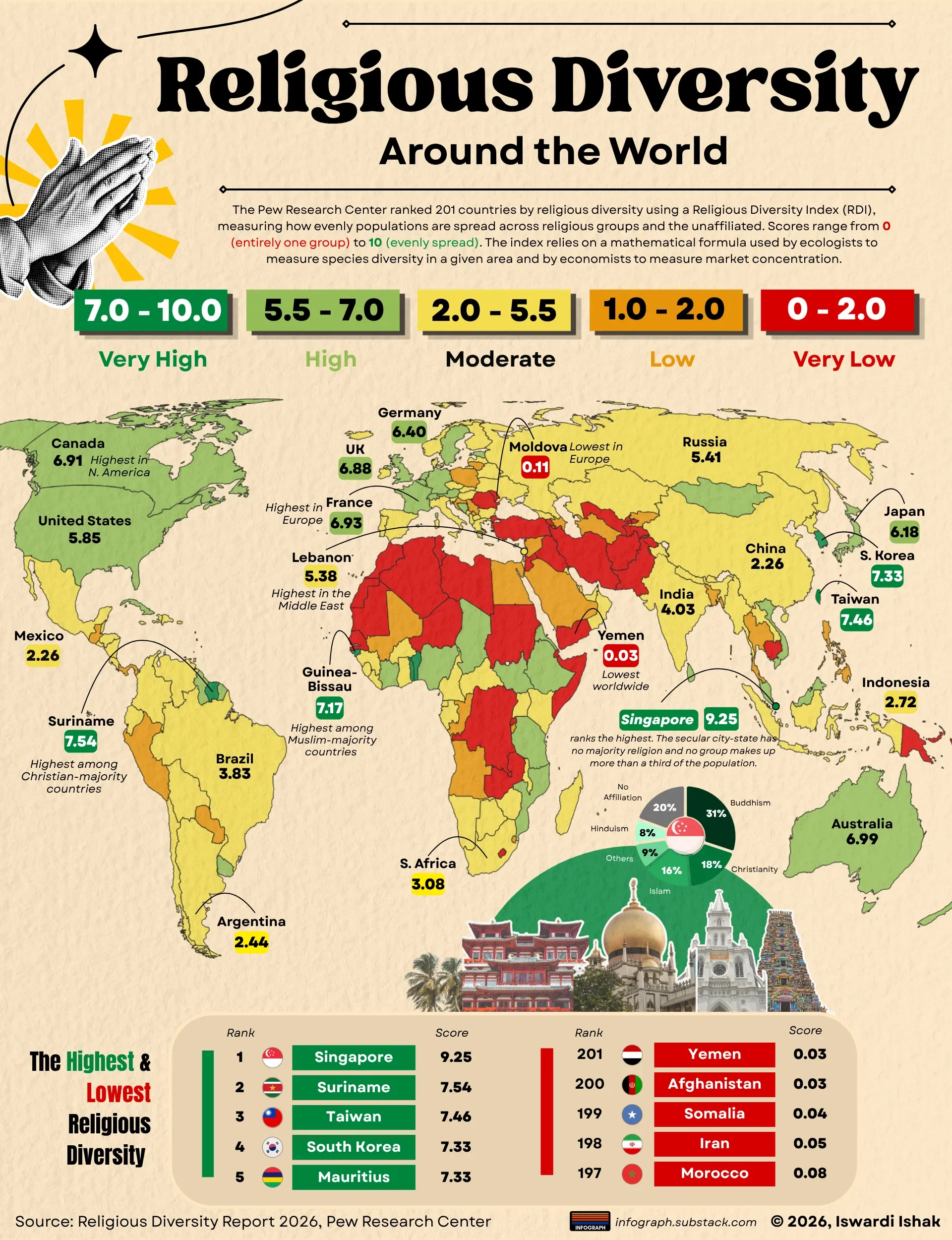
A new global ranking from the Pew Research Center suggests that when it comes to religious diversity, no country is more varied than Singapore.
The city-state topped 201 countries with a Religious Diversity Index score of 9.25 out of 10, reflecting an unusually even spread of faiths and non affiliation across its population. No single religious group makes up more than a third of Singapore’s residents, making it one of the rare places where Buddhism, Christianity, Islam, Hinduism, and secular communities coexist at nearly equal scale.
Suriname and Taiwan followed closely behind, while South Korea and Mauritius rounded out the top five.
At the other end of the spectrum, Yemen ranked last with a score of just 0.03, alongside Afghanistan, Somalia, Iran, and Morocco, where populations are overwhelmingly dominated by a single religion.
The findings reveal stark regional contrasts. Much of East and Southeast Asia scored high, helped by pluralistic societies shaped by migration, trade, and colonial history. In contrast, large parts of the Middle East and North Africa recorded some of the world’s lowest scores, reflecting more religiously homogenous populations.
Europe and the Americas fell largely in the middle, though countries like France and Canada scored relatively high levels of diversity compared with their neighbors.
The index measures not religiosity itself but how evenly different religious groups are represented within a country. In other words, the ranking is less about how religious people are and more about how many different belief systems share the same national space.
In an era shaped by migration, identity politics, and rising cultural polarization, the map offers a revealing snapshot of where religious pluralism thrives and where faith remains far more uniform.