
Where Data Tells the Story
© Voronoi 2026. All rights reserved.

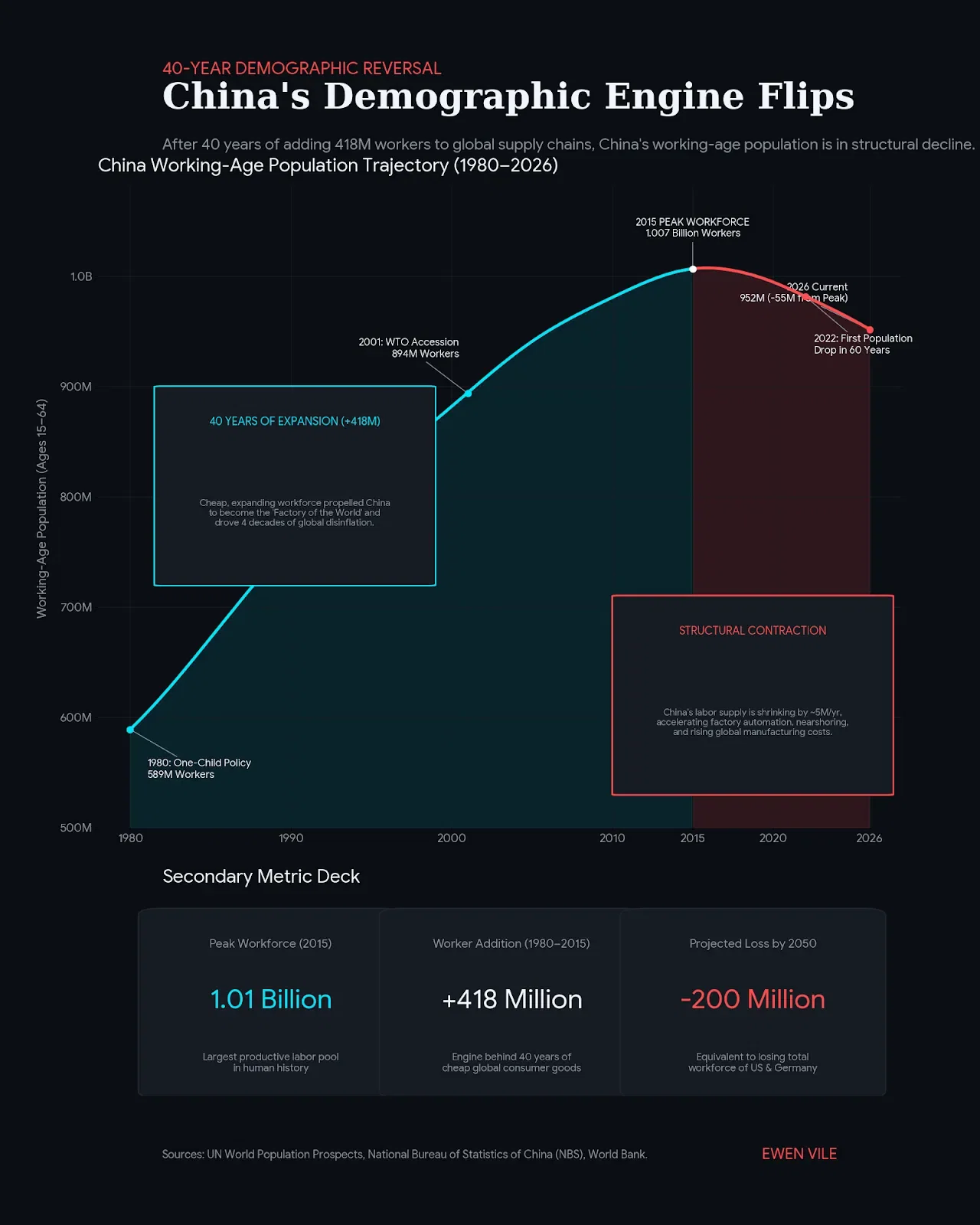
For four decades (1980–2015), global trade and manufacturing were fueled by the largest demographic expansion in modern history. Following 1980 economic reforms and the One-Child Policy, China added 418 million working-age citizens (ages 15–64) to its labor pool, peaking at an unprecedented 1.007 Billion workers in 2015. That demographic tailwind was the primary disinflationary engine of global capitalism, supplying cheap, abundant labor for global supply chains. Between 2015 and 2026, that 40-year secular expansion officially reversed into permanent structural contraction. China's working-age workforce has already shrunk by 55 million people—and is projected to shed another 200 million workers by 2050 (a loss equal to the combined workforce of the U.S. and Germany). This multi-decade demographic reversal is forcing a fundamental macro restructuring: accelerating factory automation inside China while driving global corporations to nearshore manufacturing to Southeast Asia, India, and Mexico. KEY METRICS & HIGHLIGHTS: • Peak Workforce (2015): 1.007 Billion (Largest productive labor pool in human history) • 40-Year Labor Addition (1980–2015): +418 Million Workers (Engine behind cheap global consumer goods) • Current Workforce (2026): 952 Million (-55 Million workers lost since 2015 peak) • Projected Labor Loss by 2050: -200 Million Workers (Equivalent to losing total workforce of US & Germany)