
Where Data Tells the Story
© Voronoi 2026. All rights reserved.

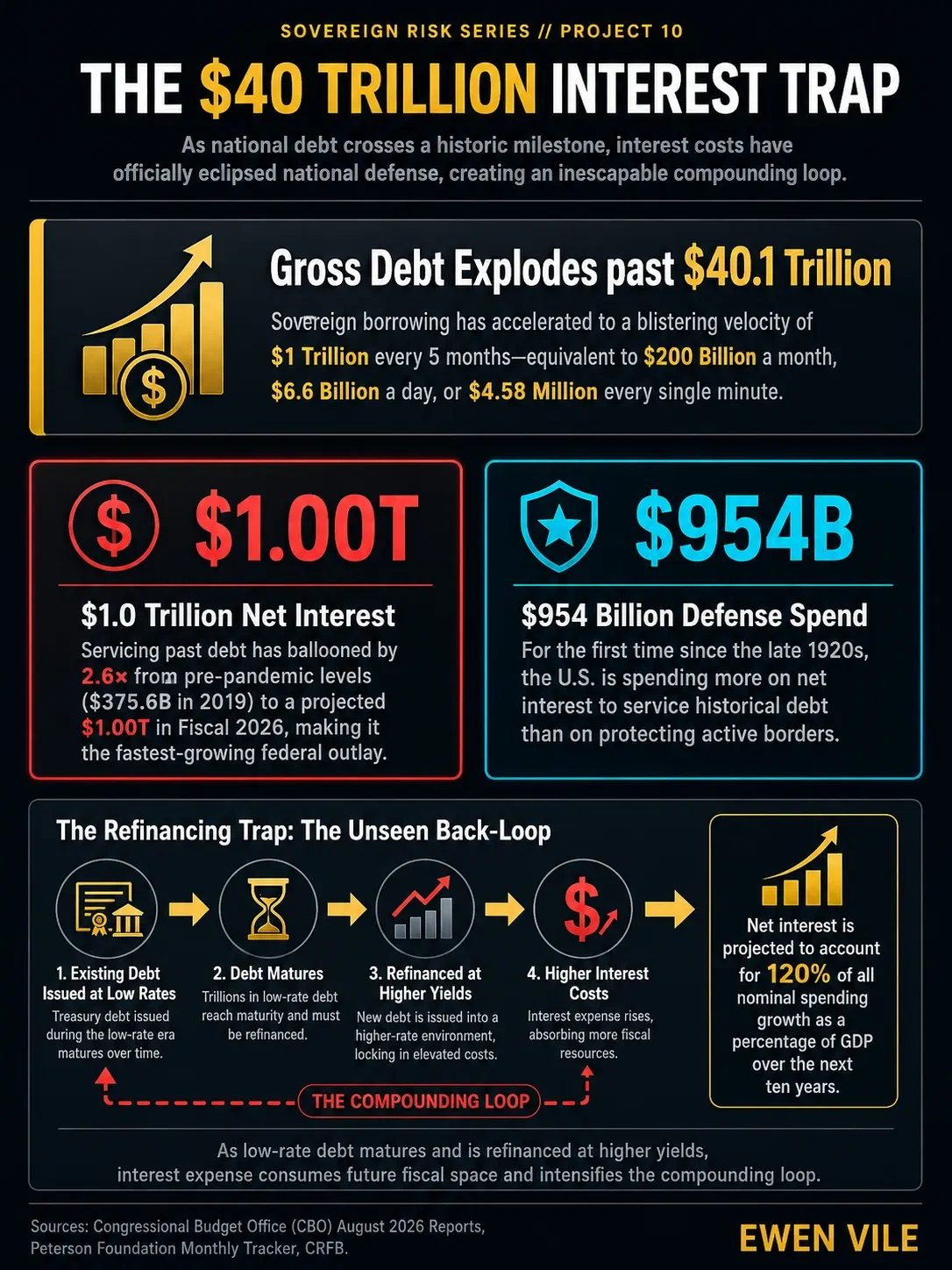
While public attention remains transfixed on political gridlocks and discretionary spending debates, the physical reality of the U.S. balance sheet has quietly slipped into an inescapable mathematical loop. When you run a rigorous "Predictive Break" analysis on the latest 2026 federal disclosures, a terrifying truth emerges: **the cost of servicing America's past is officially cannibalizing its future.**

The scale of the aggregate debt is staggering. In August 2026, the gross U.S. national debt officially surpassed the historic **$40 Trillion** milestone—doubling in size in less than a decade. But the real outlier isn't just the round number; it's the blistering velocity of the expansion.

The U.S. is currently adding **$1 Trillion of new debt every 5 months** (passing $38T in October 2025, $39T in March 2026, and $40T in August 2026). When trivialized to a human scale, this is an acquisition rate of:
*   **$200 Billion** every month.
*   **$6.6 Billion** every single day.
*   **$275 Million** every hour.
*   **$4.58 Million every single minute, 24/7.**

This rapid accumulation, combined with rates staying higher for longer, has triggered a historic crossover. In Fiscal Year 2026, net interest payments on the national debt will hit **$1.0 Trillion** for the first time in history. This represents an incredible **2.6× explosion** from pre-pandemic levels ($375.6 Billion in FY2019) and officially eclipses America's national defense budget (**$954 Billion**). For the first time since the late 1920s, the U.S. is spending more to service its historical liabilities than to protect its active global borders.

But the true "trap" is the unseen refinancing back-loop. As older, low-yield Treasury bonds mature, they are being rolled over and refinanced at today's much higher yields. Because of this, the Congressional Budget Office (CBO) projects that rising interest costs will explain **28% of all nominal spending growth** and account for an outrageous **120% of all federal spending growth as a percentage of GDP** over the next ten years.

Transitions can be debated in legislative assemblies, but compounding interest cannot be legislated away. The sovereign debt engine is officially on autopilot.