
Where Data Tells the Story
© Voronoi 2026. All rights reserved.

Across Europe, protests over education, housing affordability and the cost of living are putting pressure on governments to deliver better public services and improve economic prospects for younger generations. Though many governments face competing demands on public finances, from social spending and infrastructure to defence and debt servicing.
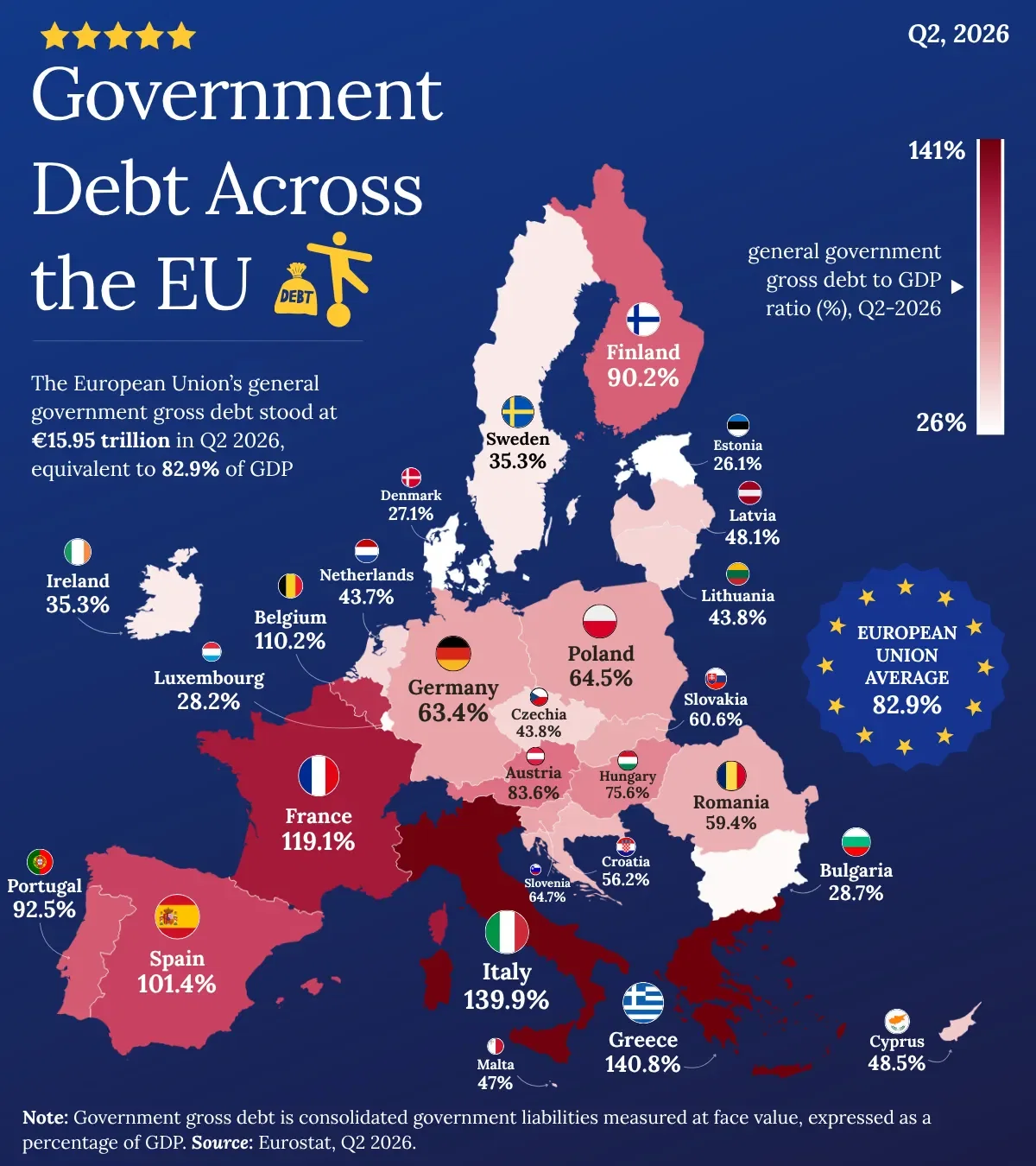
The EU’s general government gross debt stood at €15.95 trillion in Q2 2026, equivalent to 82.9% of GDP. The burden varies considerably across member states, with Greece and Italy near 140% of GDP and France at 119.1%. High debt and persistent deficits have constrained fiscal choices, raised questions about how governments will finance future investment in education, skills and other areas critical to long-term growth.
The map compares general government gross debt as a percentage of GDP across the 27 EU member states in Q2 2026, alongside the EU-wide average.
Key Takeaways:
Note: General government gross debt is consolidated government liabilities measured at face value, expressed as a percentage of GDP.
Source: Eurostat, Q2 2026.
Access data here: https://ec.europa.eu/eurostat/web/products-euro-indicators/w/2-21102026-bp