
Where Data Tells the Story
© Voronoi 2026. All rights reserved.

On the eve of Thursday, June 4, Ukrainian President Volodymyr Zelenskyy posted an open letter to Russia’s Vladimir Putin.
He posted it three weeks before the third anniversary of the Wagner Group rebellion that briefly tore a hole in Putin’s military command structure.
Open letters from heads of state carry weight only when the sender’s position is strong enough to make the words credible.
The Kiel Institute for the World Economy has been tracking the cost of that position.
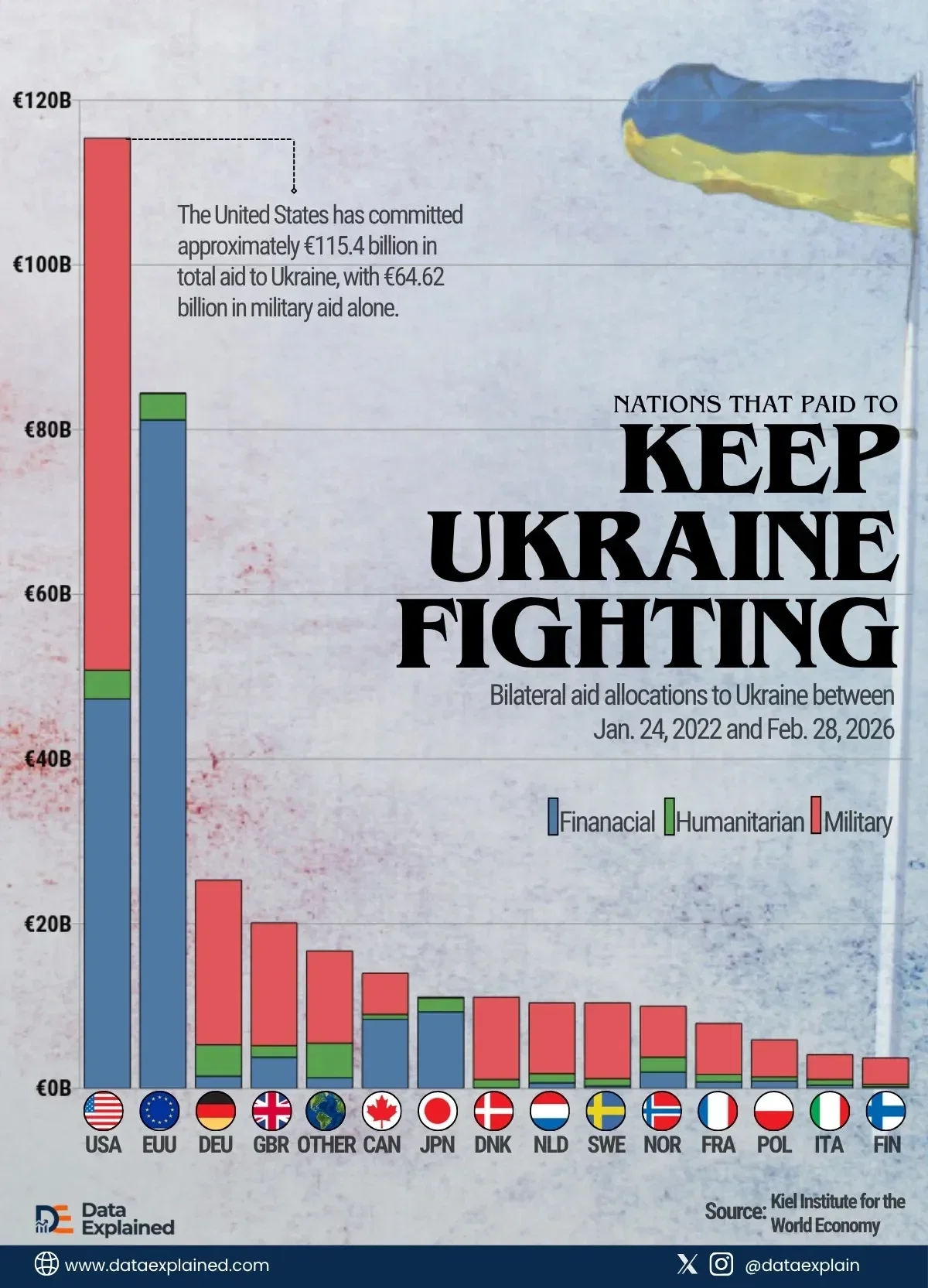
This episode’s visualization focuses on the bilateral aid commitments made to Ukraine from January 24, 2022, through February 28, 2026, documenting €415 billion in total support across 23 donors.
This is the fourth installment in a five-part data series on Russia’s war on Ukraine. The first three covered the dead, the displaced, and the military spending gap. This installment covers who stepped in to close that gap, and how.
The European Union’s institutions and the United States have divided Ukraine’s survival between them along a line that has never been formally agreed but is clearly visible in the data.
The EU Commission and Council have committed €81.21 billion in financial aid, the largest financial contribution from any single entity in the tracker.
It has exactly zero in military support.
On the other hand, the United States has committed €64.62 billion in military aid (the largest military contribution from any single entity).
It goes alongside €47.3 billion in financial aid.
Europe keeps Ukraine’s government and economy functioning. America keeps its military fighting.