
Where Data Tells the Story
© Voronoi 2026. All rights reserved.

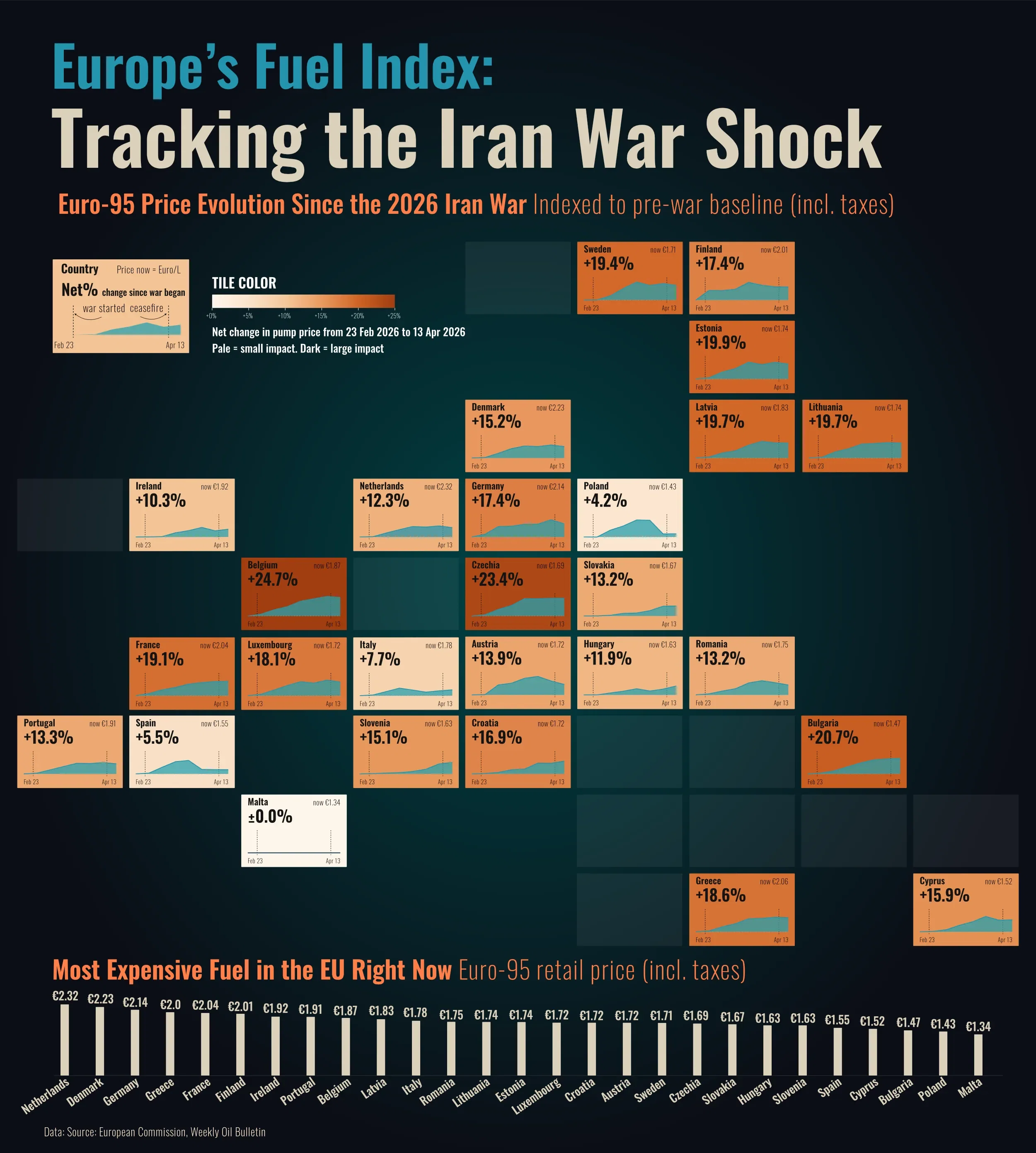
On 28 February 2026, a joint US and Israeli strike on Iran set off a 40-day conflict that disrupted the Strait of Hormuz and threatened Gulf oil supplies. European drivers noticed the effects right away. In all 27 EU countries, the weekly price of Euro-95 gasoline climbed from its pre-war level on 23 February, reaching a high in late March and early April, then easing somewhat after the ceasefire on 8 April.
The tile map below shows how each country’s prices changed week by week, compared to their own pre-war prices. Prices went up everywhere except Malta, where state regulation kept fuel at €1.34 per litre the whole time. Belgium saw the biggest overall increase, ending 24.7% above its starting point, followed by Czechia (up 23.4%), Bulgaria (up 20.7%), and several Baltic and Nordic countries (up about 19 to 20%).
After the ceasefire, Poland saw the biggest drop in prices. Prices there peaked at 22.5% above the baseline on 23 March, but fell to just 4.2% higher by 13 April, marking the sharpest turnaround in the EU. Austria and Spain had similar patterns, finishing the period well below their highest points during the conflict.
The ranking chart below shows which countries had the highest fuel prices on 13 April 2026. Prices differed by as much as 73% across the EU, from €1.34 per litre in Malta to €2.32 in the Netherlands. The six most expensive countries: the Netherlands, Denmark, Germany, Greece, France, and Finland—all had prices above €2.00 per litre and are mostly in Western and Northern Europe, where fuel taxes are highest.
On the other hand, the seven cheapest countries: Malta, Poland, Bulgaria, Cyprus, Spain, Slovenia, and Hungary—all had prices below €1.63 per litre, forming a clear group across Southern and Eastern Europe. The average price in the EU was €1.78 per litre, with 13 countries below this average and 14 above.