
Where Data Tells the Story
© Voronoi 2026. All rights reserved.

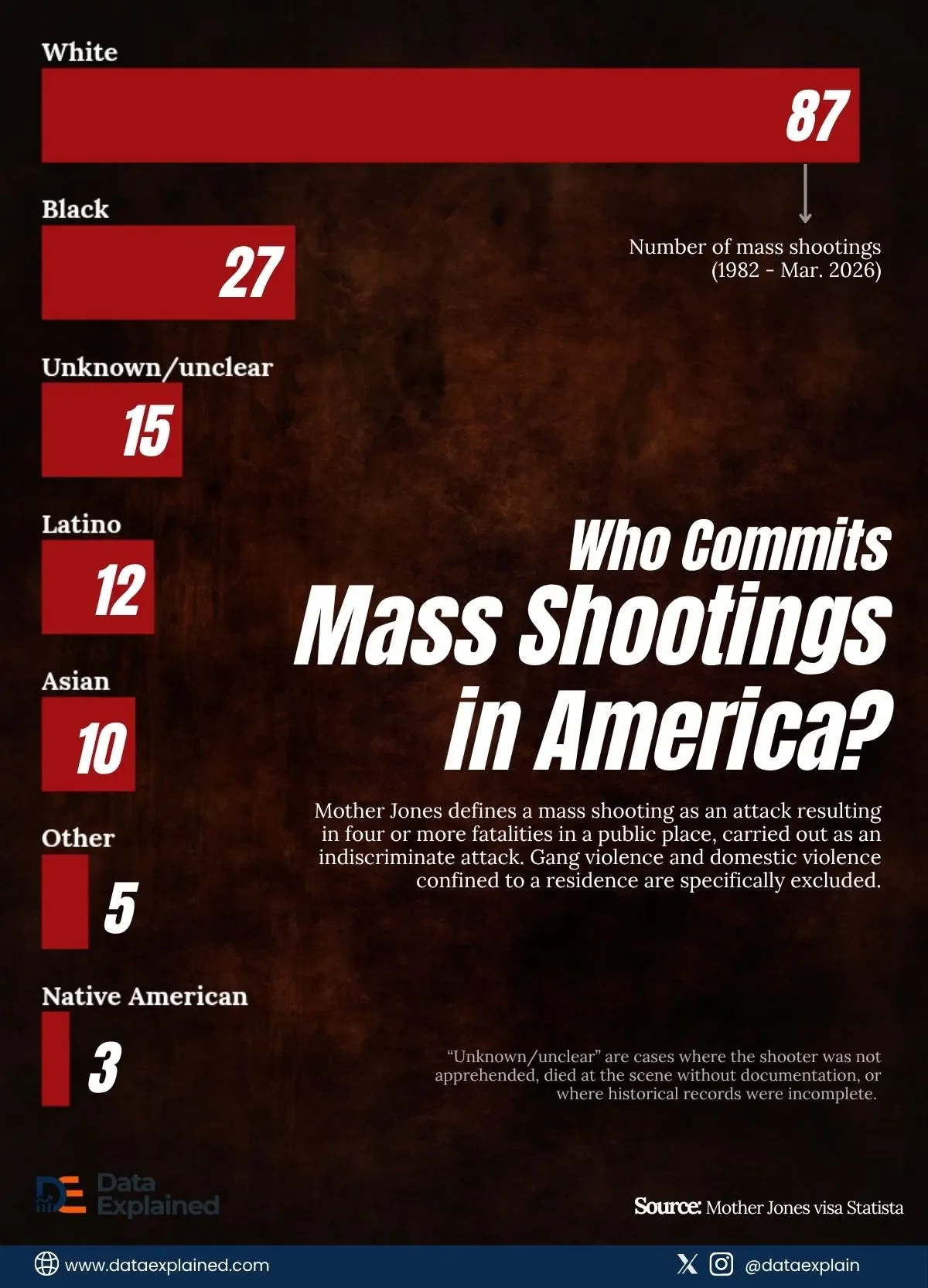
Between August 1982 and March 2026, Mother Jones tracked 159 mass shootings in the United States.
The database, accessed via Statista and released in March 2026, categorizes each incident by the shooter’s race or ethnicity across a 44-year period.
Before any number in that dataset is read, one thing must be stated clearly:
Mother Jones defines a mass shooting as an attack resulting in four or more fatalities in a public place, carried out as an indiscriminate attack. Gang violence and domestic violence confined to a residence are specifically excluded.
That definition determines everything that follows.
White Americans represent approximately 59% of the U.S. population. Their share of mass shooting perpetrators (54.7%) is modestly below their population share.
White Americans account for 54.7% of the 144 incidents with an identified perpetrator race.
They are the largest group in absolute terms by a significant margin, more than three times the next largest category.
On those raw numbers alone, mass shootings in America look like a predominantly white phenomenon.
But raw numbers without population context are not the full picture. They are the beginning of it.
The Mother Jones methodology is rigorous within its scope.
That scope has consequences.
The Gun Violence Archive, which tracks all incidents involving four or more people shot, regardless of location or gang involvement, produces dramatically higher total counts and a different racial distribution.
The dataset also makes no distinction between a racially motivated attack and one with a different motive.
For example, the 2022 Buffalo shooting (in which a white gunman specifically targeted Black shoppers, killing 10) and the 2021 Atlanta spa shootings (in which an Asian perpetrator targeted Asian women, killing 8) both appear in their respective racial perpetrator categories without the targeting dimension being visible in the data.
Perpetrator race and victim targeting are two different analytical dimensions that the dataset does not separate.