
Where Data Tells the Story
© Voronoi 2026. All rights reserved.

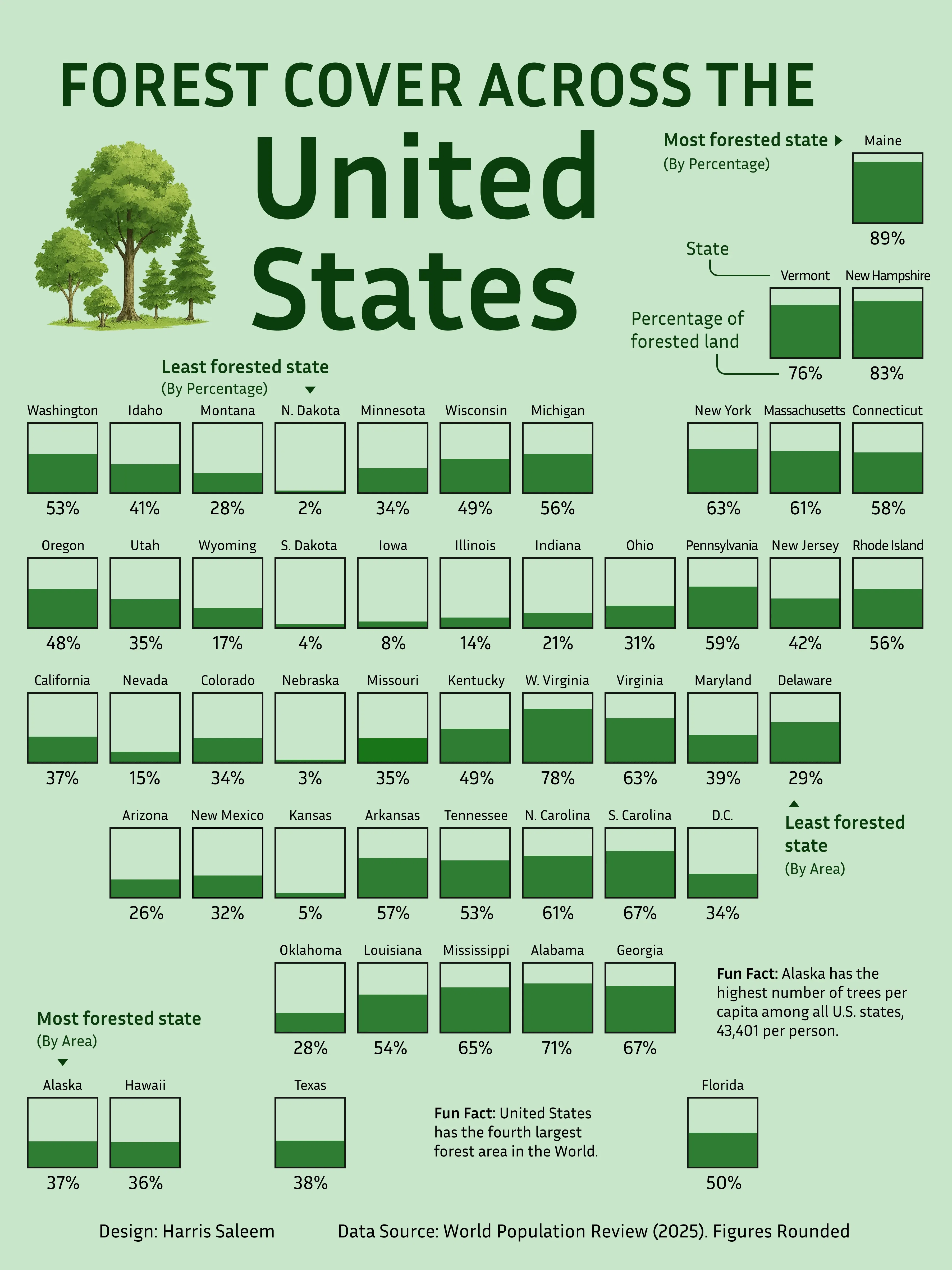
Forests cover almost one-third of the Earth’s land surface and play a crucial role in maintaining ecosystems, biodiversity, and carbon balance. United States has the fourth largest forest area in the World. Across the U.S., however, the share of land covered by forests varies dramatically from state to state.
This infographic ranks all 50 U.S. states by percentage of forest cover, highlighting where forests dominate the landscape, and where they are scarce.
The Northeast leads the nation in terms of forest cover. Maine tops the list with a remarkable 89% of its land covered by forests, followed by New Hampshire (83%), West Virginia (78%), and Vermont (76%).
In the South, states like Alabama (71%), South Carolina (67%), and Georgia (67%) also rank among the most forested, showing the regional diversity of America’s forest ecosystems.
Many states fall into the mid-range of forest coverage, typically between 40–60%. Such as, Pennsylvania (59%), Michigan (56%), Washington (53%), Florida (50%), and Oregon (48%).
On the other end of the spectrum, the Great Plains and western desert states rank among the least forested. North Dakota (2%) and Nebraska (3%) have the lowest forest coverage in the nation.
South Dakota (4%), Kansas (5%), and Iowa (8%) also feature sparse forest areas, reflecting their predominantly grassland and agricultural landscapes.
Nevada (15%) and Wyoming (17%) are similarly low due to arid climates and vast open ranges.
The U.S. forest landscape is one of extremes, from the dense forests of New England and Appalachia to the nearly treeless expanses of the Great Plains. This wide variation underscores the country’s diverse geography, ecosystems, and land use patterns.