
Where Data Tells the Story
© Voronoi 2026. All rights reserved.

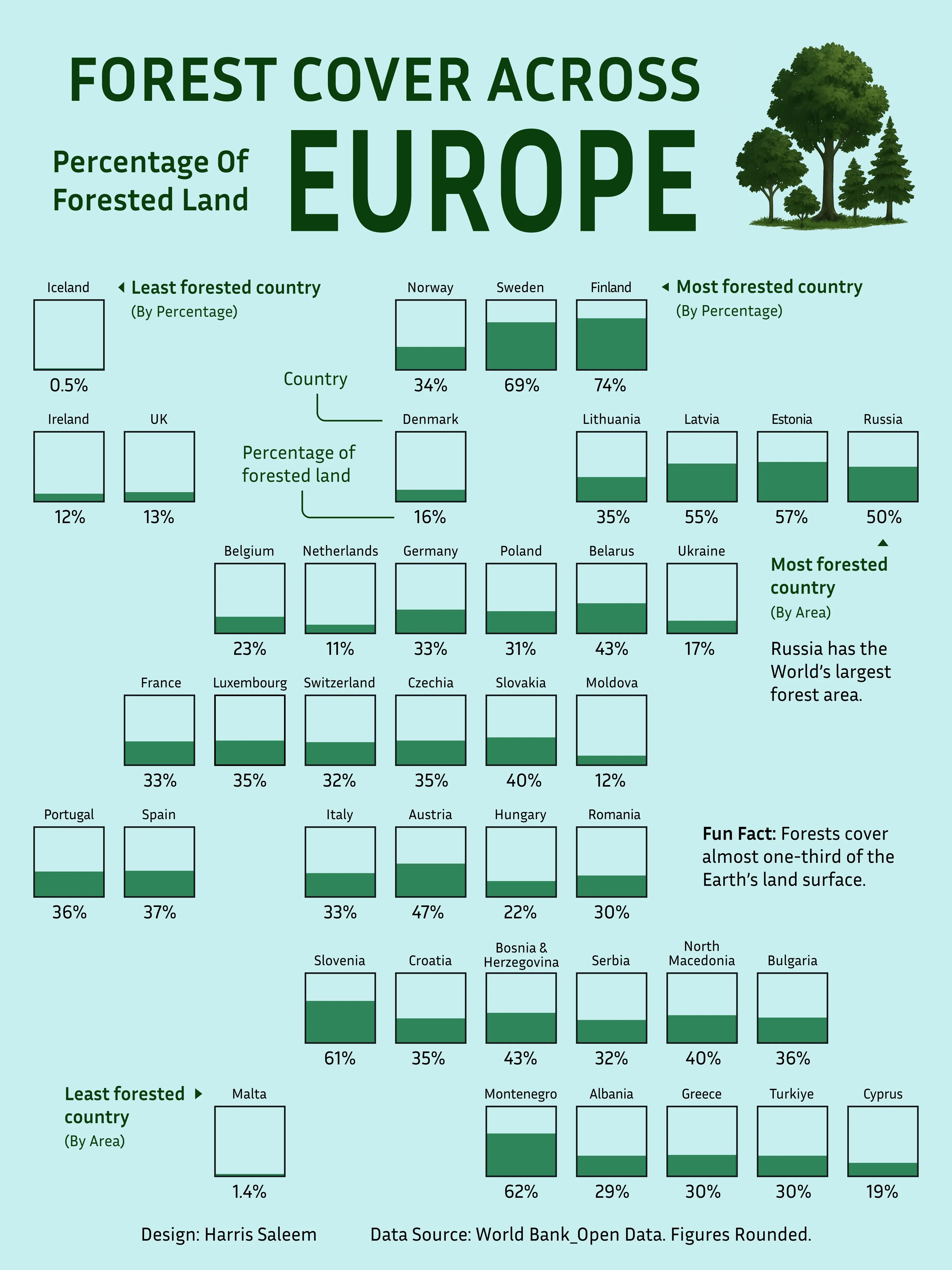
Forests are a vital component of World's natural landscape, supporting biodiversity, climate regulation, and sustainable resource management. However, forest coverage varies widely across Europe due to differences in geography, climate, and land use.
This infographic visualizes European countries by the percentage of land area covered by forests, offering a snapshot of how green the continent truly is.
The Nordic countries dominate the top of the ranking, with Finland (74%) and Sweden (69%) standing out as Europe’s most forested nations. Vast forests and low population density have allowed these countries to preserve extensive woodland areas.
Norway (33%), Lithuania (35%), Latvia (55%), and Estonia (57%), also have huge forests.
Other countries, such as Montenegro(62%), Slovenia(61%), and Austria(47%), also have high forest coverage.
Russia(50%), has the largest forest area in the entire World.
Much of Central and Southern Europe falls into a mid-range forest coverage, typically between 30% and 50%. Countries such as Germany, France, Spain, and Italy balance forests with urban development, agriculture, and infrastructure.
At the lower end of the scale are countries where natural constraints or high urbanization limit forest growth. Malta (1.4%) and Iceland (0.5%) rank last due to limited arable land and harsh climates.
Europe’s forest landscape ranges from the vast woodlands of the north to the sparsely forested islands and lowlands of the south. This variation shows how climate, geography, and human activity shape environmental outcomes.